
Feldman's Faves: April 13, 2026
- Jon Feldman
- Apr 13
- 5 min read
GOOD MORNING EVERYONE
For those of you who followed The Masters it provided the high drama we expect to get every years. Rory’s commanding and historically unprecedented lead going into Saturday led me (and everyone else) to believe that he had it in the bag. But where’s the fun (and life lesson) in that… So impressive that despite his struggles he pulled off his second Green Jacket in row.
In Goodmans news, I hope you are all able to our annual Give A Night Auction on Thursday where our very own Duncan will be doing his thing as a world class auctioneer to help raise money for the Stephen Lewis Foundation. All of the prizes come from our talented and creative students. Even it you don’t bid on anything it is always a fund and entertaining event.
Finally, don’t forget to join our monthly BAGEL BREAKFAST this morning (thank you, Alex).
This week’s theme is how Elon Musk thinks.
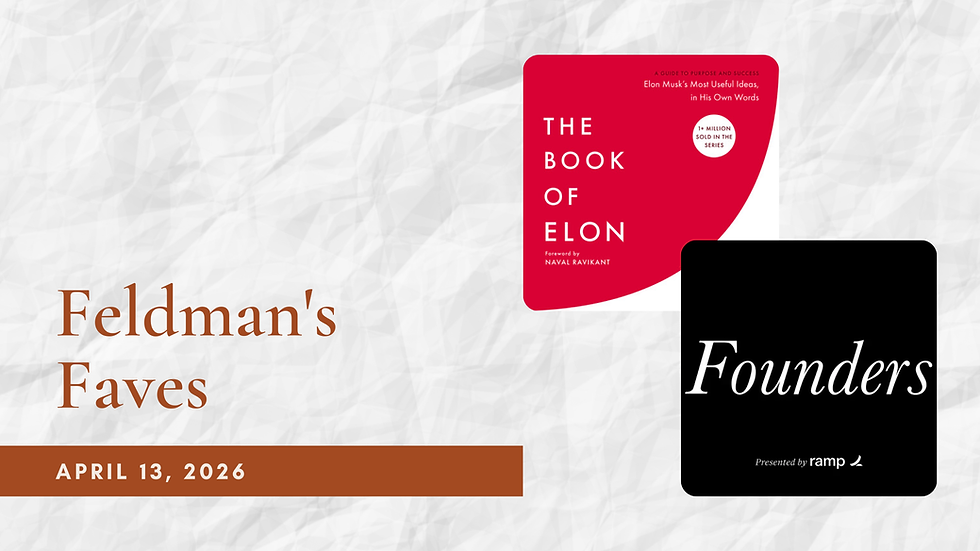
THE BOOK OF ELON: ELON MUSK’S MOST USEFUL IDEAS IN HIS OWN WORDS By: Eric Jorgenson – Like many of you, I have read a lot about Elon Musk. He is the Thomas Edison of our time, if not more. He is not like anyone else on this planet and his unique skill set has enabled him to create innovative technologies, transformational businesses and the ability for humanity to dream big dreams. He is also a bit of a lunatic and working and/or hanging out with him can’t be fun. The Book of Elon is a great compilation of Musk’s thoughts and ideas and could one day (maybe) join the ranks of all time classics such as The Art of War and The Prince. We shall see. As one reviewer summarizes, “After The Almanack of Naval Ravikant — 2 million copies, 40+ languages, zero marketing budget — he’s applied the same method to the most polarizing entrepreneur alive. The Book of Elon dropped today. Five years of research. Millions of Musk’s own words. Distilled into one concentrated read. This isn’t a biography. It isn’t hero worship. It’s a mental model extraction — the same curatorial method Jorgenson used for Naval, now applied to Elon Musk. Love him or loathe him — his frameworks are worth understanding. Here are the three ideas that matter most for investors.
1. First-Principles Thinking
The most discussed Musk concept, and Jorgenson gives it the space it deserves. First-principles thinking means breaking a problem down to its fundamental truths and reasoning up from there — rather than reasoning by analogy. SpaceX: rockets cost $65M. Musk asked what they’re actually made of. Raw materials: ~2% of the price. The rest was inefficiency and unchallenged assumptions. He built his own. Cost per kg to orbit: down 95%. Tesla: batteries cost $600/kWh. Musk decomposed to raw materials (~$80/kWh) and engineered the gap away.
The investor application: When the market prices a company at 40× earnings because “AI will change everything,” the first-principles investor asks: what are the actual cash flows? What’s the return on invested capital? What’s priced in — and what’s assumed? Don’t accept consensus valuations. Decompose them.
2. The Algorithm
Musk’s five-step process for every engineering and manufacturing challenge:
Step 1: Question every requirement. Each must come with a person’s name — not a department. Requirements from smart people are the most dangerous.
Step 2: Delete any part or process you can. If you’re not occasionally adding things back, you’re not deleting enough.
Step 3: Simplify and optimize. But only after deleting — optimizing a step that shouldn’t exist is the most common mistake.
Step 4: Accelerate cycle time. But only after steps 1–3.
Step 5: Automate. Last — because automating a bad process locks in dysfunction permanently.
The ordering is everything. Most organizations do it in reverse: automate first, question never.
The investor application: Apply this to your own finances. Question every expense. Delete what you can. Simplify your structure. Accelerate your savings rate. Then automate with a standing order. Most people start at step 5 and wonder why nothing changes.
3. Purpose Scales. Talent Doesn’t.
The deepest layer of the book. Jorgenson’s thesis: Musk’s defining advantage isn’t intelligence, capital, or luck. It’s purpose. He chooses missions so large they attract talent, capital, and attention by gravitational force. Making humanity multiplanetary. Accelerating sustainable energy. Building AGI. These aren’t business strategies — they’re civilizational goals. The audacity of the mission creates a self-reinforcing loop: bold mission → best engineers → better products → more capital → next impossible project.
The investor application: The companies that compound longest are purpose-driven. LVMH’s obsession with craftsmanship compounds through every cycle. Visa’s infrastructure sits behind every transaction on Earth. Nestlé’s mission has endured 150 years. Companies built on purpose compound. Companies built on quarterly targets don’t.
The book is necessarily one-sided. Built from Musk’s own words, you get Musk’s version — not the version his employees, ex-wives, or regulators would tell. The human cost of his intensity is largely absent. The political dimension (DOGE, government contracts) barely touched. For the full picture, read alongside Isaacson’s Elon Musk (2023).
Sentences to Remember
1. First-principles thinking strips away assumptions and gets to what’s actually true. Apply it to your career, your spending, and your investments.
2. The Algorithm: question, delete, simplify, accelerate, automate — in that order. Most people start at automate.
3. Purpose scales. Talent doesn’t. Own companies built around missions that outlast any single quarter.” Elon is a different kind of cat, to put it mildly. But as Walter Issacson argued in his biography of Elon, to get the great in him you also need to endure the worst in him. On balance I believe that humanity benefits tremendously from these outliers/generational talents if we are to progress and evolve as a species. While none of will be Elon, his life lessons are ones with application to all of our lives. Here’s a good review from the WSJ - https://www.wsj.com/tech/ai/the-playbook-that-elon-musk-relies-on-to-make-his-wild-ideas-work-f41138f1
Founders - How Elon Thinks – For those of you without the time or interest in reading the book, this PODCAST provides an excellent summary of the book. Here’s an excerpt from the PODCAST itself, “My friend Eric Jorgenson spent years—and thousands of hours—studying Elon Musk. Eric read everything Elon has written, read everything written about Elon, and watched every interview Elon's given. He distilled all of Elon's insights into his new book. This episode is all about How Elon Thinks based on The Book of Elon: Elon Musk's Most Useful Ideas in His Own Words”: https://podcasts.apple.com/ca/podcast/founders/id1141877104?i=1000757119172
Thank you for your ongoing engagement and participation.
And remember to stay safe, stay healthy and to docket daily.
Jon


Comments