
Feldman's Faves: August 14, 2023
- Jon Feldman
- Aug 14, 2023
- 6 min read
GOOD MORNING EVERYONE
What a week it has been. I hope those of you that tried were successful in getting your Taylor Swift tickets. Success in this field requires the skills of a ninja and the patience of Job (which I do not possess, but luckily my daughter does). I now have over 14 months to try learn the bridge of Cruel Summer.
Just a reminder that we are having a welcome lunch on Thursday for our new students. So please make every effort to be there.
A huge congratulations to Emily and her family on the birth of Casey – who is beyond adorable.
Finally, I want to wish Tara a very happy birthday – I hope you celebrated well over the weekend.
This week’s theme focuses on two giants of the 20th century who are still doing “their thing” right now and demonstrating that age is no barrier to success.
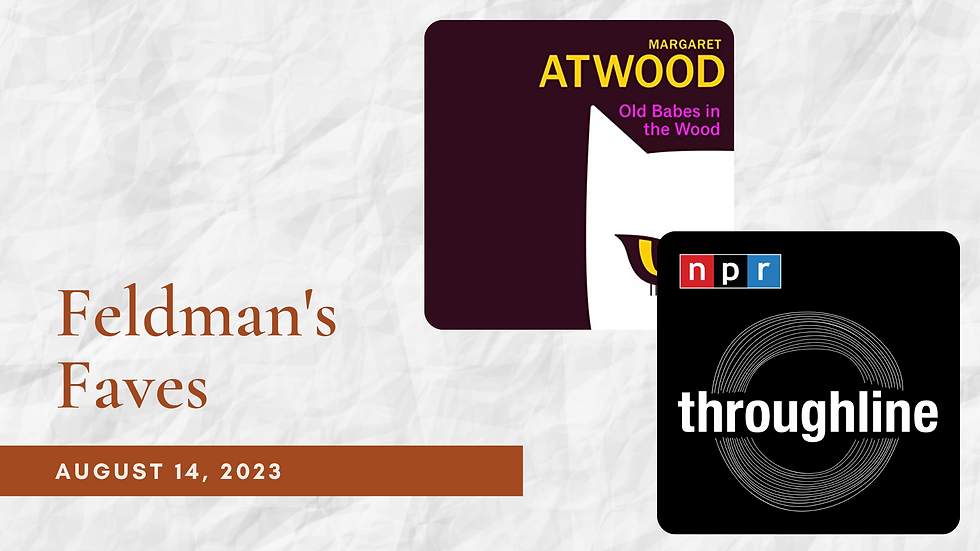
Old Babes in the Wood By: Margaret Atwood – One of my most prized possessions is a bottle of Aberlour that I received from Margaret Atwood as a thank you for some work I did for her and my sister a few years ago. I am drinking it very slowly but with teenage children in the house it seems there is some level of evaporation I cannot control. As some of you know, one of my latest obsessions is understanding what it takes to age in a healthy manner. One of those ways is to keep a sharp mind, for which Atwood is a poster child. It has been years since Atwood published a book of short stories but I am so happy she did. Old Babes in the Wood is a compilation of great stories that focus on a couple, Tig and Nell as they age over the years that I sense is very much autobiographical about Atwood and her loving husband. The loss she feels from his death is heartbreaking and covered in a very loving way. In between are a bunch of stories that are mythological in character involving witches, the soul and old friendships. It is no secret that Atwood is a strong feminist voice but the subtly and nuance of her writing delivers the message in a very unique way. I loved every single story in this book and really hope she has many more to come. As one reviewer notes, “Margaret Atwood, without a doubt one of the greatest living writers, is best known for her incredibly successful and award-winning novels The Handmaid's Tale and, more recently, The Testaments. However, she is also an extraordinary short story writer — and Old Babes in the Wood, her first collection in almost a decade, is a dazzling mixture of stories that explore what it means to be human while also showcasing Atwood's gifted imagination and great sense of humor. Old Babes in the Wood contains 15 stories, some of which have previously appeared in The New Yorker and The New York Times Magazine. The collection is divided into three parts. The first and last, titled "Tig & Nell" and "Nell & Tig," revolve around a married couple and look, more or less, at their entire lives — what they've done and felt, the people that left a mark on them, their thoughts. These stories, which taken together feel like a mosaic novella more than literary bookends for a collection, offer a deep, heartfelt, engrossing look at the minutiae of life. The middle part, titled "My Evil Mother," is perhaps the crowning jewel in this collection and brings together eight unique tales that vary wildly in terms of tone, voice, theme, and format. From imagined interviews and stories told by aliens to the circle of life and a snail trapped in the body of a woman, these tales show Atwood's characteristic insight and intellect while also putting on full display her ability to make us laugh, her chronicler's eye for detail, and her unparalleled imagination. There are no throwaway stories in this collection, but several demand their time in the spotlight. "Morte de Smudgie," about the death of a cat, is a perfect portrait of the unique kind of grief that follows the loss of a beloved pet. "My Evil Mother" follows a mother-daughter relationship through the years and shows how, and why, many people eventually become just like their parents. In "The Dead Interview," Atwood "interviews" author George Orwell through a medium in a trance. Part tribute and part celebratory deconstruction of Orwell's oeuvre and persona, this one becomes unexpectedly funny and shows just how on top of everything Atwood is as she tries to explain things like the internet, getting "cancelled," anti-vaxxers, and even the January 6 coup attempt to Orwell. "Impatient Griselda" explores, through the translated voice of an alien that looks like an octopus and doesn't have all the words it needs to communicate perfectly, estrangement and miscommunication. "Bad Teeth" is a fun vignette about friendship that follows two old friends as one of them insists on asking why the other had an affair with a man with bad teeth, but the affair never happened. In "Death by Clamshell," Hypatia of Alexandria narrates her own murder and offers her thoughts on how she's morphed into different things to different groups of people in the centuries since her death. And she does so with great energy and a good sense of humor about it: "I try to look on the bright side: I did not have to endure the indignities of extreme old age." In "Metempsychosis: or, The Journey of the Soul," the narrator is a snail whose soul "jumped directly from snail to human" after it got sprayed with a homemade, environmentally friendly pesticide. The snail's desire to return to its previous form, and its understandable shock at human behavior and practices, quickly morph into a truly eye-opening, heartfelt read about yearning and feeling out of place. Old Babes in the Wood is touching, smart, funny, and unique in equal measure. Atwood, who's always had her finger on the pulse of modern society, tackles everything from love and the afterlife to the importance of language and the pandemic (fans of The Handmaid's Tale will love "Freeforall," which is a return to themes of motherhood with a political angle and plenty of social commentary). Throughout all these stories, Atwood's usual wit is always present, and she offers plenty of memorable characters and lines. "That is what it is to be human, I suppose: to question the terms of existence," says the snail trapped inside a woman in "Metempsychosis." That line echoes throughout the collection. It's been almost a decade since Atwood's previous short story collection, Stone Mattress, was published. Not surprisingly, the wait was worth it. Old Babes in the Wood showcases Atwood's imagination and her perennial obsession with getting to the core of what makes us human while dishing out plenty of entertainment and eye-opening revelations along the way. At this point, Atwood has nothing left to prove. But she writes like she wants the world to notice her work — and that fire makes it easy to react every time she publishes something: We know we must sit down, read, and be in awe of her talent.” I think it is time that the Nobel Committee does the right thing and recognize our Canadian treasure, Margaret Atwood, for the genius that she is. Here is a good review from the Guardian - https://www.theguardian.com/books/2023/mar/01/old-babes-in-the-wood-by-margaret-atwood-review-tales-of-love-and-age
Throughline - The Legacy of Henry Kissinger – The name Henry Kissinger is synonymous with diplomacy, power and Realpolitik of the 20th century (and, to a lesser degree, the 21st century). Kissinger is now 100 years old and is still at it. For many people he is a hero – he did open US/China relations – and to others a war criminal (e.g., supporting Pinochet in Chile). In any case, his impact on the global order is undeniable, which makes him a leading historical figure (who was never elected to public office) in American history. From his humble roots (escaping Nazi Germany) to his tenure at Harvard, to working with Nixon to being on the Theranos board (oops…) his life story is just remarkable. Here is an excerpt from the PODCAST itself, “Depending on where you stand, Henry Kissinger is either a foreign policy mastermind or a war criminal. Some see him as a brilliant strategist who made tough but necessary decisions to advance American interests in a complex world; others point to his infamous order that American warplanes should "bomb anything that flies, on anything that moves" as evidence that he bears responsibility for the loss of countless civilian lives. But one thing both sides agree on is that few figures in the 20th century have had a more profound influence on how the U.S. conducts foreign policy.Kissinger grew up in an orthodox Jewish household in Germany, under the shadow of the Nazis' rise to power; he and his family fled to the U.S. when he was a teenager. Professor Jeremi Suri, author of "Henry Kissinger and the American Century," argues that Kissinger's experiences during the Holocaust have informed his approach to global politics throughout his career, as well as his relationship with democracy, war, and power.” https://podcasts.apple.com/ca/podcast/throughline/id1451109634?i=1000619428824
Thank you for your ongoing engagement and participation.
And remember to stay safe, stay healthy and to docket daily.
Jon


Comments