
Feldman's Faves: August 22, 2022
- Jon Feldman
- Aug 22, 2022
- 5 min read
GOOD MORNING EVERYONE
I wanted to take this opportunity to thank Alex for initiating and executing on our summer hit, Thirsty Thursdays. Due to popular demand, we are extending this party into the fall and I expect that it will grow as we start to come back to the office on a more regular basis.
For those of you still using your Peloton (even if you might have sold your stock), I highly recommend that you consider trying the eight-week Peak Your Power Zones program. It really does wonders for the FTP numbers and translates into real performance on the road. It’s really fun and very well constructed.
The theme this week can loosely be considered current events.
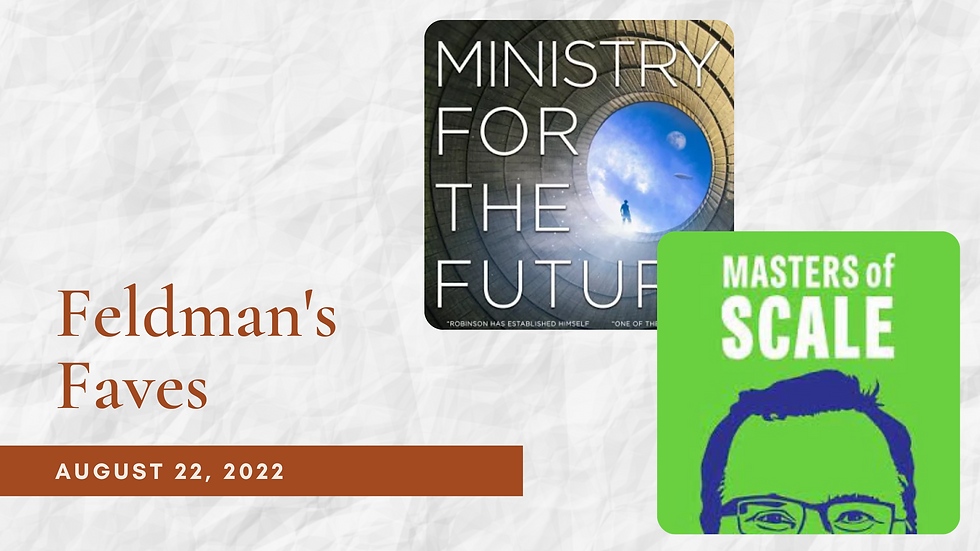
The Ministry for the Future By: Kim Stanley Robinson – I am of two minds with this book. On one hand it is a very gripping story of what our future could look like if we continue to let climate change deteriorate on the path it is going. On the other hand, the book is a little preachy, to say the least. This book is recommended by Bill Gates who usually makes great suggestions. If you can get over the preachy part (like going to a U2 concert and enjoying the music and ignoring Bono’s various diatribes) it is worth it. The basic premise of this novel is that climate change is destroying the world and as a result the world needs to mobilize on multiple fronts if we are to solve the problem and this is what happens. The leaders of the world and the scientists of the world figure it out. There is some scary stuff in here and also much hope in that it shows, at least a fictional path (based on science, economic theory, political science and law) to getting there. The creation of the Ministry of the Future is intended for the “current generation” to take action the protect the future – pretty simple. As one reviewer describes the story, “It opens like a slow-motion disaster movie. In the near future, a heatwave of unsurvivable “wet-bulb” temperatures (factoring in humidity) in a small Indian town kills nearly all its inhabitants in a week. The Indian government sends up planes to spray sulphur dioxide into the atmosphere to mimic the dimming effect of major volcanic eruptions. This does not, naturally, meet with unalloyed approval around the world. A new international climate-crisis body has been “charged with defending all living creatures present and future who cannot speak for themselves”, and is quickly dubbed the Ministry for the Future. It is led by our protagonist, Mary Murphy, former foreign minister of Ireland. Her outfit may or may not also have a black ops wing, but a shadowy terrorist network called the “Children of Kali” has no white ops wing: it uses drone swarms to crash passenger jets and container ships in deadly protest at continuing carbon emissions. Meanwhile, scientists at the poles are trying to pump water out from under the ice caps to prevent them from sliding into the ocean and raising sea levels catastrophically. Kim Stanley Robinson, who wrote the classic Red Mars trilogy of novels about geoengineering the red planet to be habitable by humans, now offers a story about whether we can geoengineer Earth back into Earth. Within these pages there is much hard science, of atmospheric and oceanic physics, usually helpfully explained by a passing expert; but also speculative military strategy – the invention of “pebble mob” missiles, which converge on a target speedily from all directions, renders almost all military hardware redundant – plenty of economic history and much comforting detail about the grey civility of Switzerland in winter. Robinson shows that an ambitious systems novel about global heating must in fact be an ambitious systems novel about modern civilisation too, because everything is so interdependent. Luckily, when he opens one of his discursive interludes with the claim “Taxes are interesting”, he makes good on it within two pages. There is no shortage of sardonic humour here, a cosmopolitan range of sympathies, and a steely, visionary optimism. Dark comic relief comes from fragmentary dialogues between unnamed speakers. “Have you heard,” one asks, “that the warming of the oceans means that the amount of omega-3 fatty acids in fish and thus available for human consumption may drop by as much as sixty percent? And that these fatty acids are crucial to signal transduction in the brain, so it’s possible that our collective intelligence is now rapidly dropping because of an ocean-warming-caused diminishment in brain power?” The other replies: “That would explain a lot.” Indeed it would.” The Ministry for the Future is long and meandering and frankly sometimes boring – and it could have been much shorter than its 106 chapters. But Robinson’s vision for the future considers how science, rethinking the economic order (including the creation of a ‘carbon-reducing-based-currency’) and the way we organize society is a very creative thought experiment about what we need to do to solve the greatest issue of our time. Here’s a good review from Gates Notes: https://www.gatesnotes.com/Books/The-Ministry-for-the-Future
Masters of Scale - Five ways to burnout-proof your organization – As we continue to think about the current state of work and managing through the current issues of the day (including the “Great Resignation” – although this certainly seems to be changing fast with many people experiencing the Great Regret…), what is more important is how we think about what the future will look like and one way to do so is to take lessons of the recent past and think about how we can do better going forward. One key issue that has arisen in our world, after the craziest two years in the M&A market in decades, is how to we manage people’s health and well-being when we are asking for super human performances from everyone. I think that being thoughtful and even mindful of this issue (something that people never were before) is helpful in trying to shape policy and culture and addressing issues like burnout, which is what this PODCAST covers in a methodical and thoughtful manner. Here’s an excerpt from the PODCAST itself: “If you’re a leader right now navigating the global pandemic, supply chain disruptions, and your own mental list of what’s keeping you up at night, the issue of burnout is probably on your mind. You can’t shield your team from all stress, but you can find effective ways of supporting your employees through it. This episode highlights the best conversations we’ve had recently about stopping burnout in your organization, before it takes hold. Featuring BetterUp’s Alexi Robichaux, Upwork’s Hayden Brown, Merck’s Ken Frazier, Chobani’s Hamdi Ulukaya, director J.J. Abrams, Girls Who Code’s Reshma Saujani, BW4BL’s Tokunbo Koiki, and FuelFinance’s Alyona Mysko.” https://podcasts.apple.com/ca/podcast/masters-of-scale/id1227971746?i=1000574751328
Thank you for your ongoing engagement and participation.
And remember to stay safe, stay healthy and to docket daily.
Jon


Comments