
Feldman's Faves: August 8, 2023
- Jon Feldman
- Aug 8, 2023
- 4 min read
GOOD MORNING EVERYONE
I hope you all had a great long weekend. This one is always bittersweet given that it marks the mid-point of the “dog days” of summer….
The world as we know it has changed forever, Taylor Swift is coming to Toronto in November 2024 – good luck to those of you trying to get tickets!
On another positive note, I am delighted that we are welcoming our new class of Articling Students today. Please join me in welcoming Zach and Ayesha into our section for their first rotation who will be starting their training today but I know will be eager to jump onto your files. Please take the time to meet them and make them feel welcome. We are having a welcome lunch next week – so please join if you can.
No theme this week – just topics of interest.
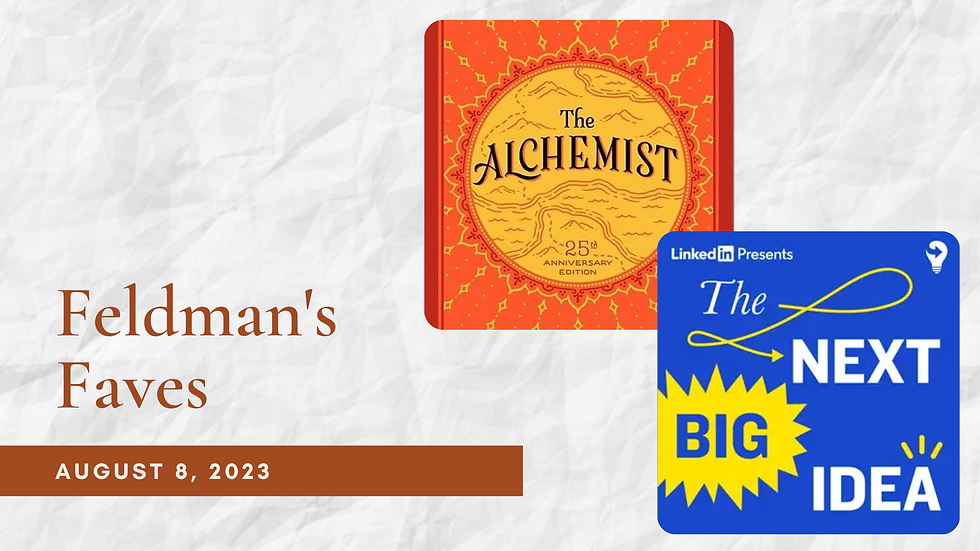
THE ALCHEMIST By: Paulo Coelho – Whenever I think that I am “well read” I get humbled (but not honored….) by coming across yet another classic novel for the first time and realize how much more time I need to read to really be considered well read (please help me Dr. Attia….). The world LOVES The Alchemist and now I know why. Coelho uses the classic “hero’s journey” device to teach some fundamental lessons about what it takes to be successful as a human and learning how to understand what drives a person to become their best self. There is so much out there about “realizing one’s full potential”, following one’s “Personal Legend”, which is basically the advice the we tell our kids. As we get older we start to shift our mindset and think that following “what we are good at‘ is the way to go. Different people decide what path is best for them and there are happy and unhappy people doing both (only happy and passionate people in law, of course). As one reviewer notes, “Coelho is a Brazilian writer with four books to his credit. Following Diary of a Magus (1992—not reviewed) came this book, published in Brazil in 1988: it's an interdenominational, transcendental, inspirational fable—in other words, a bag of wind. The story is about a youth empowered to follow his dream. Santiago is an Andalusian shepherd boy who learns through a dream of a treasure in the Egyptian pyramids. An old man, the king of Salem, the first of various spiritual guides, tells the boy that he has discovered his destiny: "to realize one's destiny is a person's only real obligation." So Santiago sells his sheep, sails to Tangier, is tricked out of his money, regains it through hard work, crosses the desert with a caravan, stops at an oasis long enough to fall in love, escapes from warring tribesmen by performing a miracle, reaches the pyramids, and eventually gets both the gold and the girl. Along the way he meets an Englishman who describes the Soul of the World; the desert woman Fatima, who teaches him the Language of the World; and an alchemist who says, "Listen to your heart" A message clings like ivy to every encounter; everyone, but everyone, has to put in their two cents' worth, from the crystal merchant to the camel driver ("concentrate always on the present, you'll be a happy man"). The absence of characterization and overall blandness suggest authorship by a committee of self-improvement pundits—a far cry from Saint- Exupery's The Little Prince: that flagship of the genre was a genuine charmer because it clearly derived from a quirky, individual sensibility. Coelho's placebo has racked up impressive sales in Brazil and Europe. Americans should flock to it like gulls.” This book feels like it is written for children and it is certainly a book that a young reader can digest and understand. At the same time, The Alchemist is a story that can and should be read at different stages of life, almost as check on one’s level of optimism vs cynicism as we get older and move through different stages of life. Here is a good review from The Guardian - https://www.theguardian.com/childrens-books-site/2015/oct/10/the-alchemist-paulo-coehlo-review
The Next Big Idea - Parking: How It Explains the World - Cars have had a profound impact on our ability to travel, where we can live and the state of our health. In addition, the need for parking over the years has been a significant driver of the way homes and offices get built, how streets are constructed and how cities are designed. In this PODCAST we learn about the issues parking has created, the opportunity costs it presents and solutions to figure out a way to make cities more nimble in their abilities to change the way we live, which to a large degree starts with parking. To a certain degree this discussion makes me think of “if all you have is a hammer….” That said, there is some great insight to be obtained by looking at the world through the lens of parking. Here’s an excerpt from the PODCAST itself, “For decades, urban planners have blanketed our cities with the cheap and convenient car storage known as parking. They've swapped sidewalks for strip malls and bulldozed bright, inviting storefronts to make room for dark, urine-scented parking garages. In some downtowns, more land is now devoted to parking than buildings. Parking profligacy has left us with cities that are polluted and hostile to pedestrians; they're also increasingly unaffordable because legally required parking can drive up the cost of residential construction by 25 percent. In "Paved Paradise: How Parking Explains the World," journalist Henry Grabar dares to imagine a future in which we knock parking off its pedestal by enacting new laws, adopting new attitudes, and embracing new technologies (like e-bikes and autonomous cars) that make our cities greener, friendlier, safer, and more fun.” https://podcasts.apple.com/ca/podcast/the-next-big-idea/id1482067226?i=1000618725886
Thank you for your ongoing engagement and participation.
And remember to stay safe, stay healthy and to docket daily.
Jon


Comments