
Feldman's Faves: December 16, 2024
- Jon Feldman
- Dec 16, 2024
- 7 min read
GOOD MORNING EVERYONE
I am happy to report that this week will be the final set of reviews for 2024. Yes – you all get a well deserved break….
Last week’s party was awesome and once again I want to extend a very big thank you to Noa and Jeffreen (and of course to Alex) for all of your work in making this evening one we will never forget. Next year I will try my very best to make it to the after party (call it a New Year’s resolution for 2025).
Finally, I want to thank each and every one of you for the incredible contributions you made to Goodmans this year. It has been one for the books and hopefully one we can use as a launch-pad for an even better 2025. I really hope you all get a chance to recharge and to spend the holidays with the important people in your lives.
As we celebrate our 2024 success and look forward to an awesome 2025, this week’s theme is about optimism – something we can all use more of in our lives.
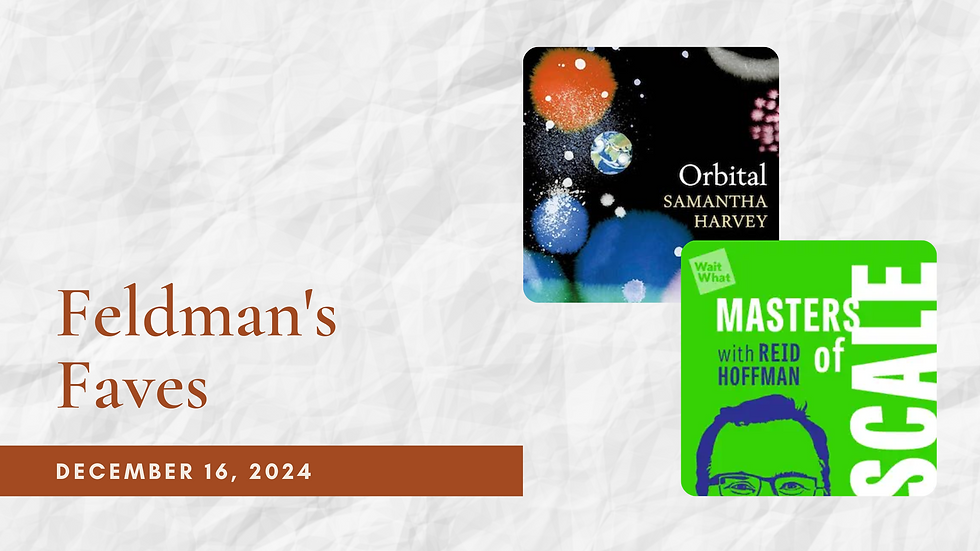
ORBITAL By: Samantha Harvey – Samantha Harvey’s Orbital is this year’s winner of the Booker Prize. While I have to admit it was not my first choice of the books that were shortlisted this year, I do think it was worthy of the award. It’s perspective is quite unique – that being the perspective of a number of astronauts and cosmonauts circling the earth and watching from up high as days change to nights, storms approach population centres and the universe is all around them to witness. It also describes in some interesting detail what it feels like to be in space and how life up there takes place on a daily basis. Beyond that it provide the reader with perspective on elements such as space, time and matter (a favourite McGill bird course – at least when I was there). There is one passage that situates human history in the context of time, which (although done many times by many authors) is done in an original and creative way that in my mind is the best part of the book. We also get vignettes into the lives of the people on board, which are moderately interesting as well. As one reviewer notes, “Six astronauts are bobbing about in a spacecraft, looking out at their planet as they circle it. From up here, 250 miles above the surface, Japan is a wisp. The Philippines appear “scarily frail”. Though the views are on a planetary scale, the object of their mesmerised observation is as intricate as a Fabergé egg. All of Europe is “outlined with fine precision”, ringed by a golden thread of night-lit roads. Autumn blooms in the Jiuzhaigou valley, Tunisian salt flats glow in cloisonné pink. The astronauts who turn and turn through Samantha Harvey’s finely crafted meditation on the Earth, beauty and human aspiration are in the process of understanding themselves in new ways, too. Harvey has long been a fearless explorer in wild places. She started with The Wilderness, accompanying a man with Alzheimer’s into regions far out beyond the usual signposts of today’s date and the prime minister’s name. Each book since then has been as conceptually rugged as it is stylistically honed. In her 2018 novel The Western Wind, troubled parishioners make their confessions in a remote 15th-century village where the river breaks its banks and facts slip from their moorings. Then came a work of nonfiction, The Shapeless Unease, a bracing study of insomnia and its murky terrains. Space, by comparison, or at least the nearest region of space – “Earth’s back garden” – seems more knowable and less lonely. With this slender and stretchy fifth novel, Harvey makes an ecstatic voyage with an imagined crew on the International Space Station, and looks back to Earth with a lover’s eye. Orbital goes into flight for a single day, though a day is a different kind of thing up here, where “the whipcrack of morning arrives every ninety minutes” and the sun is “up-down-up-down like a mechanical toy”. It’s a nicely giddying structural ploy to align each chapter with an orbit of the Earth: 16 orbits all together. The mobile narrative sends out probes into past and future, but all is held in the looping motion of elliptical travel. The astronauts go about their laboratory tasks, monitoring microbes or the growth of cabbages. They work with a sense of vocation that is unabated after months on the mission. Nothing has dimmed for them. Earth is newly ravishing every moment as it moves with “ringing, singing lightness” through the “ballroom of space”. Sometimes the observers want to see the planet’s most theatrical displays, but often it’s the small things (“the lights of fishing boats off the coast of Malaysia”) that most affect them. Even the atheists ponder whether those lucky enough to live on Earth might already have died and be in a heavenly afterlife. While the astronauts clock up their hours on the treadmill to prevent muscle wastage, Harvey takes on the imaginative athletics of finding language for this optical feasting and metaphysical reflection. The greater challenge for the heaven-faring novelist lies in allowing us to feel for ourselves the power of these sights. There are moments in Orbital when wonder, like happiness, writes white. Thrilled reports of exquisite light effects start to fall a little flat. The beauty of the book is at work less in its explicit hymns of praise than deep in its rhythms and structures. And it’s here that some of the most compelling thinking goes on – about the spectacular and the ordinary, distance and intimacy. There are sentences that start with a Miltonic boom and move to a gentle hum. Others slip without fuss from “I” to “you” to “we”. A memory may take us suddenly plummeting from up in orbit to deep in the sea off Samar Island. “The six characters were supposed to be one,” Virginia Woolf told a friend who had just read The Waves. “I did mean that in some way we are the same person, and not separate people.” Harvey’s six astronauts have their individual pasts and preoccupations, they think their way back to their different countries, but together they form a collective being. Their continual movement of joining and parting gives the novel its patterning as much as the movement through space. “Drawn like moths” to hover at the windows and see auroral lights folding and flexing around the globe, they are conscious of themselves as a composite creature. But mostly it is the novelist’s job to mark the moments in which these separate people, humanity’s emissaries, make their own electric circle of light: “Without word or reason they sail in and join, twelve arms interlinked.” The Russians go off to their “decrepit Soviet bunker”, but geopolitical divisions are hard to maintain when moving at 17,000 miles an hour. “Please use your own national toilet” reads the sign on the spacecraft loos, perkily disregarded by astronauts who are drinking each other’s recycled urine. Russian, Japanese, American, British, Italian: they offer themselves as emblems of human cooperation. A narrative voice rises to pre-empt the obvious criticism: “Their hope does not make them naive.” That’s convincing enough, until you look up from the page.
Orbital is a hopeful book and it studies people who act on their hope. It’s an Anthropocene book resistant to doom. We might miss the restless anger that tossed about in The Shapeless Unease, and the acerbic, downright forms of expression it found for itself. But Orbital offers vehement appreciation of the world in a range of tones and situations. One of the Russian cosmonauts likes to pick up amateur radio signals from Earth in a kind of cosmic phone-in. A voice from Vancouver asks whether it’s ever disappointing up there. “Are you dispirited … crestfallen?” The Russian explains that, in space, he is never disappointed. In space he sees that even his sleeping bag is a thing full of life; untethered from gravity, “it billows”. And so while a planet of “miraculous and bizarre loveliness” shines at the window, the sleeping bags go on quietly billowing, and the novel musters its energy for another ascent, refusing to be crestfallen.” I wouldn’t have vote for this one but I understand why the committee did. Here’s a review from the Booker Prize Committee - https://thebookerprizes.com/the-booker-library/features/everything-you-need-to-know-about-orbital-booker-prize-2024-winner
Possible: Bill Gates on possibility, AI, and humanity – Bill Gates has one of the most interesting perspective on the major issues that impact our lives. He is obviously an expert in technology and has become one in both public health and climate science. He is now focusing his attention on the “topic de jour”, which is AI and has a really unique perspective on how AI can be used to better our lives. This PODCAST is a very interesting discussion with Reid Hoffman who, as among other things, being the co-founder of PayPal and the founder of LinkedIn (that was sold to Microsoft) , also has credibility in the area of technology (although I will never forgive him for creating the world’s largest forum for “humble bragging” (but I digress). Here is an excerpt from the PODCAST itself, “ Reid and Aria sat down with Bill Gates to discuss his main areas of focus: climate change, energy, global health, and education—and how AI will help transform each of them. Taking a bird’s-eye view of society’s challenges, it’s easy to give in to pessimism. But as one of the most influential people in the world, Bill Gates has a unique perspective on how far humanity has come and what our potential—and timelines—for meaningful change really look like. He gets granular on everything from cows (5% of global emissions) to disease reduction and eradication (Guinea worm disease). At each turn, he has data at his fingertips to ground his beliefs. So, what current set of innovations is Bill most excited about? And what is realistically on the horizon for AI, climate change, energy, global health, and education?” https://podcasts.apple.com/ca/podcast/masters-of-scale/id1227971746?i=1000677159614
Thank you for your ongoing engagement and participation.
Remember to stay safe, stay healthy and to docket daily.
HAPPY HOLIDAYS!!
Jon


Comments