
Feldman's Faves: December 2, 2024
- Jon Feldman
- Dec 2, 2024
- 6 min read
GOOD MORNING EVERYONE
I hope all of you had a chance to enjoy “the real” Thanksgiving. No deep fried Turducken for me this year but maybe next year. Tom Brady seemed to enjoy his. And how about those BILLS! As per usual I am celebrating their regular season success – clinching the AFC EAST - with great expectations (what could possibly go wrong).
I hope you can join us today for BAGEL BREAKFAST. We all need to start eating early and often as we train and get “in shape” for the upcoming holiday season.
Finally, we have a HUGE week of birthday celebrations. Please join me in wishing Jonathan, JC and Max very happy birthdays this week. Hoping we can finally get Neill to jump out of a cake for this massive occasion.
The theme this week is art related.
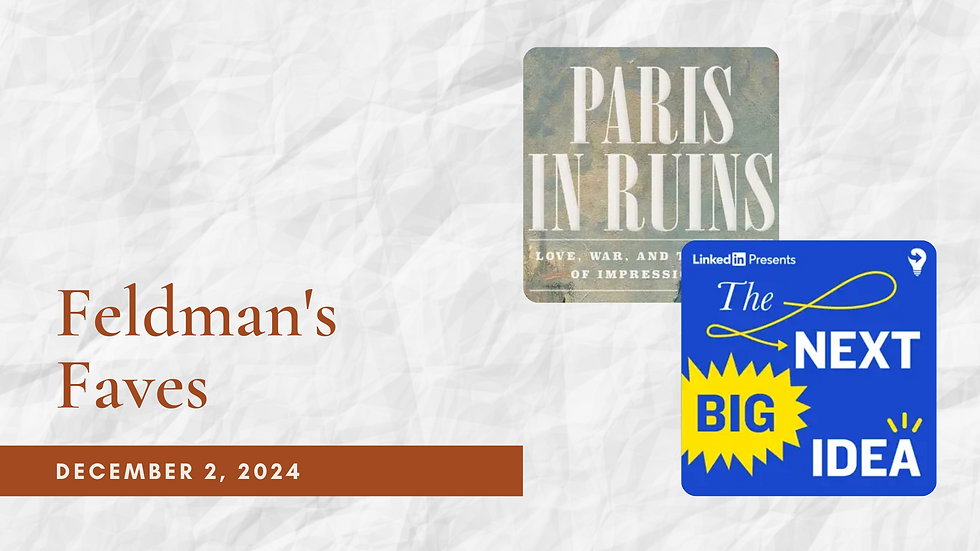
PARIS IN RUINS: LOVE, WAR, AND THE BIRTH OF IMPRESSIONISM By: Sebastian Smee – Who doesn’t love the work of the French Impressionists? When you hear the names, Monet, Renoir, Pissarro and Degas you can almost immediately picture their works. We also know the names Manet and Morisot as being part of this group. It is the latter two artists and their deep relationship that Pulitzer Prize winning author Sebastien Smee focuses on in his new book, Paris in Ruins: Love, War, and the Birth of Impressionism. But to get to this birth the reader must go through a very long process of labour….Smee goes into great deal of the siege of Paris and its impact on its residents and those who escaped Paris during the Franco / Prussian war. The first 300 pages is very directed to this part of the story and not what I was expecting. I was hoping to learn more about Manet and Morisot, which eventually happens and is very interesting. There is a lot of discussion towards the end of their collaboration and description and history of their works, which I really enjoyed. It just took a long time to get there. Had I known I might have skipped the first ¾ of this book. As one reviewer, who likes this book much better than I do, notes, “Sebastian Smee’s “Paris in Ruins” is an account of the city’s Terrible Year and its impact on the painters Berthe Morisot and Édouard Manet. “Berthe Morisot lived in her great eyes,” wrote the French poet Paul Valéry, her nephew by marriage. This assessment highlights Morisot’s dual claim to fame as both a muse and a member of the school of experimental French painting that became known, following its first exhibition in Paris in 1874, as impressionism. On the one hand, Morisot’s physical beauty — concentrated, according to Édouard Manet, in her large, dark eyes — inspired Manet to paint several portraits of her, all expressions of his innovative, bracingly modern aesthetic. On the other hand, Morisot’s own daring creative vision — honed by art lessons with the landscapist Camille Corot and by a social circle that included not only Corot and Manet but Pierre Puvis de Chavannes, Henri Fantin-Latour and Edgar Degas — established her as a trailblazing painter in her own right. These two facets of Morisot’s identity receive illuminating treatment in Sebastian Smee’s “Paris in Ruins: Love, War, and the Birth of Impressionism,” which examines her relationship with Manet against the backdrop of the Franco-Prussian War and the Paris Commune. Triggered by France’s ill-fated declaration of war on Prussia in July 1870, this double national trauma earned the epithet the “Terrible Year” for the slew of disasters it brought in rapid succession, from the abrupt collapse of Napoleon III’s Second Empire to the Prussians’ swift invasion of France and punishing four-month siege of its capital, all culminating in a bloody clash in Paris between the forces of the fledgling Third Republic and those of the city’s insurrectionary Commune. To these well-known events, Smee, a Pulitzer Prize-winning art critic for The Washington Post and the author of “The Art of Rivalry: Four Friendships, Betrayals, and Breakthroughs in Modern Art,” brings a fresh perspective by linking them to the artistic development of impressionism in general and of Manet and Morisot in particular. With this approach, Smee offers a valuable complement to a book listed in his bibliography: Peter Brooks’s “Flaubert in the Ruins of Paris: The Story of a Friendship, a Novel, and a Terrible Year” (2017), which explores the impact of 1870-71 on the French modernist authors Gustave Flaubert and George Sand. Although the siege and the Commune left Paris in ruins, the artists of the impressionist movement conspicuously avoided depicting the wreckage, opting instead to portray “fugitive light, shifting seasons, glimpsed street scenes, and transient domesticity,” Smee writes — images suffused with a “new and suddenly deeper sense of existential fragility.” If their resulting work “emphasized serenity” over chaos and light over darkness, it was not, Smee argues, because these artists were in denial about the tragedy but because it had conditioned them to seek beauty in evanescent and volatile states of being. In so doing, they inaugurated a bold new future for the visual arts, one dominated by further radical experiments in discontinuity, contingency and abstraction. As pioneers of this “new way of painting,” Morisot and Manet are the stars of Smee’s narrative, supported by a colorful cast of French writers (Charles Baudelaire, Edmond de Goncourt), politicians (Adolphe Thiers, Léon Gambetta) and above all, artists (Gustave Courbet, Claude Monet, Camille Pissarro, Pierre-Auguste Renoir, Alfred Sisley). Smee makes much of the fact that Morisot and Manet were, apart from Degas, the only painters later associated with impressionism who remained in Paris throughout the siege, their colleagues having fled to the countryside or abroad. According to Smee, the hardships of the Prussian stranglehold on the capital — such as severe food shortages and reliance on hot-air balloons and carrier pigeons for communications with the outside world — left Morisot and Manet with a “profound sense of precariousness” that indelibly marked their postwar oeuvre. The pair’s harrowing shared experience also led them to fall deeply in love. This development brought heartache of its own because Manet was married and Morisot was not, and for all their painterly audacity they were both products of Paris’s socially conservative, rule-bound bourgeoisie. So passionate as it was, their romance apparently remained chaste. In December 1874 — months after the first impressionist group show, to which Morisot had been the lone female contributor — the hopelessness of her feelings for Manet drove her to marry his younger brother Eugène (“the next best thing,” Smee writes, to marrying “the man she truly loved”). Smee does not address the biographer Jeffrey Meyers’s claim that while Morisot was still single, she and Édouard Manet probably became lovers. Nor does he mention the titillating fact that on the eve of her wedding, the two artists burned each other’s letters. Smee concentrates instead on the paintings they produced in the wake of the Terrible Year. With exquisite sensitivity, he reads the similarities in their work from this period — “strange, flat, barely legible pattern[s]” undergirding urban vistas; contrasting motifs of white billowing curtains or steam and black “bars boldly striping” the picture plane; paint worked in “slashing, diagonal, often cross-hatched brushstrokes … notably distinct from the signature marks of Monet, Renoir, or Pissarro” — as a secret “conversation on canvas” that bound Morisot and Manet together even as life tore them apart. Together alchemizing “some mysterious alloy of intimacy and despair,” they turned unspeakable sadness into art. As Smee reminds us, “The medium exists, after all, to express things that can’t be put into words.” This book is a lot of work and I’m not sure it is worth it. Here’s a good review from the NYT - https://www.nytimes.com/2024/09/13/books/review/paris-in-ruins-sebastian-smee.html
The Next Big Idea - The Work of Art: How Something Comes From Nothing – As someone with absolutely no artistic talent whatsoever, I am always fascinated by the artistic process and how great artists create. In this PODCAST we about some common themes of artists of all kinds ranging from the visual arts, to musicians to writers. While all of them are very different they do share the same common threads of a belief in themselves, their desire to create and the will to try and fail. In many ways, artists are like CEO of startups (also something I am not). It is really interesting to think of artists of entrepreneurs of their own ideas. Here’s an excerpt from the PODCAST itself, “Making art is hard work, as Adam Moss, the revered former editor of New York magazine, reveals in his illuminating new book, "The Work of Art." The book is a collection of interviews with painters, poets, filmmakers, and even sandcastle builders about the demanding, mystical, peculiar process of creating something out of nothing. Adam spoke with our curator Daniel Pink in front of a live audience in New York City earlier this month.” https://podcasts.apple.com/ca/podcast/the-next-big-idea/id1482067226?i=1000674288453
Thank you for your ongoing engagement and participation.
And remember to stay safe, stay healthy and to docket daily.
Jon


Comments