
Feldman's Faves: December 5, 2022
- Jon Feldman
- Dec 5, 2022
- 5 min read
GOOD MORNING EVERYONE
It is hard to believe that we are rolling into December. This has been another crazy year at Goodmans with many ups and downs along the way for many of us. Everyone has been working really hard (and of course really smart) once again. I hope people will have a chance to connect with friends and family over the holiday season and find a way to recharge for 2023.
HUGE congratulations to Julian and Steph on the birth of their son James, who is absolutely adorable.
This week’s theme is all about status.
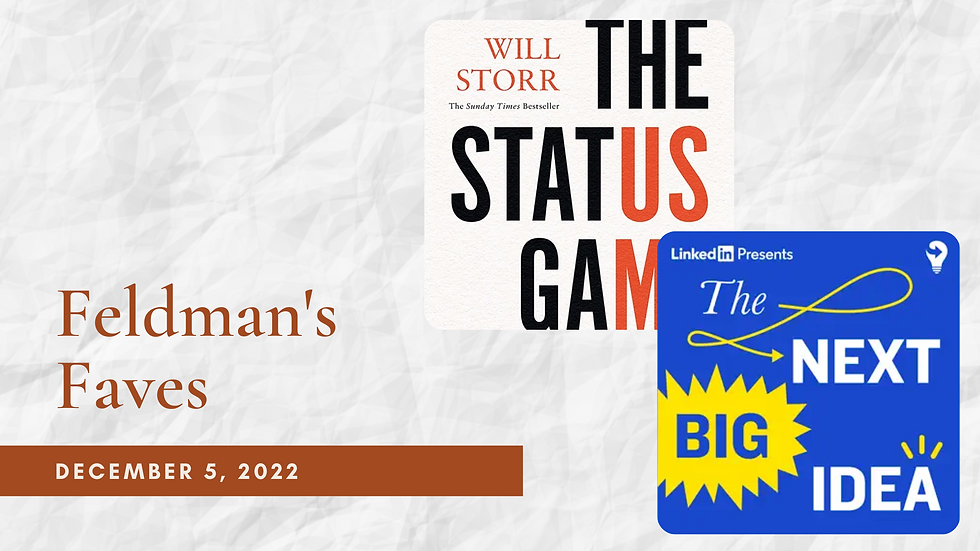
THE STATUS GAME By: Will Storr – It is truly amazing to me how status, which can be defined so broadly is so ingrained in the human condition. In The Status Game, Will Storr provides countless examples from all over the world and throughout time to prove out his thesis that we are evolutionarily driven to seek status. From which family member buys the best Xmas gifts, to which monk goes the longest without eating and to which teenager (or immature adult) has the most followers on Instagram, relative importance (way more than anything absolute) is what drives human behavior according to Storr. As Storr himself notes, “Life is a game...We play games for status incessantly and automatically. We do so because it’s a solution our species has come upon to secure our own survival and reproduction. As a tribal animal, our survival has always depended on our being accepted into a supportive community. But once inside any group, we’re rarely content to flop about on its lower rungs. We’re driven to rise within it. Back in the stone age, increased status meant access to better mates, more food and greater safety for ourselves and our offspring. The more status we earned, the greater our capacity to thrive and produce thriving children. So we’re driven to seek connection and rank, to be accepted into groups and win status within them. This is the game of human life. No matter where you might travel, from the pre-modern societies of Papua New Guinea to the skyscraper forests of Tokyo and Manhattan, you’ll find it: humans forming groups and playing for status. In the developed world, we play political games, religious games, corporate games, sports games, cult games, legal games, fashion games, hobby games, video games, charity games, social media games, racial, gender and nationalist games. The variety feels infinite. Within these groups we strive for individual status, for acclaim from our co-players. But our groups also compete with rival groups in status contests: corporation battles corporation, football team battles football team. When our teams win status, we do too. When they lose, so do we. These games form our identity. We become the games we play. They’re built into our brains, part of how we experience reality. It’s simply not possible to opt out of it. But we can decide which games we choose to play….Humans are extraordinarily imaginary creatures who use almost anything to symbolize status: money, Twitter followers, literary tastes, power, the brand of a watch or the shape of a stomach. In 1948 the anthropologist William Bascom published an account of a status game on the Micronesian island of Pohnpei that was played with yams. The man with the largest yam at a feast would be declared “Number One” and praised by the chief for his generosity. The men of Pohnpei would furiously compete for this position, raising around 50 yams a year in secret, remote, overgrown plots that they’d creep out of bed at two in the morning to tend to. A single yam could take 10 years to grow, reach more than 4m in length, weigh over 90kg and require 12 men to carry into the feast using a stretcher….But it would be a mistake to conclude from all this that status pursuit is purely a curse. On the contrary, almost everything we think of as “good” in the world is underpinned by the mechanisms of the game. In the small, mobile bands in which our brains did much of their evolution, we won prestige by showing ourselves to be beneficial to the group. We could do this by demonstrating virtue (being generous, dutiful or courageous) or by being competent (a great hunter, honey finder or storyteller). Still today, we award prestige to those who are conspicuously virtuous or successful. The joy of status is nature’s bribe that tempts us into being useful. In today’s strange and rageful online-mediated neoliberal world, we’re continually offered new and shifting symbols of what it is to be a winner: thinner, larger, whiter, darker, smarter, happier, brave-and-sadder with this career triumph and that many likes. When it becomes overwhelming, it’s useful to remind ourselves that these symbols we chase are often no less ridiculous than giant yams and that none of us are competing with everyone in the world, no matter how much it can feel that way. The great consolation of the game is that it’s not final victory we should seek in order to be happy, but simple, humble progress: the never-ending pleasure of moving in the right direction. Nobody wins the status game. They’re not supposed to. The meaning of life is not to win, it’s to play.” I’m not sure how we can solve this problem and frankly, I am not sure status seeking is a problem per se. Rather I think Storr provides us with an interesting lens through which to understand what motivates human behavior that allows us to create structures and incentives to better society and the world around us if we use this understanding when developing policies, ideas and rules of the road for life. Here is a good review from Kirkus - https://www.kirkusreviews.com/book-reviews/will-storr/the-status-game-human-life/
The Next Big Idea - Status: Does Our Need for It Explain ... Everything? – For those of you who are interested in this book but don’t have the time or interest to actually read it, this interview lays out the basic premise of Storr’s book and philosophy in about an hour. Here’s an excerpt from the PODCAST itself: “Life is a game. There’s no way to understand the human world without first understanding this. Everyone alive is playing a game whose hidden rules are built into us and that silently directs our thoughts, beliefs and actions. This game is inside us. It is us. We can’t help but play.” So begins “The Status Game,” a new book by acclaimed writer Will Storr. He continues: “We play for status, if only subtly, with every social interaction, every contribution we make to work, love or family life and every internet post. We play with how we dress, how we speak and what we believe. … Life is not a journey towards a perfect destination. It’s a game that never ends. And it’s the very worst of us.” Does it have to be? We may not be able to quit the status game, but Will says we can learn to play it better. In this episode, he explains how”: https://podcasts.apple.com/ca/podcast/the-next-big-idea/id1482067226?i=1000584905408
Thank you for your ongoing engagement and participation.
And remember to stay safe, stay healthy and to docket daily.
Jon


Comments