
Feldman's Faves: February 2, 2026
- Jon Feldman
- Feb 2
- 8 min read
GOOD MORNING AND HAPPY GROUNDHOG DAY EVERYONE!!
I know that I could use a few more weeks of winter. I think I now have sense of what life must be like in the Artic and its not clear to me why politicians from all over the world want to be fighting over it….
As a die hard Bills fan I was never excited about the Patriot dynasty but it still offends me to the core that Bill Belichick was snubbed by the writers who – play God and - determine admission to the NFL Hall of Fame. I wonder if they will do the same to Tom Brady?
Just a reminder that there is a CLE lunch on Thursday that will address key considerations for this year’s upcoming proxy season. So worth attending for the credit and the food (and you might even learn something too).
And more importantly, a reminder of our BAGEL BREAKFAST starting at 9:15 am this morning (thank you, Alex). Please try to make it if you can.
Just a heads up that I will be away next week so you will be hearing from me the following week.
This week’s theme is capitalism – its history and one of its greatest modern day successes.
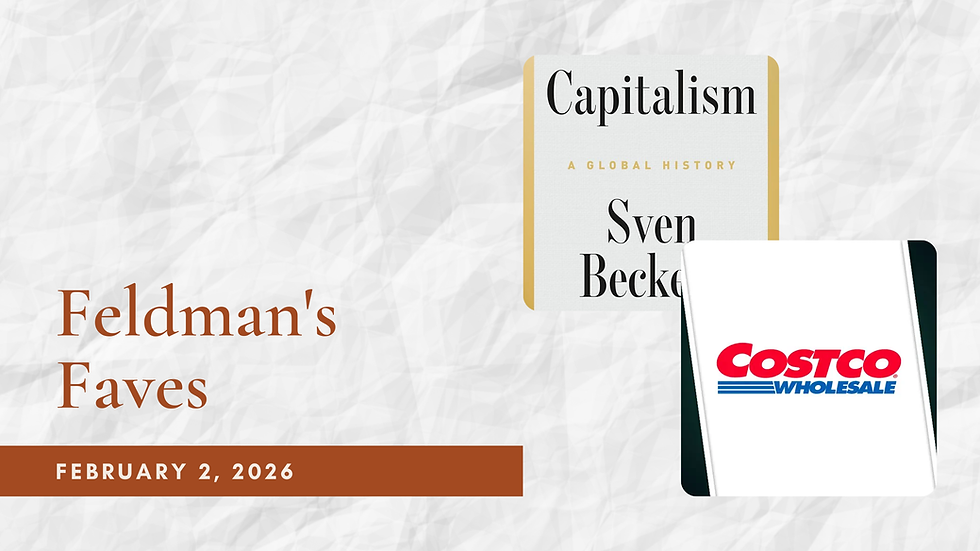
CAPITALISM By: Sven Beckert – If you’ve ever wondered how humanity went from trading a very nice goat for a slightly worse cow to "buying" digital real estate in a metaverse that doesn't exist yet, Sven Beckert’s Capitalism: A Global History (that at times make our “blue book” feel like a pamphlet), is the ultimate "origin story" for our collective obsession with the hustle. Beckert basically tells us that capitalism didn't just emerge because people liked shopping; it was born like a gritty superhero reboot. He introduces us to "war capitalism," where 16th-century merchants and states basically looked at the globe and said, "It’s free real estate!" This wasn't a polite handshake in a coffee shop—it was what he refers to as “a centuries-long montage of state-sponsored muscle, imperial land-grabs, and turning literally everything (including people) into a line item on a spreadsheet”. The wildest part of Beckert’s tale is that this system is a total shapeshifter—a "global leviathan" that is surprisingly "undogmatic." By the time you finish (if you can…), Beckert successfully argues that capitalism isn't some inevitable law of nature like gravity or the fact that the Bills won’t win the Super Bowl (let alone get there). It’s a human invention, which means we’re the ones driving this bus. It’s a brilliant, and not so subtle reminder that since “we built this machine”, we might—just maybe—be able to fix the brakes. As one reviewer notes, “In the early 17th century, the Peruvian city of Potosí billed itself as the “treasure of the world” and “envy of kings”. Sprouting at the foot of the Cerro Rico, South America’s most populous settlement produced 60% of the world’s silver, which not only enabled Spain to wage its wars and service its debts, but also accelerated the economic development of India and China. The city’s wealthy elites could enjoy crystal from Venice and diamonds from Ceylon while one in four of its mostly indigenous miners perished. Cerro Rico became known as “the mountain that eats men”. The story of Potosí, in what is now southern Bolivia, contains the core elements of Sven Beckert’s mammoth history of capitalism: extravagant wealth, immense suffering, complex international networks, a world transformed. The Eurocentric version of capitalism’s history holds that it grew out of democracy, free markets, Enlightenment values and the Protestant work ethic. Beckert, a Harvard history professor and author of 2015’s prize-winning Empire of Cotton, assembles a much more expansive narrative, spanning the entire globe and close to a millennium. Like its subject, the book has a “tendency to grow, flow, and permeate all areas of activity”. Fredric Jameson famously said that it was easier to imagine the end of the world than the end of capitalism. At times during these 1,100 pages, I found it easier to imagine the end of the world than the end of Capitalism. “No religion, no ideology, no philosophy, has ever been as all-encompassing as the economic logic of capitalism,” Beckert claims, defining it as “the ceaseless accumulation of privately controlled capital”. Accounting for it therefore feels like explaining water to fish. Adam Smith, “the hero of capitalism’s triumphant self-remembrance”, attributed it to benign self-interest. Beckert, however, calls it a revolution, centuries in the making, which depended on things that Smith downplayed: “power, violence, the state”. Far from natural or inevitable, it has always been “unstable and contested”, proceeding by jolts.
The word “capitalism” originated in France in the 1840s, around the same time as its antagonists “socialism”, “communism” and “anarchism”, but the system was much older. “Capitalism is a process,” Beckert writes, “not a discrete historical event with a beginning and an end”. He begins tracking the process in the port of Aden in 1150. This vibrant trade hub between Asia and the Middle East, in what is now Yemen, was one of several “islands of capital” which formed a “capitalist archipelago”. Inventing new trades like accountancy and insurance, its “strikingly modern” residents were in the vanguard of a global insurgency. But their accumulation of profit for its own sake was regarded with suspicion by rulers, religions and ordinary people alike. They enjoyed wealth without power or prestige: “capitalists without capitalism”. What they needed was the state’s collaboration. This developed during the “Great Connecting” between 1450 and 1650, when the discovery of the Americas (named after a slave-owning merchant) finally enabled European traders to challenge Asia and the Middle East while making themselves indispensable. In the era of “war capitalism”, new trade routes and territorial seizures triggered conflict, which trade then financed. Colonialism established capitalism’s “connected diversity”, which is to say, think global, act local. Like silver, sugar reconfigured the world. On the then uninhabited island of Barbados, just 74 sugar planters used “American lands, African labour and European capital” to create a private slave colony – the new capitalist avant garde. Across the Americas, millions of enslaved people represented trillions of dollars in unpaid labour. Even after Britain abolished slavery in 1833, there were no clean hands. An ordinary European who began his day with a cigarette and a cup of sweetened coffee was already complicit in three branches of the slave trade. The Industrial Revolution, capitalism’s Great Leap Forward, required less explicit forms of coercion and exploitation. One luminary described Victorian Manchester as “the chimney of the world … the entrance to hell realized”. Meanwhile, envy of America’s vast territories and abundant resources inspired Europe’s dismemberment of Africa, which one French newspaper called “America at our doorsteps”.
Beckert enjoys shredding capitalism’s self-flattering myths. He calls the notion of the free market “nothing more than a figment of scholars’ and ideologues’ imaginations”. The Protestant work ethic was deployed to justify child labour at home and forced labour abroad. “It is necessary to use methods that best can shake their idleness and make them realize the sanctity of work,” was how the Belgian King Leopold II rationalized working millions to death in Congo Free State. And yet, impossible though it was to imagine at the time, capitalism outlasted both slavery and empire. Capitalism’s “permanent revolution”, Beckert writes, produces both dynamism and instability. Similarly, its “connected diversity” cuts both ways – when one crucial region or commodity catches a cold, the whole world sneezes. Crisis is in its DNA. Some emergencies, like the long depressions of the 1870s and 1930s, appeared terminal. Karl Marx, of course, believed that capitalism had an expiration date, but so did the conservative economist Joseph Schumpeter, who asked in 1942: “Can capitalism survive? No. I do not think it can.” Yet every Jeremiah underrated its remarkable survival instincts. Infinitely adaptable, agnostic about nations and creeds, and essentially amoral, it keeps on going. If anyone comes out of this story looking good then it’s John Maynard Keynes, who sought to save capitalism from itself. Combined with thriving labour movements, the challenge of communism and the double shock of war and depression, his prescription for state intervention tamed capitalism’s worst instincts during three decades of extraordinary growth and relative equality after 1945. Call it capitalism with a human face. But then the neoliberal counterrevolution, Beckert argues, spurred capitalism towards its endgame: the commodification of everything. In 2025 it would be foolish to argue that capitalism goes hand in hand with liberal democracy.
The scope of Beckert’s research is mind-boggling. He visits Barbados, Samarkand and Phnom Penh. He quotes cultural texts from Abba to Zola. He profiles emblematic figures such as the Bavarian merchant Jakob Fugger (possibly the richest man who ever lived), Chile’s General Pinochet (“the Lenin of neoliberalism”), the Indian nationalist and industrialist Ardeshir Godrej and the German steel magnate and war criminal Hermann Röchling. He manufactures a ceaseless, and sometimes exhausting, flow of startling details. The question that Beckert never quite answers is: why capitalism? While it’s hard to argue with his copious evidence of capitalism’s poisonous offspring, from scientific racism to climate change, and the numerous efforts to resist its advance, there must be more to it than war, slavery, imperialism and inequality. Even Marx and Engels gave the devil his due in The Communist Manifesto: for all its savagery, it had “accomplished wonders”. Beckert is so good at decrying the sticks that he downplays the carrots: longer lives, higher living standards, labour-saving innovations, new vistas of experience. In this story, capitalism is the answer to every question, the root of every ill, yet the histories of feudalism and communism suggest that cruelty and exploitation are not unique to one economic system. If Adam Smith was wrong to see capitalism as human nature manifest, then Beckert overcorrects by presenting it as anti-human: a “rogue artificial intelligence”, an invasive species, an alien force, a supernatural hunger. It is insatiable and unkillable. Beckert calls his book an “actor-centered history” about a phenomenon “made by people”, but it is ultimately a kind of horror story about a monster that eats men.” This book is a BEAST. While I don’t agree with everything Beckert argues in Capitalism, I do appreciate the rigor and depth of his research and storytelling. If nothing else, .this book helps the (dedicated) reader look WAY BACK in time to try to get an understanding of where we are today, which is never a bad thing. I certainly won’t be re-reading it any time soon. Here’s a good review from the NYT - https://www.nytimes.com/2025/11/26/books/review/capitalism-sven-beckert.html
ACQUIRED - Costco - This episode of Acquired is an older one but one I have wanted to listen to for quite some time. As some of you know, COSTCO truly is my happy place. I can’t really explain why (as I hate shopping and I hate big crowds)– but it just is. What is clear is that I am not the only one. If you build one (pretty much anywhere) people will come. It is of course a great place for shoppers but also for employees and suppliers. And these stakeholders are COSTCO’s main focus – never shareholders. And yet shareholders love the company, which has provided exponential returns over many, many years. A truly remarkable story and a truly remarkable business. Here’s an excerpt from the PODCAST itself, “Costco is not only Charlie Munger’s favorite company of all time (plus he’s on the board, natch), it’s an absolutely fascinating study in how seemingly opposite characteristics can combine to create incredible company value. For instance: Costco has the cheapest prices of any major retailer in America — and also the wealthiest customer base. They pay their hourly workers 30% above the industry norm (and give them excellent healthcare + 401k benefits) — and are almost 3x more profitable on labor than Walmart. Speaking of Walmart, Costco stocks 40x fewer SKUs than their Bentonville-based rivals — yet sells an average of 15x more volume of each. And oh yeah, practically all of Costco’s C-Suite started their careers as baggers and checkout clerks! Tune in for a mind-bending exploration of one of the world’s most iconic — and iconically unique — companies.”: https://podcasts.apple.com/ca/podcast/acquired/id1050462261?i=1000625088063
Thank you for your ongoing engagement and participation.
And remember to stay safe, stay healthy and to docket daily.
Jon


Comments