
Feldman's Faves: February 20, 2024
- Jon Feldman
- Feb 20, 2024
- 4 min read
GOOD MORNING EVERYONE
I hope you all had a wonderful Family Day Weekend. It’s been an incredibly busy start to the year so I hope you all had a chance to spend some time away from the office and with the important people in your lives.
Last week was a great one for women’s basketball. The three point shoot-out between Sabrina and Steph during All Star Weekend was the first of its kind and was great step forward in bringing the sport together. But the sporting event of the last week was, without doubt, Caitlin Clark’s breaking of the all-time NCAA scoring record, which she did in style by hitting a LOGO THREE – total gangster. LOVE IT!!
Finally, happy belated birthday to Tim (from last week).
No theme this week – just topics of interest.
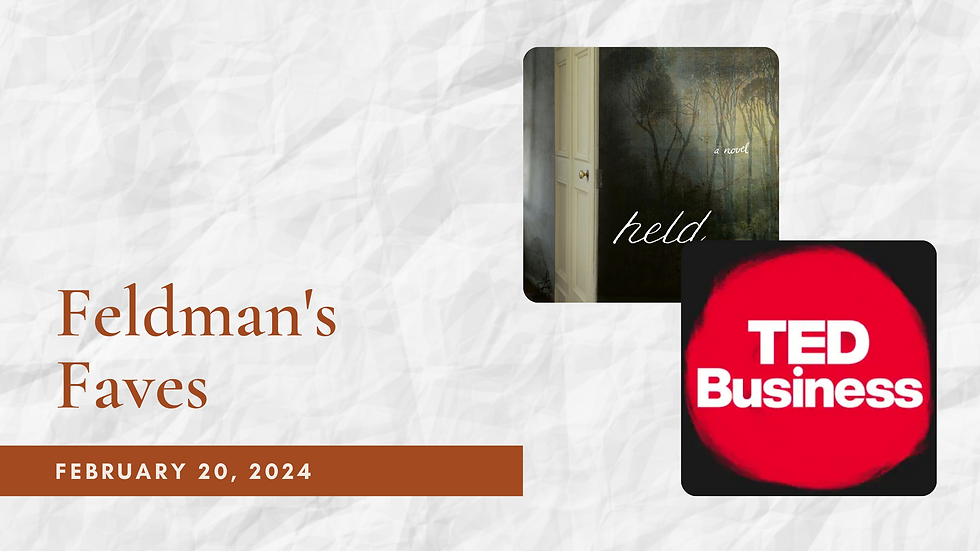
HELD By: Anne Michaels – I remember reading Fugitive Pieces when it came out and thought to myself this really a poet pretending to be a novelist. Anne Michaels is a Canadian treasure and her writing style is just beautiful. To me reading what she writes feels like looking at an impressionist’s painting. You get subtle glimpses of the idea she is trying to convey but in a way that makes you think deeply about that message. In her new novel, Held, Michaels travels across time in a non-linear manner over the course of over 100 years beginning in 1910 and ending in the future (2025). Along the way, we meet several generations of one family and learn about their lives, their suffering and their deep existential thoughts about life, death and moments in time. As one reviewer notes, “Canadian author Anne Michaels’s first novel, Fugitive Pieces, published in the UK in 1997, was described by John Berger as “the most important book I have read in 40 years”. In 2020, it was chosen as one of the BBC’s 100 “novels that shaped our world”. The book explores the long shadow of the Holocaust through the intertwined stories of two survivors. It was not the story that fascinated readers, though – it was the language. Michaels was a poet before she became a novelist and, in Fugitive Pieces, every sentence has a brilliant crystalline luminosity. Critics were also fascinated by the dreamlike quality of the book and by Michaels’s ability to move seamlessly between the intimate and the epic. Fugitive Pieces undoubtedly deserved the many accolades it received but, for a writer, a spectacularly successful first novel can be a curse as well as a gift. When Michaels’s second book, The Winter Vault, was published 12 years later, it was admired but, almost inevitably, judged to be less brilliant. Now Michaels returns with a third: Held. In this new novel, Michaels revisits the themes of her earlier stories – history, memory, the effects of trauma and grief over long periods, and the power of love to heal even the most grievous pain. She also continues to draw on the techniques of poetry and the lyrical novel. The writing is always personal, hypersensitive and profoundly interior.
Michaels works in short, dazzling snapshot scenes, collage-like and even hallucinatory. Each paragraph is as carefully shaped as a poetic stanza and characters are constantly captured in situations that illuminate Michaels’s belief that “we are born to face a single moment”. All of this will be familiar to readers of her earlier books, but Held breaks new ground by introducing a large cast of characters and many different stories. Scenes loop back and forwards from 1902 through to 2025. Locations shift from a battlefield in first world war France to North Yorkshire, London, Belarus and various war zones. John was grievously wounded in the first world war. Alan is a war photographer. His partner, Mara, is a nurse in a field hospital. Her father, Peter, makes exquisite hats. Sometimes, the reader is able to understand how these characters and their stories connect but often the links are not explicit. We are asked to let go of traditional narrative structures and surrender to a looser architecture that is held together by association and recurring motifs. As one of Michaels’s characters puts it: “The elusiveness of the form is the form.” Techniques of narrative layering are employed with great skill as themes echo and return. Photography and image are central, along with the insistence that the dead are never gone. Michaels reminds us that while history is sometimes “simply detritus”, it’s also true that “the past exists as a present moment”. War, destruction and tyranny are ever present – but so is hope. Paavo, living under communism, remarks that “with every tightening of the screw, the tyrant makes our hope more precise. And nothing enrages a tyrant more than hope.” While the fluid structure of this work may be challenging for some readers, it’s clear that Michaels’s writing continues to stand head and shoulders above most other fiction. At the heart of this book lies the question of how goodness and love can be held across the generations. For Michaels, our final task is “to endure the truth”.“ Nothing will ever compare to Fugitive Pieces, but Held “holds its own” in terms of being a great contribution to the cannon of Canadian literature. Here’s a good review from Quill and Quire - https://quillandquire.com/review/held-2/
TED Business - How to solve the world's biggest problems | Natalie Cargill – This PODCAST has a very interesting on the power of philanthropy and the way we should be thinking about it. In essence, the argument is that if the world’s top earners all contributed 10% of their income to charity many of the world’s problems could be solved including, pandemic preparation, nuclear disarmament and poverty. This may be a bit of an overstatement but the idea is worth thinking about. Here’s an excerpt from the PODCAST itself, “Sometimes the world's biggest issues can seem so intractable that meaningful change feels impossible. But what if the answer has been right in front of us all along? What if the answer is actually throwing money at the problems? In this thought-provoking talk, philanthropic advisor Natalie Cargill shares what might happen if we came together to spend 3.5 trillion dollars on fixing the world. And, yes, she also has a plan for where to get the money from. (Followed by a Q&A with Anna Verghese, executive director of The Audacious Project.) After the talk and Q&A, Modupe shares her philosophy on giving.” https://podcasts.apple.com/ca/podcast/ted-business/id470622782?i=1000641345799
Thank you for your ongoing engagement and participation.And remember to stay safe, stay healthy and to docket daily.
Jon


Comments