
Feldman's Faves: February 21, 2023
- Jon Feldman
- Feb 21, 2023
- 3 min read
GOOD MORNING EVERYONE
I hope you all had a chance to take some time to enjoy the long weekend. Something we all need in the middle of our beloved Canadian winter….
It was fun having lunch together last week (thank you Alex) and we plan on doing this more often.
No theme this week – just topics of interest.
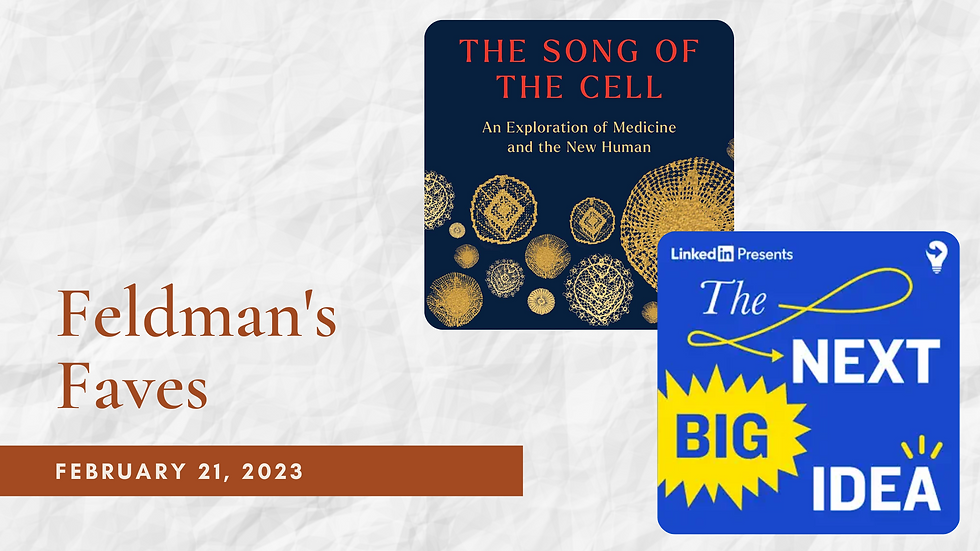
THE SONG OF THE CELLS By: Siddhartha Mukherjee – One of my all-time favourite books is Siddhartha Mukherjee’s tomb on the history of cancer, The Emperor of Maladies, which Ken Burns made into a fascinating documentary. Mukherjee, a practicing doctor and founder of multiple businesses (in addition to being an award winning author) has a unique ability to frame the history of science in a way that is interesting and reads like a suspenseful novel. He has done so in his landmark studies in both cancer and the gene and in his latest book, The Song of the Cells, his focus shifts to the cellular level, starting from discovery to modern day use and ethical considerations relating to the same. As one reviewer notes, “In The Song of the Cell, the extraordinary author of the Pulitzer Prize-winning The Emperor of All Maladies and the #1 New York Times bestseller The Gene blends cutting-edge research, impeccable scholarship, intrepid reporting, and gorgeous prose into an encyclopedic study that reads like a literary page-turner. Mukherjee begins this magnificent story in the late 1600s, when a distinguished English polymath, Robert Hooke, and an eccentric Dutch cloth-merchant, Antonie van Leeuwenhoek looked down their handmade microscopes. What they saw introduced a radical concept that swept through biology and medicine, touching virtually every aspect of the two sciences, and altering both forever. It was the fact that complex living organisms are assemblages of tiny, self-contained, self-regulating units. Our organs, our physiology, our selves—hearts, blood, brains—are built from these compartments. Hooke christened them “cells.” The discovery of cells—and the reframing of the human body as a cellular ecosystem—announced the birth of a new kind of medicine based on the therapeutic manipulations of cells. A hip fracture, a cardiac arrest, Alzheimer’s dementia, AIDS, pneumonia, lung cancer, kidney failure, arthritis, COVID pneumonia—all could be reconceived as the results of cells, or systems of cells, functioning abnormally. And all could be perceived as loci of cellular therapies. Filled with writing so vivid, lucid, and suspenseful that complex science becomes thrilling, The Song of the Cell tells the story of how scientists discovered cells, began to understand them, and are now using that knowledge to create new humans. Told in six parts, and laced with Mukherjee’s own experience as a researcher, a doctor, and a prolific reader, The Song of the Cell is both panoramic and intimate—a masterpiece on what it means to be human.” There is a lot of detail in this book, but like all of his works, this book gives the lay reader (like myself) a very helpful guide to understand the complexity of this area of science. Here is a good review from the NYT Book Review - https://www.nytimes.com/2022/10/24/books/review/the-song-of-the-cell-siddhartha-mukherjee.html
The Next Big Idea - Pleasure: An Epicurean Guide to the Good Life – The Epicurean philosophy often gets a bad rap as those seeking out hedonistic pleasure at the expense of everything. Instead, our society gives much more respect to those who practice (consciously or otherwise) a more stoic life. But when one digs deeper into its basic tenets you begin to understand and see the wisdom of this school of thought. In this PODCAST we are presented with the fundamental ideas of epicureanism, which focus on taking care of one’s basic needs, developing human connection, understanding basic science while at the same time not worrying if others around you are doing better. Makes a l lot of sense to me. Here’s an excerpt from the PODCAST itself, “The Greek philosopher Epicurus made a rather bold claim over two thousand years ago. The key to life, he said, was simple: pursue pleasure and avoid pain. Around this maxim he developed a school of philosophy, Epicureanism, which promised its adherents that if they took care of their basic needs, surrounded themselves with trustworthy friends, and developed a basic understanding of science, they would be happy. But is it really that simple? Can the advice of someone born 2,363 years ago still hold true? To answer these questions, we turned to Emily Austin, professor of philosophy at Wake Forest University and author of the delightful new book "Living for Pleasure: An Epicurean Guide to Life.”: https://podcasts.apple.com/ca/podcast/the-next-big-idea/id1482067226?i=1000596707457
Thank you for your ongoing engagement and participation.
And remember to stay safe, stay healthy and to docket daily.
Jon


Comments