
Feldman's Faves: February 23, 2026
- Jon Feldman
- Feb 23
- 10 min read
GOOD MORNING EVERYONE
It feels like the Winter Olympics just flew by. Very proud of our athletes who did great this year in Milano Cortina notwithstanding the double heartbreak on the ice.
BTW, I thought that Ski Mountaineering (this year’s new controversial event) was really fun to watch (even more than break dancing…).
If you haven’t done so already, please make sure to involve Josephine and Serayah on your files who are eager to learn and contribute to our team.
This week’s theme is the history and politics of places I previously knew next to nothing.
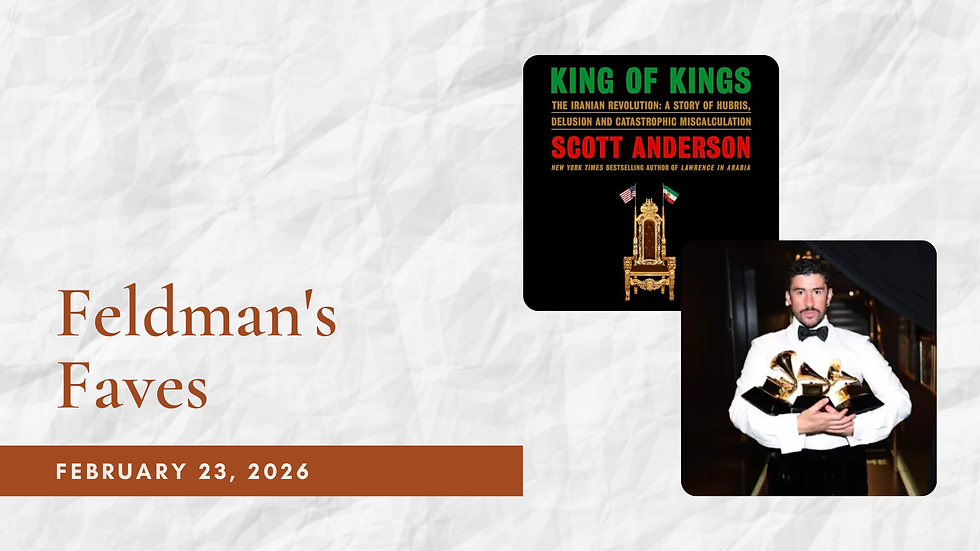
KING OF KINGS - THE IRANIAN REVOLUTION; A STORY OF HUBRIS, DELUSION AND CATASTROPHIC MISCALCULATION By: Scott Anderson – Thanks once again to Steve for his recommendation. King of Kings the name of Scott Anderson’s in depth study on the fall of the Shah of Iran (Mohammad Reza Pahlavi) and rise of the current regime is also the name that the Shah gave himself, which one, with hindsight, may have been a strategic error on his part. I remember the US Hostage Crisis from my childhood but had no real sense of what led to the overthrow of the Shah and the Iran we see today. Anderson does an outstanding job of explaining the history of Iran, the factors that led to regime change and the key players involved on all sides of these destiny shaping world events. As one reviewer notes, “Scott Anderson begins his latest book, King of Kings: The Iranian Revolution; A Story of Hubris, Delusion and Catastrophic Miscalculation (2025), with the story of an infamous 1971 party in a desert. The king of Anderson’s title, Iran’s shah Mohammad Reza Pahlavi, was ostensibly marking 2,500 years of the Persian empire in Persepolis, once the capital under Cyrus the Great, who founded the Achaemenid Empire around 550 BCE. At a time of political stress, the shah was making a bid to link the Pahlavi dynasty, and himself in particular, to Cyrus, as the basis of an unquestionable legitimacy—“his rule and his achievements forming a continuum with those of the ancient immortals,” in Anderson’s words. By some estimates, the party cost upwards of $600 million, and by all accounts, it was a flop. The images, which you can see in the 2016 BBC documentary Decadence and Downfall: The Shah of Iran’s Ultimate Party, are on a level of ostentation and sheer kitsch that borders on farce. The festivities were able to draw some 60 heads of state (President Richard Nixon did not attend, but his vice president, Spiro Agnew, did). One of the more nauseating moments in the documentary is the voice of Orson Welles, in a regime-backed piece of propaganda, grandiloquently reciting lines about Cyrus and his empire, and even ventriloquizing for the shah himself. Pahlavi had officially been on the throne since 1941, after his father, Reza Shah Pahlavi, was forced from power by the British and the Russians during World War II. The elder Pahlavi’s crime was to have suspended use of his railroads for transporting food and weapons to the Russian army in its fight against Hitler. Only 22 at the time, Mohammad Reza Pahlavi showed more interest in sports, travel, and other distractions than in ruling, which opened opportunities for elected representatives to shape policy and politics, reviving the spirit of the 1906 constitution that was enacted in an earlier Iranian revolution. Foremost among these representatives was Mohammad Mossadegh, who became prime minister in 1951.
If Iran is not of the Arab world, the country’s history and politics, not to mention its geography, are nevertheless intertwined with it. Mossadegh became prime minister at the dawn of a new era of Arab nationalism, whose two most emblematic incarnations were Egypt’s Gamal Abdel Nasser and the Algerian independence movement. Mossadegh was their forerunner. His most consequential decision—nationalizing Iran’s oil industry days into his tenure—prefigured Nasser’s nationalization of the Suez Canal in 1956. This move effectively undercut the Anglo-Iranian Oil Company (now British Petroleum) that hitherto controlled Iran’s royal treasure and, by extension, also undermined both the British economy at the height of its postwar recovery and British influence in the Middle East. In response, the United States and United Kingdom committed one of their original sins of the Cold War, supporting and orchestrating a coup against Mossadegh. Iran would now be ruled directly and harshly by the shah, a loyal Western client and friend to Israel. One can imagine the comedown for Iranian citizens, who had briefly taken pride in their country’s defiance of the West. After a rocky 1960s, during which the shah’s regime was challenged by leftists, guerrillas, clerics, students, intellectuals, and others, the Pahlavi dynasty would need to pour national meaning into that increasingly hollow space. This was the purpose of the party in Persepolis. Unsurprisingly, neither the shah nor Orson Welles won over an Iranian public struggling with inflation. The imperial birthday bash was an explicit reminder, during economic crisis, of the extreme inequalities in Iranian society. The regime had eight years left.
If Persepolis was one turning point, a January 1978 article, widely believed to have been commissioned by the regime, was another. The piece, titled “Iran and Red and Black Colonization,” accused a popular cleric, Ruhollah Khomeini, of being a British agent, a fraud, a mediocrity, and possibly a foreigner. The “red” and the “black” in the title were meant to associate Khomeini with both communism and Islamism. That the government’s eagerness to diminish a cleric living in exile did exactly the opposite, provoking mass protests that started in the Shia holy city of Qom, reflects how far Khomeini had traveled from obscurity to revolutionary leader in less than a decade. Khomeini had first made his name during a revolt against the shah’s so-called White Revolution of 1963, a modernization drive rooted in land reform and denounced by guild leaders, bazaar merchants, farmers, the clergy, and other middle-class constituencies. In his monumental 1982 book Iran Between Two Revolutions, Ervand Abrahamian wrote that “the revolution came because the shah modernized on the socioeconomic level and thus expanded the ranks of the modern middle class and the industrial working class, but failed to modernize another level—the political level.” Those constituencies were protesting more than the reforms themselves: they were protesting their lack of participation in major decision-making. Exiled to Najaf because of his role in the protests against the White Revolution, Khomeini became the de facto leader of the opposition. By then, Iran’s leftist parties were no longer the force they’d been during Mossadegh’s time, unable now to deliver the crowds like religious leaders could. The mosque was where the harassed and extorted Iranian came “to find balance and calm, to recover his dignity,” as Ryszard Kapuściński wrote in his impressionistic 1982 account Shah of Shahs. Islamists had ideological appeal too. The shah evoked a pre-Islamic Iranian identity, an Iran of Cyrus the Great, as symbolized by the Persepolis celebrations. In 1976, he backed a change from the Islamic calendar to a new year, 2535, defined around Cyrus’s empire. Roy Mottahedeh described this, in his 1985 book The Mantle of the Prophet: Religion and Politics in Iran, as “an act of defiance to religion that only a time like the French Revolution could produce in the West.” To embrace Islam was now to join a cultural revolt against the regime. Shia Islamic ritual also provided a powerful framework for protest—not only the esteem given to resistance and martyrdom but also the 40-day period for commemorating the dead. On September 8, 1978 (a day commemorated as “Black Friday”), Khomeini’s supporters in Tehran were fired upon by security forces and several were killed—and thus began the Pahlavi dynasty’s final chapter.
Jimmy Carter’s administration acted as night nurse at the shah’s bedside. The failure to abandon an increasingly delusional shah or understand Iran’s unequal oil-driven economy is Anderson’s main subject. He writes that a “truism about embassies—indeed, about almost any office place—is that the greater they grow, the more insular and remote from their surroundings—in a word, dumber—they tend to become.” As Anderson notes, “in this regard, by the mid-1970s the burgeoning embassy on Takht-e-Jamshid stood as a veritable citadel of fatuousness.” The fatuousness was just as bad in Washington, DC. Coming off least honorably in Anderson’s tale is National Security Advisor Zbigniew Brzezinski, who advocated full-throated support of the shah despite what some on the ground were reporting. The book’s through line is a familiar tension between clueless American policymakers and subordinates more in touch with local anger. Michael Metrinko, United States consul in the northwestern city of Tabriz, warned his bosses first about how fragile the shah’s grip on power was and, later, that Khomeini would not be a moderate Cold War ally. He was ignored in both cases. Anger boiled when Carter allowed a dying Pahlavi to seek treatment in the United States, culminating in the takeover of the embassy, that “citadel of fatuousness.” Metrinko was among the hostages.
Anderson is an enthralling chronicler, and some sections of King of Kings are invaluable. His narrative mode illuminates the play-by-play: the August 1978 Cinema Rex fire, ignited by militants but blamed on the regime, which killed hundreds of moviegoers; Khomeini’s October 1978 move to France after falling afoul of his Iraqi hosts, who, facing a restive Shiite population of their own, “had come to view the religious upheavals in Iran with deepening alarm and saw that continuing to provide a platform for the hectoring old man in Najaf was a dangerous game”; the 40-day protest cycle; the final days as American diplomats tried to salvage a role as “bridge between the forces of revolution and the powerful military the shah was leaving behind.” But the focus on the United States’ role and response to these events becomes distracting. American Cold War missteps in Iran are undeniably conspicuous, starting with Mossadegh’s ouster. By Carter’s time, however, it is difficult to imagine what the US could have done to effect a different outcome—even if his administration had acknowledged how overwhelming the opposition to their despotic ally had grown. It certainly could have created the conditions for better relations with the Islamists, but successive administrations have missed several opportunities to reset those relations since.
While Anderson’s subtitle suggests fresh insights into the dynamics that shaped the revolution, the book falls well short of the mark. The focus on individuals, scenes, and decisions comes at the cost of more rigorously studying the revolution’s constituent elements. While the reader sees, for example, a period of protests in a Tabriz bazaar mostly through Metrinko’s secondary perspective, Anderson never seriously addresses the bazaar’s role in the revolution. The bazaar and the mosque were, as Mottahedeh wrote in The Mantle of the Prophet, “the two lungs of public life in Iran.” The bazaar was a special arena in which the moral and financial terms of interaction between two people were set. It also had power. If angry merchants shuttered their storefronts, normal life would stop. It was the humiliation of two sugar merchants by Tehran’s governor in December 1905 that sparked the bazaar revolt that ultimately led to the 1906 revolution, which concluded when a dying Qajar king put his signature on a new constitution that established a parliament with authority to make laws, approve budgets, and check royal power.
The bazaar was as important in Iran’s next revolution. One of the more interesting questions about 1979 is how, after returning home, Khomeini was able to consolidate control over a diverse coalition of clergy, merchants, guilds, and salaried managers. That’s why a book that purports to tell the full story of the revolution shouldn’t stop, as Anderson’s does, with the student takeover of the US embassy. That event may have established the hostile United States–Iran relationship we know today, but it was the war with Iraq, lasting from 1980 to 1988, that gave the ayatollahs an opportunity to put their definitive stamp on the revolution. The new regime in Tehran portrayed that war as a jihad against a West-backed Sunni foe that ruled over a majority-Shia population, elevating it “to a cosmic plane of good versus evil,” in journalist Robin Wright’s words at the time. An indelible evocation of this can be found in Marjane Satrapi’s autobiographical graphic novel Persepolis (2003–04), in which the author and her school friends are forced to line up and beat their chests twice a day to honor the war dead in funeral marches. Some are even recruited to the jihad, told that their martyrdom will unlock the gates to heaven. But these children represent a different truth about Iran: subversiveness, a defiance both of the revolution—making all kinds of mischief with the veil teachers forced on them—and of the war that was meant to make it burn anew. They mock the ritual celebration of suffering, laughingly wailing, “The martyrs! The martyrs!” while a young Satrapi, lying on the floor, reprimands her teacher: “I’m suffering, can’t you see?” The nationalism provoked by the Israeli and American bombing of Iran this past June gave new life to the ayatollah’s claim to be fighting for the underdog, and its subsequent actions—the hunt for alleged traitors, the expulsion of tens of thousands of Afghan refugees as fifth columnists—were reminiscent of the Iran–Iraq War days. But the subversiveness of the young remains. Therein lies the hope that the 1979 revolution is neither complete nor permanent.” Based on what is happening in Iran today and based on its history it feels to me that a big change is coming there. When and how remains unclear. Here’s a good review from The New Yorker - https://www.newyorker.com/magazine/2025/08/11/king-of-kings-the-iranian-revolution-scott-anderson-book-review
THROUGHLINE - How Bad Bunny took Puerto Rican independence mainstream – Bad Bunny is currently the world’s most streamed artis and his year just keeps getting better. He won album of the year for DTMF (the first time ever for a Spanish only album) and performed at the Half Time show at the Super Bowl. So he is definitely having a moment right now, which naturally peaked my curiosity. Turns out he is also a huge political and financial champion of Peurto Rico and his music reflects much of what he believes. Puerto Rico, as a colony of the USA, is in a very unusual spot and seems ripe for some sort of change. There is debate there as to the future relationship with the US but not clear (at least to me). This PODCAST does a good job of explaining both the history of Puerto Rico and the rise of Bad Bunny and connects how the two are related. Here’s an excerpt from the PODCAST itself, “How Bad Bunny became the global voice of a generation in crisis — and what it means when resistance becomes profitable. Guests: Carina Del Valle Schorske, writer, translator and wannabe backup dancer. She wrote a New York Times Magazine profile about Bad Bunny you can read here. Vanessa Díaz, professor of Chicano/a and Latino/a Studies at Loyola Marymount University. She’s been teaching a Bad Bunny college course 2023 and is the co-creator of the Bad Bunny Syllabus Project. She is also the co-author of P FKN R: How Bad Bunny Became the Voice of Puerto Rican Resistance. Jorell Meléndez-Badillo, professor of Puerto Rican, Caribbean and Latin American History at University of Wisconsin, Madison. He’s the author of Puerto Rico: A National History. He is also the author of the history visualizers for Bad Bunny’s DTMF album.” https://podcasts.apple.com/ca/podcast/throughline/id1451109634?i=1000749327422
Thank you for your ongoing engagement and participation.
And remember to stay safe, stay healthy and to docket daily.
Jon


Comments