
Feldman's Faves: January 26, 2026
- Jon Feldman
- Jan 26
- 6 min read
GOOD MORNING EVERYONE
I am told that COSTCO sells heated jackets. It would have been useful to know about this prior to this weekend. I know we are all proud Canadians who love our winters but this is getting ridiculous.
Super Bowl 60 is now set and feels a bit like a “back to the future” moment. My heart is with the Patriots but my money is on the Seahawks.
I am copying our good friend Michelle this week who is now famous. She took a live class on Saturday in the Peloton London studio and was awesome. Our own Emily and Michelle are now on the Peloton Mt. Rushmore. Who’s next?
Finally, please join me in wishing Steve a happy birthday this week
No theme this week – just topics of interest.
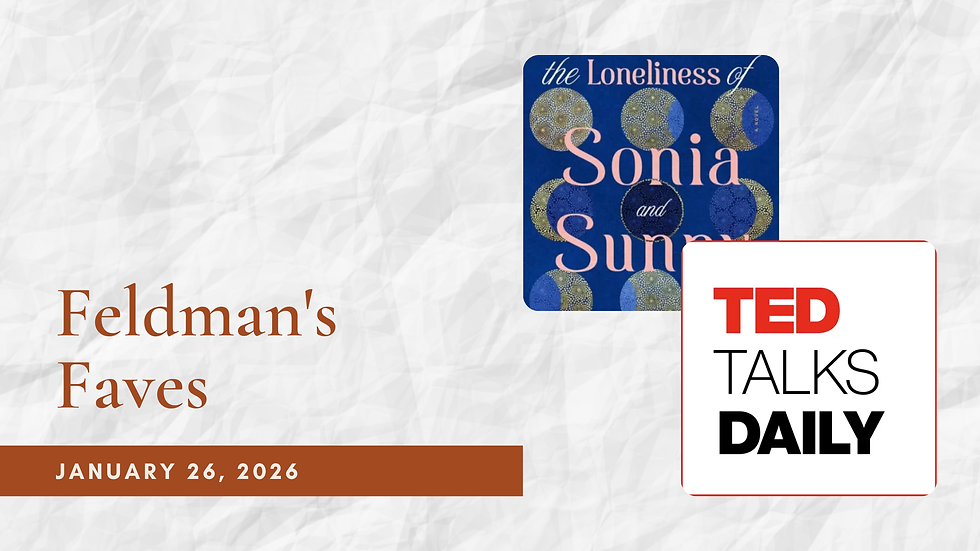
THE LONELINESS OF SONIA AND SUNNY By: Kiran Desai – Many experts thought that this book (and not Flesh – as reviewed last week) was the obvious winner of last year’s Booker Prize. While I don’t agree, I do understand the thinking. The Loneliness of Sonia and Sunny is a beast of a novel that some have described as a modern day (takes place in the 1990s’ and 2000’s) Anna Karenina but taking place in India (and other locations, including NYC, Mexico and Venice). This story is an epic tale of the two heros – Sonia and Sunny – who are both ex pat Indians living in the US and struggling with their identities there. They return to India ad struggle there too. They are destined to meet but before and after they do there is lots of drama. To know how it ends you have to read it. There are many large families and there are bouts of magical realism so in addition to the Tolstoy notes it also has echoes of the writing Gabriel Garcia Marquez. Overall, very enjoyable while dealing with globalism, modernity vs tradition (e.g, the role of arrangement marriages) and crazy family dynamics – so something for everyone. As one reviewer notes, “On a trip to see his grandparents in the Indian city of Allahabad, journalist Sunny Bhatia flicks through the morning papers, and is immediately at sea: what can the convoluted sentences before him – “TTIM files complaint against MSL at JM Rastra. MP(LTTK) holds GL Mukti strike to blame for Vasudev debacle. BORS reverberates in KLM(U) case” – possibly mean? His bewilderment at an India he cannot decode is, equally problematically, mirrored by the incomprehension he experiences in New York, where he occupies a junior role at the Associated Press. Fortunately, there are other more readily accessible stories: a woman sold at a cattle fair in Rajasthan, and a retired railway clerk in Mysore who has grown his fingernails so long that they reach across the room and oblige his family to attend to his every physical need. They do not mind, the clerk tells Sunny when he interviews him over the phone, because they understand his determination to do something that nobody else has done: “The point is not about having longer fingernails than anyone; what is important is that I am firing up the younger generation to be ambitious. If I can do it, I tell them, I who used to have no discipline, then you can also reach your dream of fame.” The story is, Sunny realizes, excellent copy, even if his piece enrages the long-nailed man, who deems him an outsider pretending to be an insider, and a cheating outsider at that. There’s an echo of Desai’s own experience of writing her debut novel, 1998’s Hullabaloo in the Guava Orchard, which drew on the apparently true story of a man who lived up a tree for 15 years to escape an unhappy marriage, and which roused the ire of the Nepali community she depicted. The irresolvable tension of the insider/outsider’s life ran through her Booker prize-winning second novel, The Inheritance of Loss, and is reprised in each of the multiple storylines in this mammoth novel, which has also been longlisted for the Booker.
Critically, it is a novel about work as much as it is about the relationship between Sunny and Sonia Shah, whose families are neighbours and whose attempts to make a match begin their on-off liaison. Where Sunny dreams of journalistic success, albeit heavily inflected by the work of JD Salinger and Kurt Vonnegut, Sonia’s heart and mind lie in writing fiction. Alienated and alone at college in rural Vermont, she finds solace in Tolstoy, but is perplexed and provoked by the idea of magic realism and “the enticement of white people by route of peacocks, monsoons, exotic-spice bazaars”. The dilemma facing an Indian writer, she ponders, is one of obeisance to the west’s appetites and projections, and the lure of producing “stories cheapened by proliferation, decorative outside and hollow inside”. Desai’s solution to the problem in this immensely entertaining and generative novel is to dart continually between modes of representation and register. The gothic novel appears with the early introduction of the monstrous Ilan de Toorjen Foss, a narcissistic artist who seduces Sonia, suppresses her literary endeavors and then abandons her (“don’t write orientalist nonsense! Don’t cheapen your country or people will think that this is actually India … What Westerners did to you, you are doing to yourself”). The predicaments and predilections of Sunny and Sonia’s Allahabad relatives create a low-key bourgeois comedy: stranded single aunts, genteel impoverishment, the wrangle over a cook famed for his kebabs. These are reprised in higher style by Sunny’s widowed mother, the impossibly grand Babita, who is embroiled in a noir crime plot by the machinations of her late husband’s brothers and whose preoccupation with wealth and status cast light on the rapidly evolving strata of contemporary urban India.
In the interstices of the discrete and distinctive tones of each of these narrative components, the novel allows itself to succumb to a wild and suggestive indeterminacy, conveyed through various iterations of Sunny and Sonia’s internal monologues, sometimes rational and ruminative, sometimes operatic and hallucinatory. Sonia “dreamt the walls leaked blood. She dreamt she ate a pie, and when she bit into it, the pie leaked blood. She dreamt she had a hideous baby and it died, and when she cut it open with scissors, it was not a baby at all – it had a child’s head but a lizard’s skeleton.” Such nightmarish visions are not confined to sleep, particularly when a marauding dog enters the story to pursue her. Capacious and shape-shifting though the novel is, filled with subtexts and shadow narratives, it is still a challenge to hold the contradictions and demands of multiple identities. Desai pictures Sonia and her father listening to the Pakistani singer Iqbal Bano, and reflecting on what the music conjures in them: “To be a citizen of a troubled postcolonial nation gave a person gravitas. To be holding out against the crass new world gave a man gravitas. To be wounded yet fighting on against the barbarians gave one gravitas. To be exiled, abandoned by love and luck, gave them gravitas. What happened within a family, what happened between a couple, was no different from that which happened in a nation under dictatorship, running on fear.” Whether or not a novel can accurately and productively capture this yearning for gravitas, or the continuum between the personal and the political, is one of the questions posed by The Loneliness of Sonia and Sunny. Another is the sheer exhaustion – mental, physical and artistic – caused by the constant need for self-invention and reinvention, whether individual, societal, national or global; and how the form of the novel, created in the European consciousness, can complexify itself to take account of an accelerated, fractured modernity. Desai’s answer to these questions is to make her story both dizzyingly vast and insistently miniature; to make us feel that there is as much at stake in the lives of Vini-Puri, a pair of servant girls in Babita’s household not even accorded single-name recognition, as in the grand ambitions of the novel’s title characters. She pulls it off, not only in her maneuvering of cast and incident, but in her ability to elicit apprehension, laughter, compassion and curiosity in the reader.” This epic novel, is in my mind the runner up to last year’s Booker Prize. Here’s a good review from NPR - https://www.npr.org/2025/10/03/nx-s1-5560818/the-loneliness-of-sonia-and-sunny-review-kiran-desai
TED TALKS DAILY - How nearly dying helped me discover my own cure (and many more) | David Fajgenbaum – This TED TALK is just fascinating. The main idea here is about the power of the use of off label drugs. The most famous to date I have to think is the weight loss use of Ozempic that was supposed to be solely for the treatment of diabetes. But this idea of using the existing stock of drugs to find treatments and cures for other diseases and making that the mission is the mission statement for Every Cure. The story of how it was created and why it was created is just fascinating and discussed in this PODCAST. Here’s an excerpt from the PODCAST itself, “Physician-scientist David Fajgenbaum was dying from a rare disease that didn't have a cure — until he discovered a lifesaving drug that wasn't originally intended for his condition. In an astonishing talk, he shares how his near-death experience led him to cofound the nonprofit Every Cure, which is using AI to uncover hidden treatments and save many other people's lives. (This ambitious idea is part of The Audacious Project, TED’s initiative to inspire and fund global change.)” https://podcasts.apple.com/ca/podcast/ted-talks-daily/id160904630?i=1000725564361
Thank you for your ongoing engagement and participation.
And remember to stay safe, stay healthy and to docket daily.
Jon



Comments