
Feldman's Faves: July 4, 2022
- Jon Feldman
- Jul 4, 2022
- 4 min read
GOOD MORNING EVERYONE
I hope you enjoyed the long weekend. It has been an intense year so far with many of you working very hard (and of course, very smart). I hope you were able to get a bit of break as we move into the second half of the year. The world is pretty crazy these days, but we are solid.
I am very excited to welcome back Steve Inglis today from paternity leave and to welcome Emily Groper who will be joining us for the rest of the summer starting tomorrow.
This week is a study in contrasts, one being extremely depressing and the other being freakin’ hilarious.
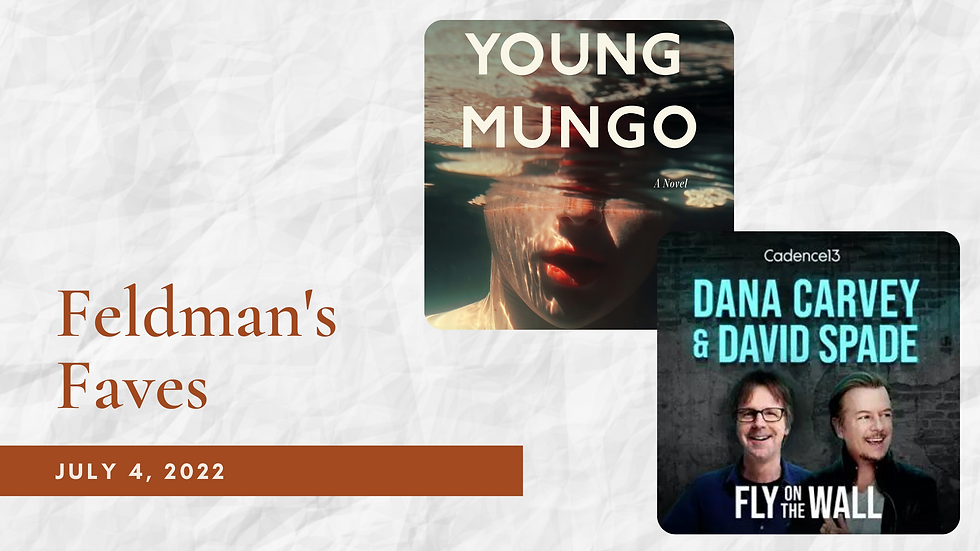
YOUNG MUNGO By: Douglas Stuart – One of the first books I reviewed for this group was Douglas Stuart’s debut and Booker Prize winning novel, Shuggie Bain, which was one of the most beautiful and chillingly sad books I have ever read. I actually think about it all the time. Stuart did a spectacular job describing the life of the poor in Glasgow, Scotland during the Thatcher era in general and in describing the dysfunctional Bain family, all through the eyes of the novel’s hero, Shuggie. So when Stuart’s follow up novel, Young Mungo, was released, I bought it right away. It is also really good but (in my mind) not as good. As one reviewer describes (better than I ever could) the basic plot is that, “Mungo Hamilton is the youngest of three children. They live on a Glasgow scheme rife with sectarian violence between the “Prodders” and the “Fenians”. The Hamiltons are Protestants, with the oldest brother, Hamish (known as “Ha-Ha”), the leader of a gang of teenagers who rob and intimidate the local Catholics. Jodie, Mungo’s sister, is a bright and ambitious young woman in a miserable and manipulative relationship with a teacher at school. Mungo is awkward, handsome and sensitive, with a tic and a patch of raw skin on one cheek. With their father long dead, all children live in the shadow of their mother, Mo-Maw, an alcoholic with the same mixture of charm, compassion and cruelty as Agnes from the previous book. Where Agnes sat at the heart of Shuggie Bain, Mo-Maw is notable here largely by her absence: she disappears for weeks at a time, leaving Ha-Ha and Jodie as the imperfect parents to the fragile Mungo. When she does appear, it is with tales of her pursuit of a new husband, or deep in her cups, when she becomes what the children call “Tattie-Bogle” – a “heartless, shambling scarecrow” Young Mungo operates a dual narrative, with chapters alternating between a fishing trip that Mungo takes with two friends of his mother and a more expansive history of Mungo’s life leading up to this point. In the wake of an event whose facts become clear over the course of the novel, Mungo has been packed off by his mother with two men she’d met at Alcoholics Anonymous. We soon learn that the men – “St” Christopher and the younger, more sinister Gallowgate – have been in jail. Now they are here in the glens, “as near tae heaven as ye can get on three buses,” as one of the men puts it. The chapters beside the loch are dark and drenched with foreboding. The men are drunk by the time they arrive and as they grow drunker our fear for the 15-year-old boy sent into the wilderness with them mounts to an almost intolerable pitch. It’s a relief when we drop back into the past, although here, too, things are far from cheery. What struck readers most about Shuggie Bain was the way that Stuart managed to redeem situations of almost unimaginable awfulness through small moments of familial connection, through scenes in the home that managed to be deeply stirring without ever straying into sentimentality. In Young Mungo, again, he brilliantly summons a family, brings them to vivid life on the page, makes us love them for all their faults. There is also romance. Mungo comes upon a “doocot” (dovecot) one day while out sketching in an area of scrub beside the tenements. There he meets James, a Catholic boy who lives on the next street over. James is like no one else he’s met: gentle and softly spoken and obsessed by his doves. Mungo begins visiting the doocot more regularly, then going to stay at James’s house. What begins with pinky fingers locked in the dark of a bedroom grows into something more serious, a love that challenges two of the powerful taboos of the schemes: that men should be violent and violently heterosexual, and that Protestants shouldn’t mix with Catholics” This book has traces of Shuggie and even reminded me a little of Hillbilly Elegy (also worth reading) as there seems to be some universal themes in Stuart’s work of those people living on the margins of society and the struggles they are forced to confront. Stuart may have cornered the market in the genre – at least in Scotland. This is not an easy read and it can be soul crushing at times, but if you push through it, you can find some beauty in this tragic story. Fly on the Wall with Dana Carvey and David Spade - Mike Myers – This one speaks for itself. Just enjoy this hilarious discussion among three comedy legends: https://podcasts.apple.com/ca/podcast/mike-myers/id1603639502?i=1000558832620
Thank you for your ongoing engagement and participation.
And remember to stay safe, stay healthy and to docket daily.
Jon



Comments