
Feldman's Faves: July 4, 2023
- Jon Feldman
- Jul 4, 2023
- 6 min read
GOOD MORNING EVERYONE
I hope you all had a great long weekend. Neither the weather nor the air was ideal but it was nice to be away and with friends and family in any event.
Well, we now have a new mayor – let’s see how that goes.
All the best to Maddie who celebrated her birthday last week.
Just a heads up that I will be taking the next two weeks off so you all get a break from “this”. I have a huge bag of books that are ready for the beach and that I look forward to sharing upon my return.
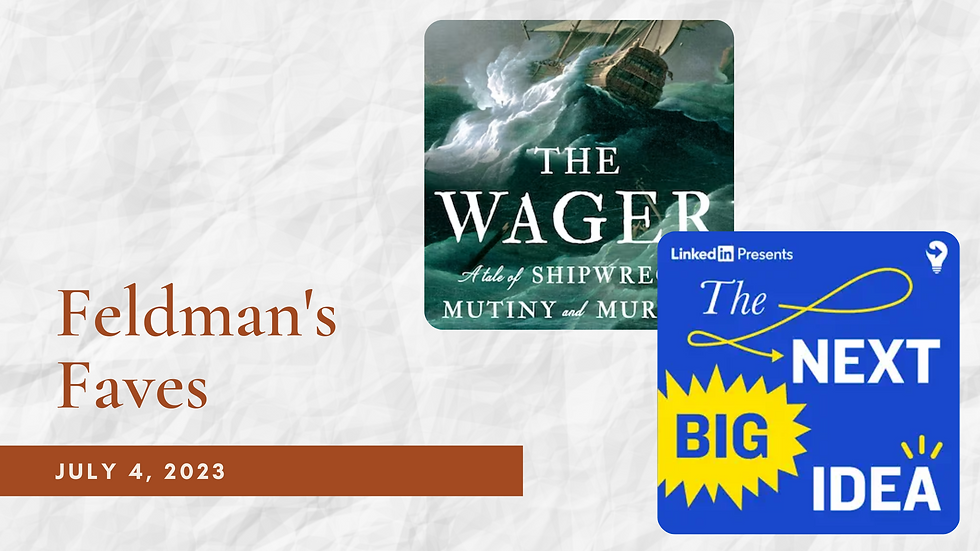
This week’s theme focuses on David Grann’s eagerly anticipated new book, The Wager.
THE WAGER: A Tale of Shipwreck, Mutiny and Murder By: David Grann – David Grann is one of the best storytellers of our time. The Wager, tells the story of a shipwrecked British naval crew and how civil society deteriorated into a Hobbesian state of nature like existence. The fundamental question Grann asks is if it is a crime to do whatever it takes to stay alive. The crew of the HMS Wager certainly tested the limits of this question. As one reviewer notes, “Step from an airplane, and it’s now ritual to boast how cruelly you’ve suffered. Seats that won’t lean back or seat backs that intrude. Violent seatmates. Starvation from tiny bags of pretzels. Crying infants. Lost luggage. The indignities pile up. Yet we forget that for almost the entirety of human existence, simply to leave the safety of hut or castle was to risk not inconvenience but violent death. “Travel,” after all, comes from the word “travail,” and nowhere was that truer than when humans crossed oceans on wooden ships. It is almost impossible for the contemporary mind to fathom the conditions and the peril. Passages that took months — years, often — in leaking, wet, unheated vessels packed with unwashed people that sailed blindly into gales and hurricanes, with no privacy, no weather satellites or GPS, no fresh food, and no Gore-Tex, surviving on bug-infested dried meat and bread. And that’s if all went well. When things went wrong, they often went very wrong, and David Grann’s “The Wager: A Tale of Shipwreck, Mutiny and Murder” is a sea story in which everything goes wrong over and over — and over — again. Reading it is like living one of those anxiety nightmares in which you’re just trying to get to that job interview, but you’re lost and your teeth are falling out and, wait, when your car dies you realize you’re naked, and then you’re attacked by flesh-eating zombies. The nightmare began in 1740 as HMS Wager set out from England among a flotilla of seven British warships carrying 2,000 men on a voyage across the Atlantic, around Cape Horn and into the Pacific, there to intercept and take as prize a Spanish galleon, a floating treasure chest filled with South American silver, gold and precious gems. At best the voyage would take several years. Before the squadron even got across the Atlantic Ocean, though, typhus hit. “Officers and surgeons roamed the decks, sniffing out potential culprits: foul bilge, moldy sails, rancid meat, human sweat, rotten timber, dead rats, piss and excrement, unwashed livestock, dirty breath,” Grann writes. “The fetidness had unleased a plague of bugs — one so biblical that it was unsafe … ‘for a man to open his mouth for fear of having them fly down his throat.’” Soon, 160 were dead. Trying to round the Horn, the Wager ran into a series of storms, relentless onslaughts of gale-force winds, waves and rain in frigid temperatures that damaged ships and wearied men. In the midst of these tempests, seven months after leaving England, scurvy swept through the fleet. Teeth fell out. Skin turned black. Bones snapped. Of the flagship Centurion’s crew of 500, 300 died. Of the Gloucester’s 400, three-quarters succumbed. The Severn lost 290. Of the Wager’s original 250, fewer than 200 were left, “and those who were alive were nearly indistinguishable from the dead,” as Grann puts it. “The once mighty squadron resembled ghost ships, where, according to one account, only vermin thrived. … They infested sleeping quarters, ran across meal tables, and disfigured the dead, which lay about the deck awaiting burial. On one corpse the eyes were eaten out, on another the cheeks.”
This catalogue of horrors was merely prologue. Separated in the storm from the rest of the flotilla, the Wager rounded Cape Horn at last but caught on a lee shore in another gale as its captain tumbled through a hatch, an accident that left a fractured bone protruding from his armpit. The ship ran aground, breaking up and stranding its crew on an uninhabited island off the coast of Patagonia. This was no Eden of white sand and balmy lagoons teeming with fruit and protein, but its existential opposite: wind, rain, fog, near-freezing temperatures, tangles of bent and twisted trees, and almost nothing to harvest or hunt, save the occasional bird or limpet. At least the celery grass they scrounged abated their scurvy. Hobbesian nightmare ensued, the 145 remaining men starving, freezing, unhoused and barely clothed. Thefts. Fights. Hoarding. Captain David Cheap, long dreaming of command and promoted at last to his position during the voyage, descended into rigid authoritarianism and violence. The gunner, John Bulkeley, a natural leader, rose as Cheap tumbled. There was more death — a lot of it — accompanied by vicious punishments with the cat-o-nine tails, betrayal, mutiny, remarkable voyages of escape in makeshift craft. Years passed as the last few dozen men alive fought their way back to England, only to find themselves called to court-martial. Ships, especially warships, were microcosms of society at large, filled with young boys and teenagers and old men, the uneducated and the highborn, all speaking a particular language. But those men were also privy to an exotic outside world experienced by few others at a time when there were no photos, no phones or even telegraphs, and most people on the planet never traveled farther than a few miles from home. In few other situations were large groups of human beings placed in such dire conditions against such powerful forces, in isolation, often for years at a time, and nowhere else does the human animal become so revealed. Depravity and violence and hubris and cowardice, yes, but also unimaginable ingenuity and brotherhood and glorious, steely, human will. These are the factors that have ensured that tales of men and ships — they were nearly always men — have such a storied literary history, the real-life grist for such authors as Defoe and Melville, C.S. Forester, Arthur Ransome, and Patrick O’Brian. “Mutiny on the Bounty,” after all, was a true story.
The writer Arnost Lustig, who survived Auschwitz and Buchenwald as a teenager, once said he learned in his time there that people would do anything to survive. He said it without judgment, as does Grann, who’s largely silent about his characters’ moral choices as they play out in front of us. “The Wager” is unadorned, almost pure, horror-filled plot, without the usual Grannian first-person moments, a tightly written, relentless, blow-by-blow account that is hard to put down, even as there are sometimes frustrating narrative gaps, a result of the limits of nonfiction grappling with 280-year-old events. For all the hours we spend with Cheap, Bulkeley and the others, they remain inaccessibly distant. That’s especially evident at the end. After the court-martial of the Wager’s survivors — its surprising outcome a revealing moral deflection by the British Admiralty — the men by and large vanish from the public record, and thus from the story, though Cheap had one last hurrah. What were the traumatic long-term effects of such a harrowing ordeal on mind and body? On that, we are left to wonder.” The next time I am forced to sit in a middle seat on the plane or have to stand in the subway I will try to remember that it could be worse – much worse….. Here is a good review from the Guardian - https://www.theguardian.com/books/2023/apr/29/the-wager-review-david-grann-shipwreck-epic
The Next Big Idea – The Wager: David Grann Tells a Tale of Shipwreck and Mutiny – For those of you interested in the book but not actually reading it, this interview with David Grann summarizes the story quite well. Here is an excerpt from the PODCAST itself, “David Grann is a staff writer at The New Yorker and the acclaimed author of "The Lost City of Z" and "Killers of the Flower Moon." In his new book, the #1 New York Times bestseller "The Wager: A Tale of Shipwreck, Mutiny, and Murder," he tells the story of an 18th-century British warship that crashed on a godforsaken island off the coast of Patagonia. Stranded and starving, the men descended into murderous anarchy. Years later, when a handful of the survivors returned to England, their heroes' welcome was quickly swamped by questions about what really happened on the island.” https://podcasts.apple.com/ca/podcast/the-next-big-idea/id1482067226?i=1000616122033
Thank you for your ongoing engagement and participation.
And remember to stay safe, stay healthy and to docket daily.
Jon



Comments