
Feldman's Faves: March 3,2025
- Jon Feldman
- Mar 3, 2025
- 5 min read
GOOD MORNING EVERYONE
OSCAR NIGHT was magical. Conan killed as one would expect and Anora cleaned house. If you haven’t seen the film, it is one worth seeing.
On the theme of acting, this whole Gene Hackman story is just nuts. For me (like many others) Gene Hackman was one of the all-time greats. Of course he is famous for French Connection but for me my two favourite movies of all time are his - Mississippi Burning and Hosiers. I hope he is remembered for how he lived and not how he died.
I hope you can all make our Bagel Breakfast today starting at 9:15.
Finally, please join me in wishing Melanie a belated happy birthday (from Saturday).
No theme this week – just topics of interest.
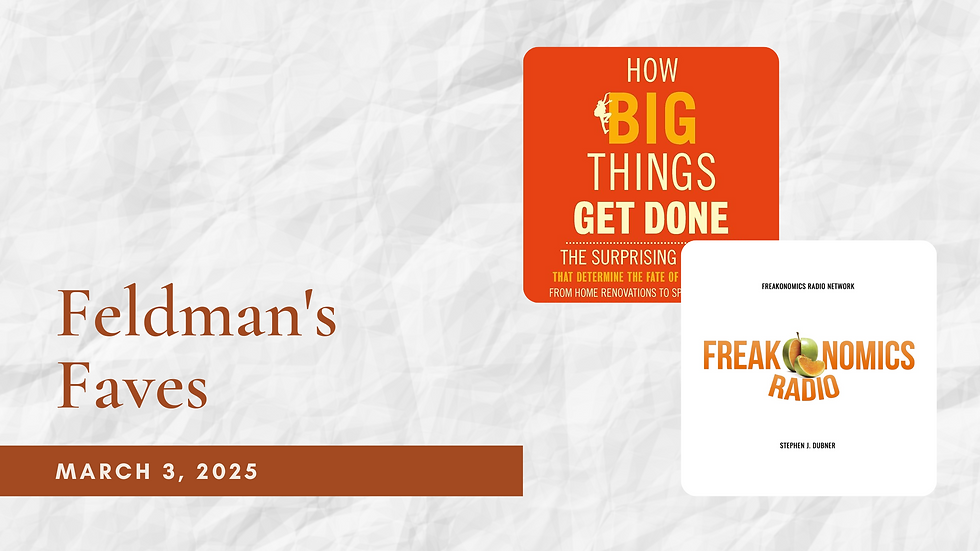
HOW BIG THINGS GET DONE By: Bent Flyvbjerg and Dan Gardner– If anyone has driven on Eglinton Avenue, the Gardiner or anywhere downtown over the last decade you would probably want to pull out any hair you have left on your (yes I have been driving a lot….). The fact that all these mega projects, and particularly the LRT on Eglinton are years delayed and billions over budget seems to be understood as just being ar for the course when it comes to the execution of mega projects. This also applies to self-considered mega-projects such as the ongoing and never ending renovations that take place in my house (one would think that I was living in Buckingham Palace or Versailles). So when I learned about the book How Big Things Get Done, I thought maybe there is a blue print or at least some guidance in terms of how to do things right. And there are many examples of this (e.g., the Empire State Building being constructed under budget and prior to the deadline). So while we know it CAN be done, most times is ISN’T done. So I wanted to gain insights into the how, which this book describes in very clear detail with a whole bunch of helpful examples. There is a lot of focus on thinking slow and acting fast – plan as best you can and minimize execution time – because that’s when bad things happen according to the authors and most of our lives’ experiences. The key takeaway they say, is to break large projects into smaller pieces that are modular – in other words, take the LEGO approach. I think this makes sense to a degree. Whether it is the panacea that the authors conclude is in my mind unclear. As one reviewer notes, “I finished this book a couple of weeks ago, but didn’t get around to putting down my thoughts on it till today. This book by Bent Flyvbjerg and Dan Gardner is an interesting, thoughtful, and data-driven narrative. It focuses on why large projects are invariably late and over budget, and what could be done to mitigate these risks. This book is especially relevant to me. I have spent over 20 years in the tech industry and have been closely involved with many large and small projects that could have used this book. The key ideas the authors focus on are - high clarity of the desired outcomes, detailed planning, deep expertise, prior experience, and, a flexible execution approach to adapt to unforeseen challenges. A very high degree of common sense right? What makes the book impressive are the real-life examples that showcase the importance of these principles. The authors start the book with describing their analysis of the data on mega projects for over a century. This gives them a sufficiently large data set to derive meaningful inferences. The data-driven theme continues throughout the book, giving their analysis and recommendations more credibility. The book also made me refer to my own experiences in these - e.g. A particular case where we had to scrap a software platform build project after 18 months of work, because the initial choice of tech stack did not factor in the scalability requirements. Many readers should be able to do the same.
The book talks about - ‘Thinking from Right to Left’ - which is a powerful tool about visualizing the desired outcomes. This includes developing a deep and clear understanding of the problem that needs to be solved, and the impact the proposed project will have. This is crucial in evaluating multiple options and choosing the most optimal one. The story on Pixar reminded me of the one from a Podcast on Steve Jobs - what Jobs learnt about animation from Walt Disney. The idea is - do the editing before you actually do the animation, since animation is prohibitively expensive. Reworking animation is a sure shot way to overshoot your budgets. The same is applicable to business requirements and prototypes for a large software application, as it is for a massive public transportation project. The book also effectively highlights the importance of expertise and prior experience. Large projects have high levels of complexity. Deep expertise, including technical and managerial skills, is a must. Prior experience in similar work helps in quickly identifying what will definitely not work, which is invaluable during the planning stage. The book covers projects across a wide range of domains. This is helpful because it allows us to see that the fundamental principles are mostly industry agnostic. These principles for success have more to do with human nature and the structure of our political and economic systems. Autocratic systems fare worse on an average because they stifle constructive conflict in the planning stages. In more democratic environments, we see unbridled optimism on timelines and budgets, which is usually to bypass initial objections on the cost of these projects. Overall, the book is well written and is an interesting read. It gives a good view of poor success rates of mega projects. The examples are relevant and insightful. The authors’ domain expertise keeps the narrative focused and their suggestions are practical. It's definitely a strong recommendation for business books to read.” I am hopeful that my renovations will be done long before the LRT is operational, but we will see. Here’s a good review from The Financial Times - https://ig.ft.com/sites/business-book-award/books/2023/shortlist/how-big-things-get-done-by-bent-flyvbjerg-and-dan-gardner/
Freakonomics Radio - Is Ozempic as Magical as It Sounds? – In the battle over Greenland the Danish Government has threatened to stop shipping Ozempic to the USA. Talk about a powerful tool in a potential trade war….. .. Who among us has not come across someone who’s life has been changed in immeasurable ways after having been prescribed Ozempic, Mounjaro or Wegovy. Obviously, it is very early days but these drugs may really end up being a wonder drug. Dr. Peter Attia often talks of the four horsemen of disease that are so dangerously prevalent in our society – cancer, heart disease, diabetes and degenerative brain diseases. Some, but not all of these diseases are impacted in large part by the obesity epidemic so prevalent in Western society and beyond. Beyond treating diabetes and weight loss, scientists are now considering other ways these medications might be effective (e.g., treating addiction and other mental health issues). This discussion with Ezekiel Emmanuel (brother of Ari and Rahm) opens a world of possibility that is simply incredible. And if nothing else, who doesn’t love the OZEMPIC song in the commercials….. Here’s an excerpt from the PODCAST itself, “In a wide-ranging conversation with Ezekiel Emanuel, the policymaking physician and medical gadfly, we discuss the massive effects of GLP-1 drugs like Ozempic, Wegovy, and Mounjaro. We also talk about the state of cancer care, mysteries in the gut microbiome, flaws in the U.S. healthcare system — and what a second Trump term means for healthcare policy.” https://podcasts.apple.com/ca/podcast/freakonomics-radio/id354668519?i=1000680067571
Thank you for your ongoing engagement and participation.And remember to stay safe, stay healthy and to docket daily.
Jon


Comments