
Feldman's Faves: March 4, 2024
- Jon Feldman
- Mar 4, 2024
- 12 min read
GOOD MORNING EVERYONE
Caitlin Clark is now the ALL TIME LEADER in NCAA basketball scoring having surpassed Pistol Pete Maravich’s 54 year record. Clark is now, without question, the GOAT.
After months of eager anticipation, I finally tried Porzia’s famous lasagna. It was really hyped on Instagram, Tik Tok and beyond and I was preparing myself for disappointment but boy is it yummy. Five stars from me. I strongly suggest you give it a try but then factor in the time you will need to sleep during your food coma.
On the other side of the spectrum, I would like to shamelessly promote an event that is amazing. On June 2, 2024 Baycrest is once again putting on the Bike for Brain Health where we close down the DVP for the morning and let people ride their bikes on this highway. It is a truly epic experience. Michel is putting together a Goodmans team so please sign up, raise lots of money and enjoy the ride. Here is the link to the ride to the extent you are interested in learning more - https://bikeforbrainhealth.ca/
For those of you with young children starting March Break next week I wanted to take this opportunity to wish you all good luck and God speed….Note that I will be giving you a “March Break” from this weekly email next week, so you enjoy that holiday as well!
No theme this week – just topics of interest.
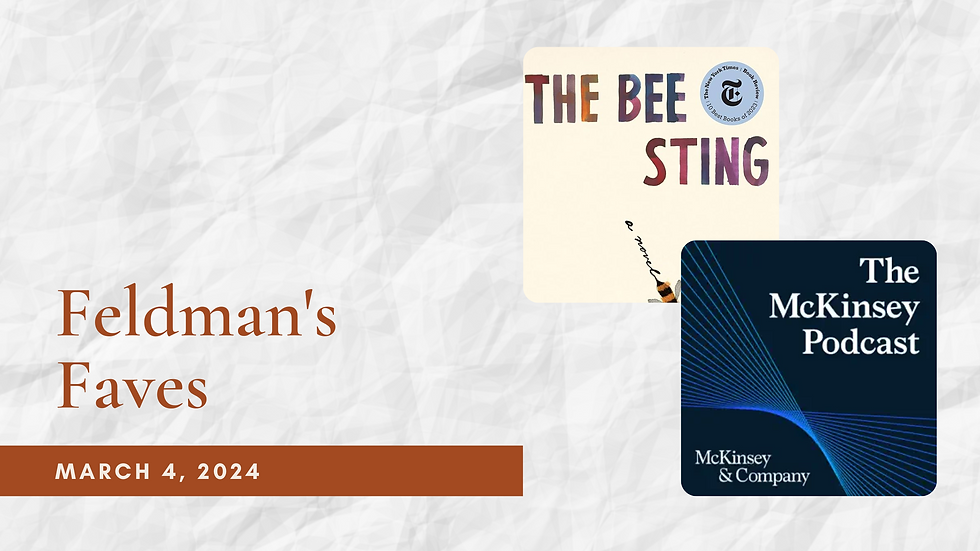
THE BEE STING By: Paul Murray – I have now read all of the books that were nominated last year for the Booker Prize and I can say unequivocally that Paul Murray’s 600 page plus tomb, The Bee Sting, is without doubt my favourite. Irish writers are definitely having a moment. In fact this book is one of the best I have read in many years. Murray uses a literary device that we often see, telling the same story from the perspective of each of the book’s main characters, but he does it in a way that shows absolute mastery of this device. The key takeaway at least for me from this book is really that you never really know what is going on in people’s lives and in their minds unless you take the time to find out. And when you do, you learn that everything is way more complicated and interesting than you what you get from only surface level knowledge. The stories all come together at the end but the ending itself is intentionally vague and the reader really never knows how the story ends. As one reviewer notes, “In The Bee Sting, the fourth novel by the Irish author Paul Murray, twelve-year-old PJ Barnes ponders the downsides of resurrection. He recently saw “Pet Cemetery,” Stephen King’s horror film about a graveyard that disgorges its occupants and sends them back into the world. “When things come back,” PJ observes, “very often they come back different.” The rule applies to his own father, Dickie Barnes, who has been working long hours on a building project in the woods; business at his auto dealership hasn’t been the same since the 2008 market crash. Dickie returns to the house periodically, but he’s almost unrecognizable, snappish one moment and catatonic the next. A friendly conversation with a local garda leaves him “death-white,” his eyes “wide as plates,” and emitting a noise like “a horrible croaking, or a reverse-croaking,” as if “he’s trying to suck in breath but he can’t.” The novel is about things coming back different, coming back weird. Its more than six hundred pages explore the eeriness of transformative change, and they are packed with literal and symbolic deaths. The first lines dispatch a handful of incidental characters: “In the next town over, a man had killed his family . . . When he had finished he turned the gun on himself.” Murray handles his protagonists with comparable ruthlessness, introducing them only to rip their identities and projected futures out from under them. The book employs a rotating structure: the four members of the Barnes family—PJ and his dad are joined by PJ’s mother, Imelda, and his sister Cass—take turns as narrator. Some of their metamorphoses are comic (the “clammy illicit flowerings” of puberty) and some are tragic (the downward slope of adult life) but what binds them together is a neck-prickling sense of defamiliarization. As with his celebrated second novel, “Skippy Dies,” Murray intertwines registers from the lyre-strumming to the fart-ripping. In “Skippy,” Murray recounts a semester at a boy’s boarding school in Dublin from a round of perspectives. At one point, a group of fourteen-year-olds try to communicate with their departed friend. “And even though it didn’t work,” one of them reflects, “it did sort of work . . . because each of us has his own little jigsaw piece of him he remembers, and when you fit them all together, and you make the whole picture, then it’s like he comes to life.” The line rhymes with “The Bee Sting” ’s theme of uncanny returns. It also foreshadows the new book’s use of revolving viewpoints to reconstruct the past. Although Murray’s swiveling P.O.V. framework evokes family novels by Jonathan Franzen and Maile Meloy, the best comparison may be to William Faulkner, whose experimental language helped differentiate between the voices of the Compson siblings in “The Sound and the Fury,” and who also had a heightened sense of the eeriness of transformative change. Murray shows off his formidable range, immersing us in worlds so distinct and textured that they seem to blot one another out—subjectivity and how its wonderful thickness can lead people astray being one of this author’s preoccupations. Early chapters are propelled by a sustained sense of revelation. As the details pile up, irony, both caustic and elegiac, flourishes in the knowledge gaps between characters. The contrapuntal format allows Murray to dramatize misunderstandings among the Barneses. Again and again, details “come back different,” reframed or reanimated by another perspective, and their repetition adds to the sense of spookiness, as if the book itself were haunted.
Murray hands over the first section to Cass, a bookish, age-appropriately surly teen-ager in her last year of secondary school. Cass is a daddy’s girl who doesn’t know how to forgive evidence of his imperfections. She hates her mother, a local beauty, whom she sees as shallow and petty, as fiercely as she loves her mercurial friend Elaine—“golden hair, green eyes, a perfect figure.” “Even when she was clipping her toenails,” Cass thinks, “she looked like she was eating a peach.” Despite her terminal case of adolescence, Cass is presented neither as a generic teen nor as a source of comic relief. Rather, the book honors her intelligence, her reserves of poetic feeling. The infatuation with Elaine evolves into something more serious and forbidden, “like a moon,” Murray writes, “hidden in the brightness of the daytime sky, whose private gravity she could feel pulling her away from the earth.” PJ is tender, with ungrounded fears of being sent away to boarding school; when the Barnes’s car dealership starts to fail, he bloodies his feet in too-small sneakers rather than admit to his parents that he needs a new pair. This turns out to be one of the less consequential secrets that he is keeping from his family. He also hasn’t volunteered that a schoolmate has threatened to live-stream beating him with a hammer unless PJ can come up with a hundred and sixty-three euros. (The schoolmate believes that the high-and-mighty Barneses cheated his mother at their garage.) Likewise, PJ hasn’t mentioned his heartfelt correspondence with Ethan, a kid he met in an online-gaming forum. Ethan thinks PJ should come visit him in Dublin, where he has a puppy and a spare room with a skylight and lives close to the zoo. PJ is seriously tempted.
It’s hard to resist Murray in his schoolyard mode, wittily choreographing nerds and bullies. As in “Skippy Dies,” he catches the electrifying friendships, confusing mating rituals, and righteous disgust at adult hypocrisy that mark one’s teen-age years. An early pleasure of “The Bee Sting” is its attention to such phenomena of adolescent and preadolescent life as the ominously meandering lecture: “Dad liked to bring you on a little journey first, up over the hills and mountains,” Cass thinks, “ . . . you just had to follow the path he had laid out, his voice calm and even, your guilt crushing down on your shoulders, until turning a corner you would find yourself at the summit, your crime lying spread out in a panorama before you, and you and he would gaze down on it together.” To a kid, a parent’s vantage can be indistinguishable from God’s.
But when the perspectival carrousel brings around Imelda and then Dickie, “The Bee Sting” becomes a richer and deeper project. The adult chapters are less cute; they are thornier, more treacherous, and formally more ambitious, using stream of consciousness to invoke the shattering power of grief and lust. In Cass’s section, Imelda comes off as inane and superficial: “To spend time with her mother was to get a running commentary on the contents of her mind—an incessant barrage of thoughts and sub-thoughts and random observations.” Imelda’s chapter recuperates not just the woman, who is revealed to be one of the book’s most interesting characters, but also her way of speaking, which, contrary to what Cass thinks, is percussive, galloping, entranced, and furious, like that of a modernist Guinevere. (“She smiles her brightest smile over and over a lighthouse blinking into the indifferent ocean Wondering are they ever going to sit down when who slouches up to her except Big Mike Comerford Well says he Well Mike she says back as politely as she can.”) Imelda’s passages flicker with accents from Irish lore: spectral black dogs, fortunes gathered from the bottom of a teacup. Her life itself feels wand-struck, alternately charmed and cursed. She grew up in poverty. Her father was a gangster, a bruiser, and a drunk; she learned to sew by stitching up her brothers after he’d beaten them. Yet she also possesses an almost supernatural beauty, a protective glamor that appears to cancel out her violent family and her “accent that could strip paint.” Early in the book, we learn that Imelda is notorious for having refused to take off her veil during her wedding—the reason, it is said, being that she was stung on her face by a bee on the way to the ceremony. Cass takes the tale as evidence of her mother’s vanity, but Murray shows the real story of the wedding to be much stranger and sadder: as a teen-ager, Imelda fell in love with Frank Barnes, the handsome star of the football team and the son of the town’s wealthiest man. They got engaged, but then her prince died in a car accident; Imelda, increasingly unmoored, agreed to marry his brother Dickie, believing that Frank’s ghost would appear to her on her wedding day. As the book goes on, Imelda and Dickie’s nuptials emerge as a landmark event. The townspeople have their own nostalgic or dismayed memories of what takes place, but Imelda’s account has a particular Gothic power. Throughout the ceremony and toasts, she waits for a flash from the back of the room: “Fleeting white faceless Drawing closer Coming straight towards her through the dark.” But the apparition, when it arrives—“A shimmering bright haze As it rose from the guests At last she thought”—is only her veiled reflection in the mirror. Imelda understands, then, that she is the ghost: “a leftover from another life A remnant of something that was no more.” Imelda is not the only leftover in her own life. In Dickie’s section, which trades operatic drama for cerebral self-consciousness, Murray extends the theme still further. Dickie, a student at Trinity College, wanders into a club debate, where he’s bewitched by the quicksilver sophistry of one of his peers, Willie, who is openly gay. Dickie hadn’t even known the truth about his own sexuality. For a time, the book swerves into the sexual-awakenings-on-campus genre:
“The two men stopped there, and looked at one another. And in that moment Dickie learned something. This thing about looking into someone’s eyes. If you’re talking about making a connection, the term is quite misleading. He looked into people’s eyes all the time. What’s really happening in these moments is that you find yourself looking at their eyes—that is, the gaze stops at the eye itself, arrested by the beauty of it; and their gaze does the same at yours; and the two gazes and your souls behind them skate off each other, swirl over each other, like mercury on mercury, so that standing quite still you feel yourself spin out of control . . .”
But Frank’s death yanks Dickie back to his parochial small town, where the guilt of outliving his brother ignites an internalized homophobia. The tragedy, he decides, is his fault, the bill come due for his “sordid pursuits” in Dublin. His is “a very specific, very pernicious kind of evil,” he thinks, “because it unwound, undid, the natural things it touched”—like Frank, “with his sports and his cars, his beautiful girlfriend with her sequined dress.” As penance, Dickie understands, he must take Frank’s place: “he would be the Frank that Frank himself was not.” He must banish his desires, marry Imelda, and run the family garage that neither brother wanted to inherit. From there, Murray deftly portrays the inexorability of a certain kind of conventional life; take one step forward and the rest is like sliding down a slide. “It wasn’t like college,” Dickie thinks, freshly reborn as a local business owner and family man, “when every moment bristled with pathways, alternatives, strangers and confusion. Everything was linear, everything made sense, the future appeared before him like a railway track . . . carrying him onwards without his needing to do a thing.” Dickie resignedly becomes Frank’s ghost. But he also becomes his own ghost: a wispy, unreal version of himself. Decades after he leaves Trinity, the gaze of a dark-haired man pins the real him to the floor, while his body proceeds on autopilot: “It [the stare] held him there . . . so when he turned to go he had not really gone, just the outward appearance of him. His outward appearance, utterly weightless, walking away, merely an illusion.” What unites Imelda and Dickie is not mutual passion but a wraithlike insubstantiality. She belongs to a person who died and a dream that ended. He is a country dad haunting a gay bar in the city: “a sorrowful creature of endless need.” Both feel themselves to be the least real thing about their lives, as if they’ve come back from the cemetery wrong and changed. As Dickie’s financial troubles worsen, he senses a barrier rising between his tired body and the vitality of his surroundings. He wonders if he’s been given a foretaste of what dying is like: “the world remains around you, like a lover who does not want to hurt you by leaving, but in spirit it’s already gone.”
Here, Murray plays with the trope of the ghost story, turning it upside down to bring into focus not only the experience of the haunted but of those doing the haunting. Early in Imelda’s section, she recalls a tale she heard as a child, about a traveler who spends the night in a fairy hall, surrounded by unearthly pleasures. When he wakes up in the morning, one hundred years have passed, and all the people he loves are dead. The legend is almost a parable of the perspectival shifts that come with aging: a kind of transition from encountering eeriness to embodying it. Murray achieves this effect structurally by beginning with the younger Barneses—Cass and PJ—who find the world intoxicating, frightening, and confusing, and then turning to the older Barneses, who dwell so much in their memories that they’ve become the strange ones, discordant with their time. Indeed, the book’s stakes are not just whether Imelda and Dickie will continue to drift absently through their lives; they are also whether Imelda and Dickie will visit their unresolved pasts upon their children. What if Cass mirrors her father, never realizing her same-sex love? What if PJ, like his mom, gets sucked into a relationship with someone who isn’t at all what he seems?
Although there is hope in “The Bee Sting,” it is slender. Pregnant with Cass, Imelda feels neither shadowy nor incomplete but fully present in her new, rounded body, as if she were at once herself and her developing child. The implication is that she has died and come back from the dead, but in a good way—she has been reborn. But for the most part Murray is interested in denial and how it ultimately fails to contain our unruly attachments and weird desperation. Dickie denies his sexuality; Imelda denies Frank’s death and her own grief. Both struggle to conceal their deceptions beneath a conventional surface, which the novel patiently and pitilessly erodes. The catastrophic price of such denial is evident in Murray’s frequent allusions to the climate crisis. At one point, PJ notices that everyone in town is pretending to enjoy a terrifying heat wave: “ ‘Isn’t it great?’ they tell each other, the butcher, the barber, standing around outside their shops in the shimmering air, but under their arms dark patches appear, and silver sprinkles of moisture break out over their scalps, and you can tell that inside they’re feeling thirsty and tired and mean.” As the book continues, the Earth’s climate and the apocalyptic climate of the Barnes family appear almost to merge, as what began as a coming-of-age saga pulls in stranger and darker forces, twisting into a tornado strong enough to rip away the thickest veil. “ As the reviewer notes, if you have ever read the book The Corrections by Jonathan Franzen, this book will ring somewhat familiar in terms of size, scope and issues covered. But I think it is even better and more thought provoking – perspective is so very important as this amazing novel teaches us. I am assuming this book will be a movie someday. Maybe we can put our nickels together and hire David Z to help us secure the rights. Here’s a good summary and discussion from the Booker Prize Panel - https://thebookerprizes.com/the-booker-library/features/reading-guide-the-bee-sting-by-paul-murray
The McKinsey Podcast - Busting myths about women in the workplace – At Goodmans we have been focusing on sponsorship as an important way to ensure that people are put in a position to succeed at the firm. While I am proud of the work we are doing here I appreciate we have much more work to do before we can start patting ourselves on the back. That said, McKinsey experts share our view and our approach and suggest ways that companies can take steps to open doors and paths for women to be successful in the workplace. Here’s an excerpt from the PODCAST itself. “Myths abound when it comes to women in the workplace. McKinsey senior partners Alexis Krivkovich and Lareina Yee debunk four of them in a conversation with global editorial director Lucia Rahilly as they discuss McKinsey's latest Women in the Workplace report”: https://podcasts.apple.com/ca/podcast/the-mckinsey-podcast/id285260960?i=1000642866401
Thank you for your ongoing engagement and participation.And remember to stay safe, stay healthy and to docket daily.
Jon



Comments