
Feldman's Faves: May 12, 2025
- Jon Feldman
- May 12, 2025
- 5 min read
GOOD MORNING EVERYONE
First and foremost, I want to welcome our summer students – Amanda and Lowell. Please make sure you introduce yourselves to them and involve them in your files (once they have learned to turn on their computers).
I also want to once again thank all of you for your incredibly hard work. I know many of you are super busy these days, which in addition to being appreciated is just mind boggling given the state of the world. Hang in there everyone, and if you need help staffing your files please do not be shy to ask.
Along those lines, I want to remind you of our CLE taking place on Wednesday at lunch entitled, “Taking Control of Your Brain Wellness: Strategies for the Busy Professional”. This is one worth attending – now more than ever.
Finally, I know that its not reasonable for me to expect the LEAFS to win every game in every playoff series but I don’t care. I hate the losses more than I love the wins. We are now down to a three game series. So all I can say is, GO LEAFS, GO!
No theme this week – just topics of interest.
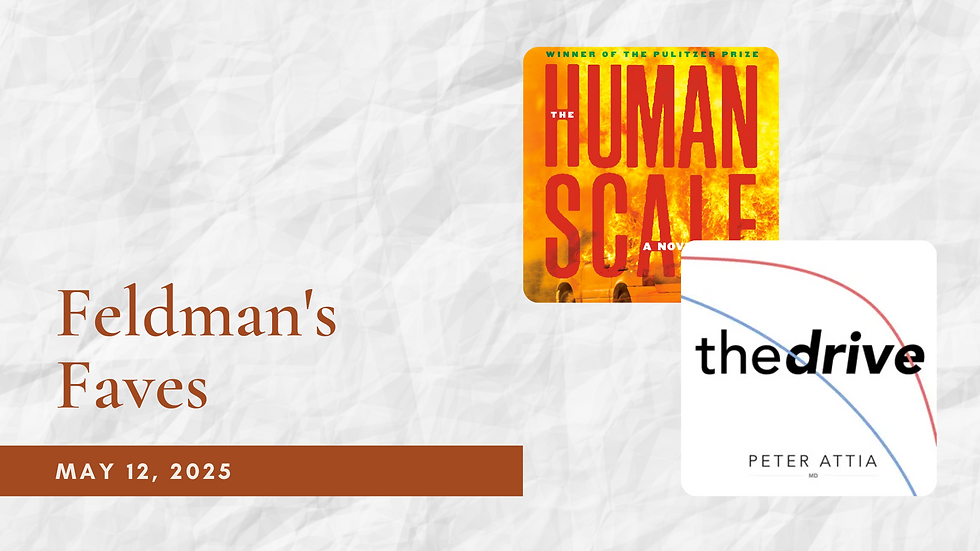
THE HUMAN SCALE By: Lawrence Wright – I wasn’t sure about this one. The Human Scale is Pulitzer Prize winning author Lawrence Wright’s latest book and it is the first novel (very recent historical fiction) that I know of that addresses the time around October 7th – so I wasn’t really sure how it would go. I will say that it is fiction but fiction that feels very real. Wright does a good job of explaining the history of the conflict in the Middle East in a somewhat balanced manner but that I think would make most people who read this book uncomfortable. It is not an easy read even though it is disguised as a police caper and political thriller, which is certainly the driver of the plot of this novel. As one reviewer notes, “In Wright’s latest topical novel, the murder of an Israeli police chief in a West Bank settlement inflames tensions, ultimately leading to the October 7 massacre. When FBI agent Tony Malik, whose father is Palestinian, travels to the historic city of Hebron to attend a cousin’s wedding, he’s still recovering from a bomb explosion that left him with erratic memory loss. His sense of disorientation deepens when, drawn into the investigation of the chief’s murder—after having been falsely named a suspect—he encounters extreme forms of violence, hatred, and inhumanity on both sides of the conflict. Teamed with hardline Israeli cop Yossi Ben-Gal, he soon recognizes that anyone could have killed the police chief, whose pacifist leanings may have cost him his life. Asked whether he’s worried about dangerous activities in Gaza, Yossi dismisses them as “some virus that pops up every few years, sometimes deadly, sometimes you hardly notice, like the difference between a cold and the flu.” No one, including Malik, is safe in this hostile environment, where religious leaders financed by drug money call for the destruction of the enemy and a “human scale” determines the value of a life, as in one abducted Israeli being worth 1,000 Palestinian prisoners. Lacking the deep literary expression of a Robert Stone, Wright falls short of capturing “the implacable darkness of human nature” (though he comes close in having the slain chief’s missing head become a pawn in a deadly game), and he frequently slips into didacticism. But the book, based on the author’s years of reporting in the region, is fully believable—and full of suspense. “What nobody outside understands is the real enemy is not each other,” says one of many ill-fated characters. “It is peace we hate.” A timely and gripping novel that works best as a political thriller.” I won’t make a recommendation here but I will acknowledge that it is hard to put down. Here’s a review from the NYT - https://www.nytimes.com/2025/03/11/books/review/lawrence-wright-human-scale.htmlL
The Peter Attia Drive - Overcoming insomnia: improving sleep hygiene and treating disordered sleep with cognitive behavioral therapy for insomnia | Ashley Mason, Ph.D. – I have gotten over myself and my old mantra that “I will sleep when I am dead”. The more I learn about the importance of sleep and the importance of sleep hygiene (e.g., get up the same time every day, don’t drink caffeine or alcohol too close to bed time, etc) the more I am doing my best to prioritize sleep. I know it is hard to do in our line of work, but as Dr. Attia describes in this PODCAST it is absolutely essential to lifespan and healthspan. Here’s an excerpt from the PODCAST itself, “Ashley Mason is a clinical psychologist and an associate professor at UCSF, where she leads the Sleep, Eating, and Affect (SEA) Laboratory. In this episode, Ashley provides a masterclass on cognitive behavioral therapy for insomnia (CBT-I), detailing techniques like time in bed restriction, stimulus control, and cognitive restructuring to improve sleep. She explains how to manage racing thoughts and anxiety, optimize sleep environments, and use practical tools like sleep diaries to track progress. She also offers detailed guidance on sleep hygiene; explores the impact of temperature regulation, blue light exposure, and bedtime routines; and offers guidance on finding a CBT-I therapist, along with sharing practical steps you can take on your own before seeking professional help. We discuss: Defining insomnia: diagnosis, prevalence, and misconceptions [3:00]; How insomnia develops, and breaking the cycle with cognitive behavioral therapy for insomnia (CBT-I) [7:45]; The different types of insomnia, and the impact of anxiety, hydration, temperature, and more on sleep [11:45]; The core principles of cognitive behavioral therapy (CBT) and how CBT-I is used to treat insomnia [20:00]; Implementing CBT-I: time in bed restriction, sleep scheduling, and the effect of napping [29:45]; Navigating family and partner sleep schedules, falling asleep on the couch, sleep chronotypes, and more [39:45]; Key aspects of sleep hygiene: temperature, light exposure, and circadian rhythm disruptions [44:45]; Blue light and mental stimulation before bed, and the utility of A-B testing sleep habits [52:45]; Other simple interventions that may improve sleep [57:30]; Ashley’s view on relaxation techniques and mindfulness-based practices [1:02:30]; The effectiveness of CBT-I, the role of sleep trackers, and best practices for managing nighttime awakenings [1:04:15]; Guidance on intake of food and alcohol for good sleep [1:16:30]; Reframing thoughts and nighttime anxiety to reduce sleep disruptions [1:18:45]; Ashley’s take on sleep supplements like melatonin [1:21:45]; How to safely taper off sleep medications like benzos and Ambien [1:26:00]; Sleep problems that need to be addressed before CBT-I can be implemented [1:38:30]; The importance of prioritizing a consistent wake-up time over a fixed bedtime for better sleep regulation [1:40:15]; Process S and Process C: the science of sleep pressure and circadian rhythms [1:45:15]; How exercise too close to bedtime may impact sleep [1:47:45]; The structure and variability of CBT-I, Ashley’s approach, and tips for finding a therapist [1:50:30]; The effect of sauna and cold plunge before bed on sleep quality [1:56:00]; Key takeaways on CBT-I, and why no one should have to suffer from insomnia [1:58:15]; and More.” https://podcasts.apple.com/ca/podcast/the-peter-attia-drive/id1400828889?i=1000700542507
Thank you for your ongoing engagement and participation.
And remember to stay safe, stay healthy and to docket daily.
Jon


Comments