
Feldman's Faves: May 15, 2023
- Jon Feldman
- May 15, 2023
- 5 min read
GOOD MORNING EVERYONE
I am writing you from Scottsdale, Arizona (for a family wedding), where it reached over 40 degrees this weekend. I can assure you that this “at least it’s a dry heat” statement is complete BS when you are sitting outside in the sun wearing a suit an tie….. You could cook eggs on the sidewalk here at 8 am.
Wishing all of you who celebrated Mother’s Day all the very best.
This is what happens when a city has a “parade” for a team coming out of the first round…By the way, Friday was also the four year anniversary of “the shot” against the 76ers. No further comments on that front.
For those of you who enjoy comedy I highly recommend the show Skyline’s the Limit being performed nightly at the new Second City Theatre, which is absolutely beautiful. It is really fun and really funny. You will love or you get your money back (actually that’s not true, but you will love it).
This week’s theme is the arts.
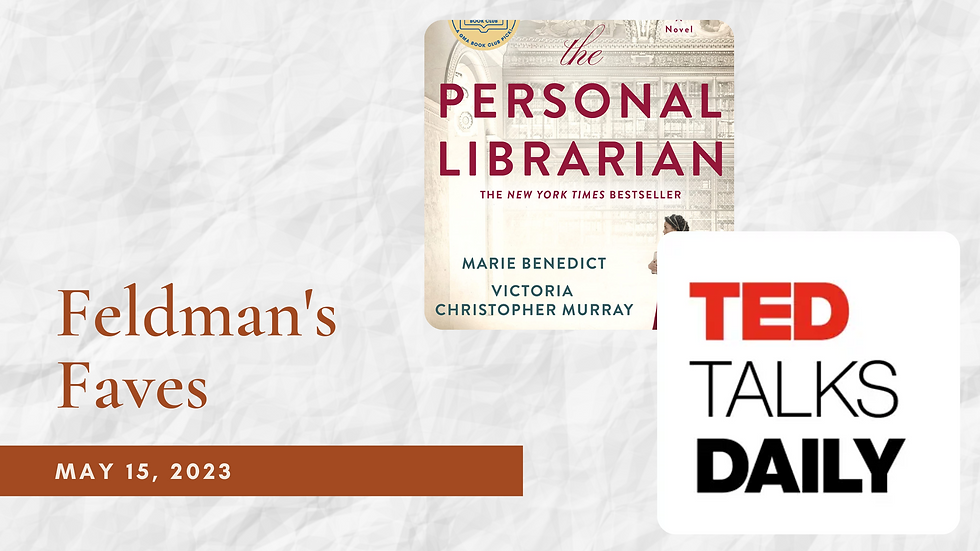
THE PERSONAL LIBRARIAN By: Marie Benedict and Victoria Christopher Murray – I love historical fiction, which is what this book is. The Personal Librarian is a collaboration by Benedict and Murray in which they tell the story of Belle da Costa Greene who was JP Morgan’s personal librarian. The authors do a great job setting and describing the era (the early 1900s in NYC and to a lesser degree, Europe) and its very interesting high society characters (especially the Morgan family). We all know JP Morgan as the King of Wall Street in his day, but he was also a major patron of the arts and in that context built a world class library full of rare books and art. So there is a lot to learn about the time, the history and the Morgan legacy beyond finance. That is interesting but what is really interesting is that this story reads like a suspense novel because of the big secret that Green keeps from everyone – namely, that while she claims to be White (with Portuguese roots to explain her “olive skin”) she is actually Black, which if revealed would take away all of the opportunities she has been given by her racist and anti-Semitic boss, Morgan. There are numerous times where she is almost caught, but she never is. As you dive into the story your heart skips a beat many times when you worry about Belle who is just trying to make her way in a world and create a legacy of art that is so far away from her origins and roots. Her dad was one of the first Black men to graduate from Harvarrd and spend his life fighting for equality and left the family that he loved since he would not “live as White”. As one reviewer notes, “The little-known story of the Black woman who supervised J. Pierpont Morgan’s storied library. It's 1905, and financier J.P. Morgan is seeking a librarian for his burgeoning collection of rare books and classical and Renaissance artworks. Belle da Costa Greene, with her on-the-job training at Princeton University, seems the ideal candidate. But Belle has a secret: Born Belle Marion Greener, she is the daughter of Richard Greener, the first Black graduate of Harvard, and she's passing as White. Her mother, Genevieve, daughter of a prominent African American family in Washington, D.C., decided on moving to New York to live as White to expand her family’s opportunities. Richard, an early civil rights advocate, was so dismayed by Genevieve’s decision that he left the family. As Belle thrives in her new position, the main source of suspense is whether her secret will be discovered. But the stakes are low—history discloses that the career-ending exposure she feared never came. There are close calls. J.P. is incensed with her but not because of her race: She considered buying a Matisse. Anne Morgan, J.P.’s disgruntled daughter, insinuates that Belle has “tropical roots,” but Belle is perfectly capable of leveraging Anne’s own secrets against her. Leverage is a talent of Belle’s, and her ruthless negotiating prowess—not to mention her fashion sense and flirtatious mien—wins her grudging admiration and a certain notoriety in the all-White and male world of curators and dealers. Though instructive about both the Morgan collection and racial injustice, the book is exposition-laden and its dialogue is stilted—the characters, particularly Belle, tend to declaim rather than discuss. The real Belle left scant records, so the authors must flesh out her personal life, particularly her affair with Renaissance expert Bernard Berenson and the sexual tension between Belle and Morgan. But Belle’s mask of competence and confidence, so ably depicted, distances readers from her internal clashes, just as her veneer must have deterred close inquiry in real life.” Benedict and Murray tell a very interesting story about a very interesting time in American history, which she turns into a suspense thriller. They acknowledge that they did all they could to portray an accurate historical record but acknowledge that Green’s attempt to hide her true identity required them to take some liberties based on the information they had. Here is a good review from NPR - https://www.npr.org/2021/07/04/1012600661/j-p-morgans-personal-librarian-was-a-black-woman-this-is-her-story
TED TALKS DAILY - How modern audiences can talk about aging art | Margaret Hall – One of the endless debates when it comes to the arts is whether it still makes sense to study and learn from “the old masters” where some of the ideas they had and so of the virtues they extolled may not only be viewed as outdated but also as offensive to some people. The main argument that Margaret Hall makes in this PODCAST is that it is not a simple formula to say these works need to be shelved or we need to learn them so we can have the context, the history and a better understanding of how to move forward. Instead, Hall argues by looking at the works of Oscar Hammerstein (the Broadway legend) as to how some works can continue to be celebrated (i.e., the Sound of Music), others need be reoriented (e.g., The King and I) and still others might be better off shelved (e.g., Showboat). I am not saying she is right or wrong here but I do appreciate her nuanced approach to considering this complex and important issue. Here’s an excerpt from the PODCAST itself, “Some works of art stand the test of time; others don't age as well. Using American musical theater as her case study, theater historian Margaret Hall shares a framework of five categories to talk about how art does (and doesn't) remain useful across generations -- encouraging us to address the "growing pains" that all art faces as time and culture moves on.”: https://podcasts.apple.com/ca/podcast/ted-talks-daily/id160904630?i=1000610434257
Thank you for your ongoing engagement and participation.
And remember to stay safe, stay healthy and to docket daily.
Jon


Comments