
Feldman's Faves: May 16, 2022
- Jon Feldman
- May 16, 2022
- 3 min read
Updated: May 24, 2022
GOOD MORNING EVERYONE
It was great seeing people IRL last week. You all seem a lot taller than I recall (but that could simply be a sign of aging on my part). We will continue to find opportunities to do this again and JC and I welcome suggestions if anyone wishes to take the initiative.
No comment on the Leafs.
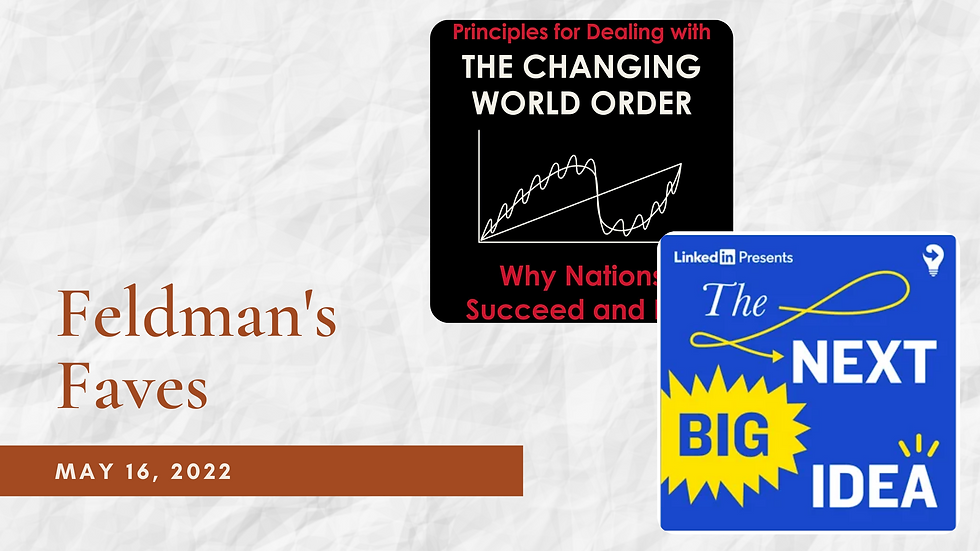
This week I am focusing on Ray Dalio’s most recent work (both book and PODCAST).
Principles for Dealing with the Changing World Order – why nations succeed and fail – By Ray Dalio –Ray Dalio is the founder and chief investment officer of, Bridgewater Associates, the largest hedge fund in the world. Dalio has written many books over the years and is never shy to share his views of how he thinks the world works and how he believes it should work. He wrote his most recent book, Principles for Dealing with the Changing World Order in an effort to understand where the world is going so he can properly and most effectively determine how to invest his clients’ money. Dalio notes that the upheaval we are experiencing now is part of the normal course of world history even though this is happening for the first time in our own lifetimes. To develop his investment strategy for the future, Dalio studied the rise and fall of great powers over a 500 year period (600 years when looking at China) and discerned that there are common patterns in how empires emerge, grow, stagnate and then die. He has a framework for both internal politics and economics as well as for international relations (e.g., he talks about six stages from emergence to collapse), that while oversimplified (as he recognizes) does a good job in situating the current state of the current world powers in the context of “Big History”. While Dalio is looking back at the Dutch, British, US and various Chinese empires (he also looks at the Mongols, the Ottoman Empire, Bismarck and others) his main focus is in understanding where each of the United States and China sit on these cycles of history today. Dalio refers to these patterns as the “Big Cycle”, which he says “produces swings between 1) peaceful and prosperous periods of great creativity and productivity that raise living standards a lot and 2) depression, revolution, and war periods when there is a lot of fighting over wealth and power and a lot of destruction of wealth, life and other things we cherish.” Based on his framework, the US is certainly in a stage of decline when considering, among other things, income and wealth disparity, political disharmony and an increasing and unsustainable debt load (statement of the obvious of the day) but he believes the end of the American Empire and the rise of China as its replacement is not a forgone conclusion but certainly a risk (or at least a scenario) that must be considered for future investing and for life in general. Here is a good review from the Wall Street Journal - ‘Principles for Dealing With the Changing World Order’ Review: Trouble Ahead, As Usual - WSJ
The Next Big Idea - EMPIRE: Why Ray Dalio Thinks We May Be Headed for Civil War –For those of you who don’t have the time or interest to read Dalio’s 500 plus page book, this interview sets out his main themes and ideas, including his view that there is a 30% chance of another Civil War in the United States…. Here is an excerpt from the PODCAST itself, “History, in the eyes of legendary investor Ray Dalio, is a perpetual motion machine. Nations rise and fall according to an inevitable cycle where peace and prosperity are always followed by depression and war. And in his new book, “Principles for Dealing with the Changing World Order,” Ray says the United States is now in the downward part of that cycle”: https://podcasts.apple.com/ca/podcast/the-next-big-idea/id1482067226?i=1000553537538
Thank you for your ongoing engagement and participation.
And remember to stay safe, stay healthy and to docket daily.
Jon


Comments