
Feldman's Faves: May 31, 2021
- Jon Feldman
- May 31, 2021
- 4 min read
GO? LEAFS, GO???? What is happening here???? Saturday night’s game was simply painful to watch (unless of course you are Steve Halperin and Neill May). Tonight is a BIG NIGHT. Like many of you, I still have PTSD from our last GAME 7 – let’s hope to change the narrative on this storyline tonight on the road to the Cup….
On the theme of narratives, this week’s topic is a study in contrasts when it comes to how one chooses to run one’s business.
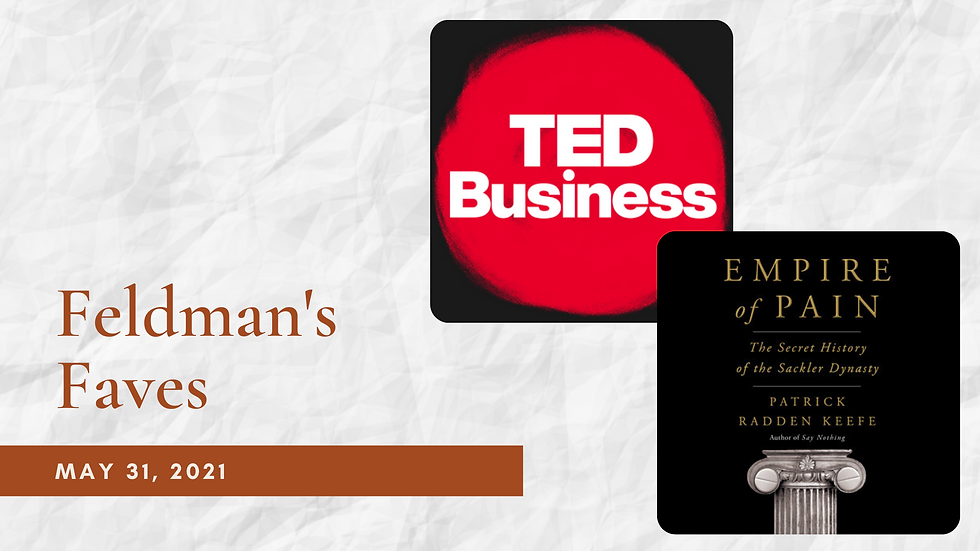
EMPIRE OF PAIN – By: Patrick Radden Keefe – I must admit that this book was not the best I have ever read – it was a little boring to be honest. That said, it does provide a good basic explanation of how we got to the place we are today insofar as the opioid crisis is concerned. It was really bad before the pandemic and it seems to be getting even worse. Statistics these days are scary where opioid deaths, particularly from fentanyl, are up across North America, as much as 74% (since March 2020). So how did we get here - the answer lies in the story of the Sackler family and Purdue Pharma. In Empire Of Pain, Keefe tells the story of the rise of the Sackler brothers (all doctors and all entrepreneurs). Look all over the world from the Met in New York, to Harvard, to the Louvre, to the medical school in Tel Aviv, to science projects in Hong Kong and their influence and money is everywhere. The initial rise of their wealth came as a result of, among other things, their ability to market and promote the use of valium in the 1950s led by Arthur Sackler – but this was just the beginning. It was Purdue’s creation of the slow release mechanism that was ultimately used in OxyContin and that was masterfully marketed by the team led by Richard Sackler (scion of the family) that led to where we are today. The book goes into great detail about Sackler family dynamics, philanthropy and their businesses. The real tragedy of this story is that is clear that members of the family were instrumental in pushing this medication but have suffered ZERO real consequences – yes their name is now ruined, but they seem to be OK with that. The opioid crisis is one of the tragedies of our time and it is not clear to me how we are going to dig out of this mess. Here is a good review from The New Yorker Magazine - https://www.newyorker.com/magazine/2017/10/30/the-family-that-built-an-empire-of-pain
TED Business - The anti-ceo playbook | Hamdi Ulukaya – In 2008, the BCE case was decided by the Supreme Court of Canada who made it very clear that despite the conventional wisdom (and the law in the U.S. at least in the context of a sale transaction) that in Canada the duty of directors (in exercising their fiduciary duties) is to the corporation itself (and not to shareholders alone) and that in exercising this duty, directors must take into consideration, the various stakeholders of the corporation, which of course includes shareholders, but also includes, employees, customers, supplier and the environment. Meanwhile, in the U.S., Hamdi Ulakaya (who is now very well known) was in the midst of building his Greek Yogurt empire at Chobani. From the outset Ulukaya took a different approach to building a business, by putting his employees first and considering the community in which he operated his factories (the first one being in upstate New York). Nobody can dispute the economic success of his business (which all owners of his company appreciate) but his approach in emphasis was unique at the time (went far beyond the BCE ruling) and seems to have opened the door for other companies (i.e., B-CORPS) to look at business differently (this is coming from someone who makes his living in the world of shareholder activism…..). There is no doubt that shareholder primacy rules the day still but the idea of looking at business differently, whether through the eyes of the SCC or the success of Chobani makes one think that there are many paths to success and many definitions of what success in business actually means. This lesson of course has implications for all aspects of our lives. For those who are interested in listening to this PODCAST, here is the summary from TED: Profit, money, shareholders: these are the priorities of most companies today. But at what cost? In an appeal to corporate leaders worldwide, Chobani founder Hamdi Ulukaya calls for an end to the business playbook of the past – and shares his vision for a new, "anti-CEO playbook" that prioritizes people over profits. "This is the difference between profit and true wealth," he says. After the talk, Modupe offers some simple practices that can help leaders realize this vision, by putting people back at the center of a CEO’s workday: https://podcasts.apple.com/ca/podcast/ted-business/id470622782?i=1000519797276
Thank you for your ongoing participation.
And remember to stay safe, stay healthy and to docket daily.
Jon


Comments