
Feldman's Faves: November 10, 2025
- Jon Feldman
- Nov 10, 2025
- 7 min read
GOOD MORNING EVERYONE
I don’t know what everyone else is doing with their free time these days…….
Thanks to everyone that participated in last week’s IBA festivities. There was A LOT to do but I think we did it really well. Big thanks to Mike for his leadership on that front.
I know I don’t usually do this in this forum but I want to congratulate Joanna and Brenda (along with Brad) on their successful pitch (no names being mentioned on purpose). I raise it because (a) it was really hard to do and (b) it’s a great reminder for all of us to swing for the fences every once and while (last baseball reference for 2025, I promise). Kudos to you!
For those of you who haven’t had a chance to meet Michael he is now here, set up and ready to hit the ground running. So please think of him for your files and do have a chat with him – a really smart and interesting guy.
PS – Assuming flights are happening I will be away next Monday – so there will be no email next week.
No theme this week – just topics of interest.
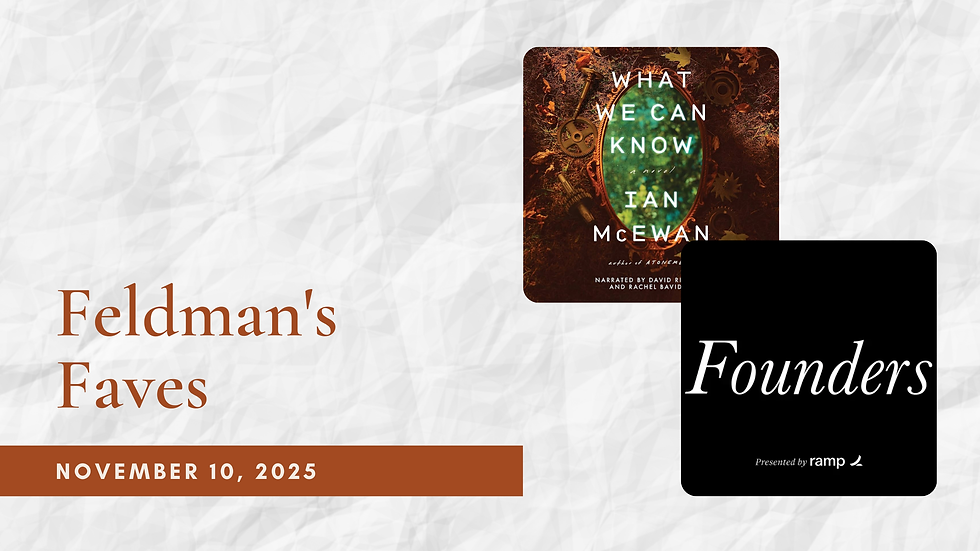
WHAT WE CAN KNOW By: Ian McEwan – New books by Ian McEwan are always an event. He is a brilliant writer with a brilliant career. He could have done nothing more and still be considered an all-time great. Instead he just released What We Can Know, which in my view is one the most interesting and brilliantly constructed novels I have ever read. You actually need to read this book twice (or least read the first half once you have finished the second half one more time for it all to make sense). The premise is so interesting, which is a researcher from the future (in the 2120’s) learning about a 21st century poet and his muse and using archives and data to tell that story as he pieces it together, which misses a whole as to what actually happened, which we learn in the second half of the book. There is so much depth in the story telling, the political statements, the history and the psychology of this story that is just one of those books you never want to end. Taking different perspectives on the same story is not in and of itself a new literary device – but the way it is done in this novel is innovative and really creative. As one reviewer notes, “The sheer Englishness of Ian McEwan’s fiction may not be fully visible to his English readers. But it is clearly, and amusingly, visible to at least this Irish reader. It isn’t just McEwan’s elegiac, indeed patriotic, attentiveness to English landscapes – to the wildflowers and hedgerows and crags, to the “infinite shingle” of Chesil Beach, to the Chilterns turkey oak in the first paragraph of Enduring Love. Nor is it merely the ferocious home counties middle-classness of his later novels, in which every significant character is at the very least a neurosurgeon or a high court judge, everyone is conversant with Proust, Bach and Wordsworth, and members of the lower orders tend to appear as worrying upstarts from a world in which nobody plonks out the Goldberg Variations on the family baby grand. No, McEwan’s Englishness has most to do with his scrupulously rational, but occasionally and endearingly purblind, liberal morality: England’s most admirable, and most irritating, gift to politics and art. These thoughts were provoked by a brief passage in McEwan’s future-set new novel that describes the “Inundation” of Britain after a Russian warhead goes off accidentally in the middle of the Atlantic, causing a tsunami that, combined with rising sea levels, wipes out everything but a Europe-wide archipelago of mountain peaks. In these entertainingly nihilistic pages, the fate of that other major chunk of the British Isles is not mentioned. Presumably Ireland, with its dearth of high peaks, fared badly as Europe drowned. But from McEwan’s future history, you’d never know it. I began to think of What We Can Know as another of McEwan’s deeply English stories. It has, I thought, the familiar partialities of vision. Has Brexit, endlessly backstopped by those pesky six counties, taught English liberals nothing? But I don’t mean to make fun. Insularity, in both senses of the word, is one of McEwan’s themes in What We Can Know. The book is composed of two islands of prose, linked only by the tenuous bridge of a brief note at the end. And it is about being islanded, in time, in space, in life.
The novel is set a century hence, in 2119. Part one is narrated by Tom Metcalfe, who teaches literature at the University of the South Downs, an institution largely focused on science and maths, located on a 38-mile-wide island in the “sleepy ahistorical” republican archipelago that is all that remains of the UK. (To say who narrates part two would constitute a spoiler.) The world is post-catastrophe. The 21st century has unfolded as we all fear it will. The US is now run by rival “warlords”; Nigeria is the hegemonic power. But this is all offstage stuff. As the novel begins, Tom catches various boats to the Bodleian Library, now occupying a Snowdonian peak and accessible by “water-and-gravity-powered funicular”. Here, he trawls the archive of Francis Blundy, a poet of our own time, and allegedly the equal of Seamus Heaney (whose papers at the National Library of Ireland must now be soggy beyond use). Superficially a quiet, scholarly sort – his opening pages stress how “tranquil” and “smooth” his life is – Tom, like a true scholar, burns within. He is in search of a lost poem, the improbably named A Corona for Vivien, which Blundy wrote for his wife Vivien’s 50th birthday in 2014. Read aloud once at Vivien’s birthday dinner, the sole copy, on vellum, which scholars know of only from contemporary accounts of the dinner, vanished into a credulity-stretching afterlife as the great lost poem of the climate crisis. Alone on the island of his obsession, Tom builds a portrait of the missing masterpiece, and alongside it, a portrait of the early 21st century.
It’s a nostalgic portrait, and Tom’s obsessive nostalgia for our violent and chaotic historical moment is the canniest thing about What We Can Know. Certainly, the plot – turning as it does on the fate of Blundy’s vellum manuscript and a series of shock disclosures about various characters – is absurdly gripping and finally unpersuasive in that familiar McEwan way (you turn the pages hungrily, and then at the end you think: Hang on). “To have been alive then,” Tom writes unironically, “in those resourceful raucous times.” Tom’s nostalgia is not shared by his present-minded students, who see us as having been “ignorant, squalid and destructive louts”. Beneath his opinionated frankness, we come to suspect, Tom is really a deeply elusive narrator. It is Tom, perhaps, and not his creator, who has the English liberal’s partiality of vision. Crusoed on his regressive scholarly island, he has little time for the needy humanity of the people around him. He views his colleague and sometime lover Rose, for instance, increasingly as a means to an end. Can his nostalgia, or indeed his liberalism, be trusted? Will they ever be enough, now or in the future? What We Can Know gradually reveals itself as an anatomy of, precisely, liberal partiality – of the insularity of a liberalism busily nostalgic for all the wrong things. At one point, Rose argues that, during the years 2015 to 2030, there was “a crisis of realism in fiction” brought about by the scale of climate disaster: “New forms were needed to frame the physical and moral consequences of a global catastrophe.” We are meant, I think, to view Rose’s theory with some irony. But we are surely also meant to see What We Can Know in Rose’s terms, as an attempt to find a new form in which to speak about what McEwan’s characters, echoing Amitav Ghosh, call “the derangement”. Thus, this is a science fiction novel (McEwan’s second proper one, after Machines Like Me) that is also a novel entirely about our mundane present, with its “metaphysical gloom” about the future. The science fiction scenario, the secret histories eventually disclosed: these are fun, and handled with great brio, but they’re not exactly original. The book’s value lies in what it is prepared to omit – nothing new, this, but a classically realist virtue. What it omits, and makes us work out for ourselves: the “moral consequences of a global catastrophe”. Which we can know only, perhaps, by inference or by imagining. Liberalism itself, in the early 21st century, feels increasingly archipelagic – confined to the island peaks of a former upland. We may see McEwan, the liberal critic of liberalism, as one of those peaks. Après lui, le déluge?” I am amazed that McEwan is still as sharp as ever. My view is that this the best book he’s ever written. I love it when smart people do smart things. Here’s a good review from the NYT - https://www.nytimes.com/2025/09/22/books/review/ian-mcewan-what-we-can-know.html
Founders - How Jensen Works – Talking about smart people, Jenson Huang, CEO and founder of NVIDIA may be the most driven person alive today. It is no accident that NVIDIA is the by far, the most valuable company in the world today. That could of course change tomorrow, but it won’t be due to Jensen’s lack of trying. In this PODCAST we learn about the 19 key principles that Jenson and his company look to in order to not only get to the top but to stay there. There are so many interesting insights and great ideas to learn from here. Here’s an excerpt from the PODCAST itself, “This episode covers the insanely valuable company-building principles of Jensen Huang—and nothing else. I spent over 40 hours reading (and rereading) this book on Jensen and Nvidia written by Tae Kim I then spent several days editing down 30 pages of notes from the book. I deleted everything that was not How Jensen Works. List of ideas: 1. Professor Jensen 2. The Whiteboard 3. Complacency Kills 4. Insist on a Flat Organization 5. Public Criticism 6. Tortured Into Greatness 7. Speed of Light 8. Extreme In All Things 9. Top 5 Emails 10. Direct Communication 11. LUA 12. The Mission is the Boss and Pilot-in-Command 13. Strategy is Action 14. Ship The Whole Cow 15. Go To School On Everybody 16. Create The Market 17. Choke You With Gold 18. Highest Priority First 19. Swarm Your Greatest Opportunity Episode”: https://podcasts.apple.com/ca/podcast/founders/id1141877104?i=1000732570996
Thank you for your ongoing engagement and participation.
And remember to stay safe, stay healthy and to docket daily.
Jon


Comments