
Feldman's Faves: November 25, 2024
- Jon Feldman
- Nov 25, 2024
- 6 min read
GOOD MORNING EVERYONE
First and foremost, I am extremely happy to be welcoming Katie to Goodmans and to our section. Katie is a very experienced securities law clerk who will be teaming up with Mel to create an absolute dream team. Please make sure you take the opportunity to introduce yourselves and make Katie feel welcome.
Also, please join me in congratulating Hari on his move to the suburbs last week. It’s only a matter of time before he starts wearing his “World’s Greatest Dad” T-shirt to the office. I for one, am looking forward to seeing that.
Finally, it’s bittersweet that the long awaited Eras Tour is coming to an end here in Canada. But on the bright side we now all know that Max can sing the entire bridge of Cruel Summer ‘on demand’ if anyone needs a Swiftie fix at any time. So that’s good.
No theme this week – just topics of interest.
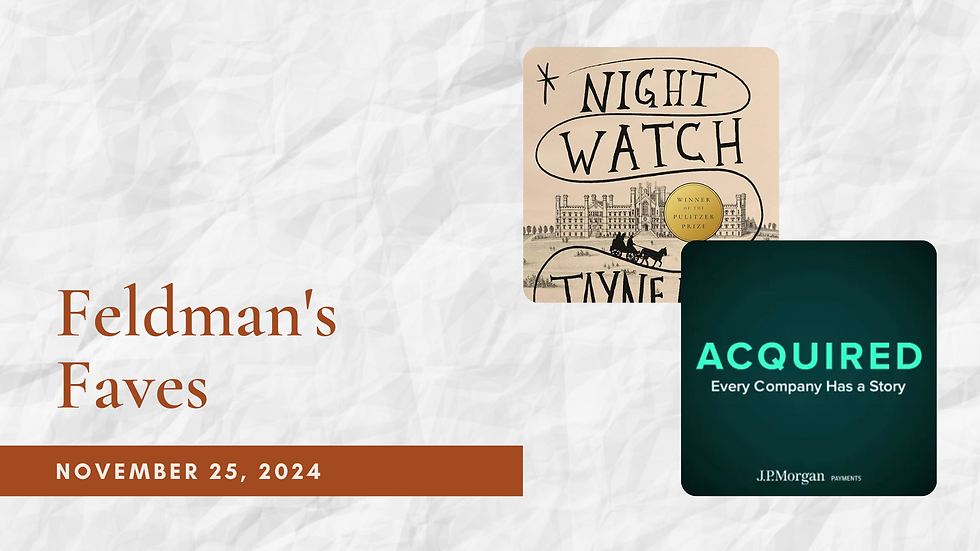
NIGHT WATCH By: Jayne Anne Phillips – This year’s Pulitzer Prize in fiction went to Night Watch. Although this book was not universally regarded as the obvious winner this year, I understand why it was. Jayne Anne Phillips writes about the Civil War but more about its aftermath and the consequences of behaviours and actions that take place in war. The notion of PTSD was not a thing back then, but sure did exist and the story explores its impact without every using the term. There are some really difficult parts to read in this book but that’s what brings the story to life. As one reviewer notes, “During a particularly memorable scene in Night Watch, which is set around the American civil war, a little girl is lowered headfirst into an open grave by her mother in order to pull a rifle off a fresh corpse. That this harrowing exploit ultimately proves pointless – the protection offered by the retrieved weapon is insufficient for the danger they face – is emblematic of the book’s unsparing vision. This is Jayne Anne Phillips’s sixth novel, and her third, after Machine Dreams and Lark and Termite, to take up the cost of war for combatants and non-combatants alike. She is unusually well placed, then, to probe the civil war, a brutal four-year conflagration that killed more than 700,000 people, devastated the lives of many more and sent aftershocks of violence and division rippling all the way through to the present. Though it contains numerous vivid characters – including John O’Shea, a disfigured night-watchman who gives the book its title, an Irish healer named Dearbhla and a wild orphan boy called Weed – the novel is largely the story of the little girl, ConaLee, who was lowered into the grave, and of her mother, Eliza, who did the lowering. Set mostly in West Virginia and Virginia during the war and at the Trans-Allegheny Lunatic Asylum some 10 years afterwards, Night Watch depicts the horrors the two confront in the wake of ConaLee’s father’s enlistment, as the US begins to tear itself apart.
Their trials come at the hands of a sadistic veteran who makes his entry into their lives by perpetrating a terrifyingly detailed assault on Eliza. Insisting grotesquely on being called “Papa”, he returns again and again to tyrannize them. In scenes that both mirror and warp the wartime travails of ConaLee’s actual father, which Phillips describes economically in alternating chapters, mother and daughter are brought low indeed.
When Papa finally tires of them, he enacts an elaborate, Wilkie Collins-style scheme to be rid of them and simultaneously cover his tracks: have them committed. At his instruction, teenage ConaLee becomes a servant known as “Nurse Connolly”, and Eliza, largely mute after years of rape and abuse, plays the role of her employer, a troubled gentlewoman called “Miss Janet”. The two are admitted with little question into the “home for lunatics”.
Phillips’s depiction of a ravaged world in which so many have lost their way or had it stolen from them, both physically and mentally, feels true to the profoundly destabilizing nature of her subject. As one woman puts it, understatedly, “My husband came back [from battle] but struggled to be himself.” Voluntarily or involuntarily, the novel’s characters have changed names, or otherwise been distanced from themselves, and the asylum, set in handsome grounds and run according to remarkably forward-thinking principles, proves a haven. As “Nurse Connolly” and “Miss Janet” accustom themselves to days that are suddenly filled with regular meals, long walks pleasant company and salubrious carriage rides, other tales emerge and become intertwined with theirs.
One story belongs to O’Shea, the guardian of the asylum, who came out of the war with an injury-induced amnesia that cuts him off from any knowledge of his past, except that he feels disturbingly comfortable with a rifle in his hands. We relive the brutal battle in which he was wounded through Phillips’s crisp narration: “The line yelled together, plunging down the slope in a bombardment of shell and bullets so heavy and deafening it was as though they’d entered a field on fire.” O’Shea’s current condition both deepens the mystery that informs the novel and serves as the central node of a matrix of coincidence that in less skillful hands might have detracted rather than enhanced. Phillips pulls it off by leaning into the device rather than away from it: the attentive reader will perceive clues and spot coincidences throughout Night Watch. The result is that when, say, one character’s relationship to another becomes fully clear, it feels like a satisfying confirmation born out of a context of deep connection, rather than a cheap reveal. Night Watch is tough reading, even excruciating at times, but far from unrelentingly bleak; small notes of grace appear throughout the novel, especially, albeit briefly, at the end. If at one juncture ConaLee remarks grimly “I’d not seen the war except in what it ruined”, she and some of those around her at the asylum are also offered a glimpse of what might, with time and care, be restored. “Much of [the civil war] is encrusted in myth or still unexplored,” the late Tony Horwitz, author of Confederates in the Attic, wrote in 2010. With this excellent novel, Phillips has brought a little more of this foundational American episode into the light.” This novel is not a light read and has many difficult passages that really leave a mark. In fairness, it does tie everything up in a neat little bow in the end that I can understand certain readers find overly simplistic. That said, it is worth reading books that make you think, which this one really does. Here’s a good review from the NYT -https://www.nytimes.com/2023/09/25/books/review/jayne-anne-phillips-finds-anguish-and-asylum-in-civil-war-america.html
Acquired – IKEA – I can probably count on one hand the people I know who have never been to or bought something from IKEA. This interesting and one of a kind company is a global phenomenon that is virtually impossible to ignore and probably impossible to replicate. The history of this company and it’s (now deceased) founder is legendary. From where it started (rural Sweden) to what it has become, IKEA (apparently, meaning Swedish for common sense , but not really) is such an interesting story. This multibillion dollar business has never raised equity and only once (for a very brief moment) took on some debt. All of the growth was financed by operations, something that we almost never see and never at this scale. The principles that govern this business are based on maximizing value for customers (not shareholders, which would be heresy if it were a public company, which it will likely never be). This PODCAST is very long – so if you are training for a marathon and need a long run day listen or if you are going to be in your car to visit family or friends then this story will really help pass the time. Here’s an excerpt from the PODCAST itself, “IKEA may be the most singular company we’ve ever studied on Acquired. They’re a globally scaled, $50B annual revenue company with no direct competitors — yet have only ~5% market share. They’re one of the largest retailers in the world — yet sell only their own products. They generate a few billion in free cash flow every year — yet have no shareholders. And oh yeah, they also sell hot dogs cheaper than Costco! (Sort of.) Tune in for an episode flat-packed with counterintuitive lessons about how this folksy mail order business from the Swedish countryside came into your living rooms (and bedrooms and dining rooms and kitchens and bathrooms and patios and garages and backyards) all over the globe!”: https://podcasts.apple.com/ca/podcast/acquired/id1050462261?i=1000677277227
Thank you for your ongoing engagement and participation.
And remember to stay safe, stay healthy and to docket daily.
Jon


Comments