
Feldman's Faves: October 15, 2024
- Jon Feldman
- Oct 15, 2024
- 6 min read
GOOD MORNING EVERYONE
I hope you all had a great long weekend. Fall in Toronto is just glorious.
Last week was a good one for Canada, with Geoffrey Hinton (along with John Hopfield) winning the Nobel Prize in physics for their work in machine learning. What’s really interesting is that Hinton, who among other gigs, spent ten years working for Google, quit that job, so he could speak freely about his concerns and fears of the dangers of AI. It’s potentially a modern day Frankenstein type situation but I guess we will see. This announcement is timely (at least for me, given the book I am reviewing this week).
Finally, I want to wish Jeffreen a very happy birthday (tomorrow).
In light of last week’s big announcement, this week’s theme is information technology and AI.
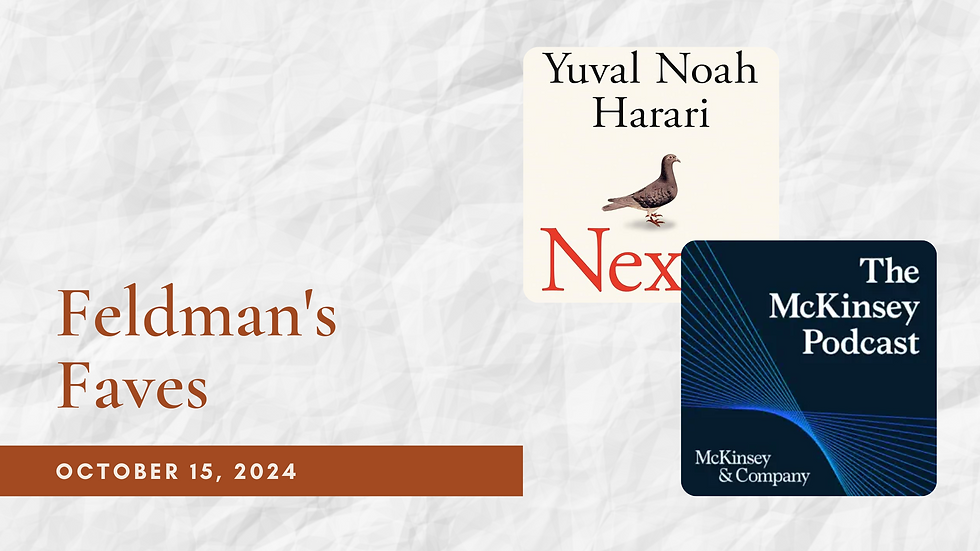
NEXUS: A BRIEF HISTORY OF INFORMATION NETWORKS FROM THE STONE AGE TO AI By: Yuval Noah Harari – One of the most popular books written over the last 20 years is Sapiens. In this book Yuval Noah Harari’s became famous for his view on what makes us different than any other species on the planet and which allows humans, as a species to dominate the planet. It is certainly not our speed or strength and It isn’t even our intelligence per se. It is our ability to create “stories” and use those stories to create order in our lives. In Nexus, Harari, spends a lot of time discussing information and how it is understood, collected and used to order society giving examples ranging from clay tablets, to radio and of course to computer networks and AI. He attacks we have deems to be a naïve view that more information is a good thing and instead demonstrates that it is less about the volume of information that defines a society but instead how it flows to members of society – one example being a comparison of democratic vs totalitarian regimes. He also focuses on the modes of information and argues that throughout history the mode was effectively inanimate that required humans to deliver content and decide how that content gets distributed. His view when it comes to algorithms and AI is that the machines are taking on a life of their own (think of HAL ins the Kubrick classic) and is unsure what this will mean for humanity at large. As one reviewer notes, “As befits a writer whose breakout work, Sapiens, was a history of the entire human race, Yuval Noah Harari is a master of the sententious generalisation. “Human life,” he writes here, “is a balancing act between endeavouring to improve ourselves and accepting who we were.” Is it? Is that all it is? Elsewhere, one might be surprised to read: “The ancient Romans had a clear understanding of what democracy means.” No doubt the Romans would have been happy to hear that they would, 2,000 years in the future, be given a gold star for their comprehension of eternally stable political concepts by Yuval Noah Harari. In his 2018 book, 21 Lessons for the 21st Century, Harari wrote: “Liberals don’t understand how history deviated from its preordained course, and they lack an alternative prism through which to interpret reality. Disorientation causes them to think in apocalyptic terms.” It seems that, in the intervening years, Harari has himself become a liberal, because this book is about the apocalyptic scenario of how the “computer network” – everything from digital surveillance capitalism to social feed algorithms and AI – might destroy civilisation and usher in “the end of human history”. Take that, Fukuyama. Like Malcolm Gladwell, Harari has a passionate need to be seen to overturn received wisdom. Many people think, for example, that the printing press made a crucial contribution to the emergence of modern science. Not so, insists Harari: after all, printing equally enabled the dissemination of fake news, such as books about witches, and so Gutenberg is partly to blame for the gruesome torture and murder of those accused of witchcraft across Europe. Silly as that might sound, it also misses the fundamental point: because the scientific method is accretional, modern science could only come into being once the results of previous experimenters were widely available to those who followed them. Only via the ladder of print could early-modern scientists stand on the shoulders of giants. But perhaps I have fallen prey to what Harari dubs “the naive view of information”, which subtly changes throughout the book as rhetorical circumstances demand until it is something of a straw Frankenstein’s monster. The naive view of information encompasses the idea that “[it] is essentially a good thing, and the more we have of it, the better”, which lots of people believe and is hard to argue with, but it also supposedly holds that sufficient information leads ineluctably to political wisdom and that the free flow of information inevitably leads to truth, propositions that almost no one believes. “Knowing that e=mc2 usually doesn’t resolve political disagreements,” Harari says, to no one.
We know this already from the history of dictatorial and totalitarian governments and their attempts at information gathering and control, a history from which Harari draws dozens of colourfully chilling anecdotes to persuade the reader of the falsity of a patently ridiculous view. What, then, can modern computers do that should worry us so much? Harari is peculiarly credulous about the capabilities of what is now marketed as “AI”. No one has yet seen a chatbot create new ideas, as Harari thinks they can, let alone generate art that is not simply a probabilistic recombination of patterns in its training data. (“Computers can make cultural innovations,” he writes in one of many passages besides which I scrawled “citation needed”.) At some point in the future, meanwhile, what Harari calls “our new AI overlords” are apparently sure to acquire scary godlike powers. In his crystal ball, an AI overlord could decide to engineer a new pandemic virus, or a new kind of money, while flooding the world’s information networks with fake news or incitements to riot.
The descent prophesied herein of a “Silicon Curtain”, meanwhile, is not a problem of AI per se but of geopolitics: extrapolating from the Great Firewall of China, which prevents most Chinese citizens from accessing sites such as Google and Wikipedia, Harari supposes that, in time, Chinese and US computer systems might be completely prevented from interoperating or even communicating with one another, so “ending the idea of a single shared human reality”. Worrying if true. Vladimir Putin’s violent irredentism in Ukraine is, Harari notes, in part inspired by his belief in a partisan version of Russian history, which shows the danger of a lack of shared myths. This, however, is a feature of almost all wars since the dawn of time, so I am not sure we can blame the computers for it.
So what can we do to save human civilisation and our shared reality? Simple, concludes Harari: subject algorithms and AI to strong official regulation, and focus on “building institutions with strong self-correcting mechanisms”. So, carry on being liberal democracies? It’s a wan sort of conclusion to a book that has struck such an end-of-days tone. The annoying thing is that Nexus also contains many too-brief but fascinating discussions on subjects ranging from the process by which the books that comprise the modern Bible were canonised, or the role of Facebook’s “news feed” in fomenting the massacres in Myanmar of 2016-17, to the facial recognition system used by Iran to detect unveiled women. There are a brilliant few pages, in particular, on the plight of Jews in fascist Romania, including Harari’s own grandfather, who in 1938 were forced to provide papers proving their right to citizenship that in many cases had been destroyed by municipal authorities. When Harari is not in his mode of oracular pontification, he can be a superb narrative writer. But oracular pontification is what, we must assume, his readers want.” I agree that Nexus is not Harari’s best work. His analysis of historical events is quite creative and thoughtful but his predictions for the future seem a little naïve and farfetched to me, but predicting the future is kind of hard to do. Here’s a good review from the NYT - https://www.nytimes.com/2024/09/10/books/review/nexus-yuval-noah-harari.html
The McKinsey Podcast - Rewiring for the era of gen AI – The gazillion dollar questions these days, are how, when and in what way will AI take over our lives. In this PODCAST the folks at McKinsey discuss where things are and where they are going when it comes to AI taking over our work lives. There is no doubt that it is coming the depth and intensity of this takeover is still very unclear, which is why many businesses in this space have failed to date. We may still be in the Friendster era at the moment but we may be not that far away from the Meta era of AI. Here’s an excerpt from the PODCAST itself, “It’s easy to fall in love with gen AI—but recent research suggests that realizing its value is harder than the hype. Rewired offers a playbook that can help. In this episode of The McKinsey Podcast, Rodney and fellow senior partners and co-authors Eric Lamarre and Kate Smaje join global editorial director Lucia Rahilly to talk about their book Rewired: The McKinsey Guide to Outcompeting in the Age of Digital and AI (Wiley, 2023)—which, a year and a gen AI disruption post publication, continues to offer leaders a play-by-play guide for outcompeting in a fast-changing era. “ https://podcasts.apple.com/ca/podcast/the-mckinsey-podcast/id285260960?i=1000672540472
Thank you for your ongoing engagement and participation.
And remember to stay safe, stay healthy and to docket daily.
Jon


Comments