
Feldman's Faves: October 17, 2022
- Jon Feldman
- Oct 17, 2022
- 6 min read
Updated: Oct 31, 2022
GOOD MORNING EVERYONE
I am delighted that today we are kicking off our first in-person United Way Week since Covid began. I strongly recommend that you participate in as many of these events as you can. This week is a great way for all of to come together as a community in a really fun. The United Way does such great work and we can all help them make meaningful contributions to our community at large.
I want to take this opportunity to thank Alexa and Bayley for the great job they did in our section – it is hard to believe their rotation is done on Friday. We really appreciate all of your hard and smart work and we hope you continue to develop into great lawyers as you progress throughout your articling year. Please continue to be in touch and keep us apprised of how things are going.
For music fans, this is a busy month. Last Friday, the Red Hot Chilli Peppers released their new album entitled “Return of the Dream Canteen”(their second of the year), which as my children would say, is “bussin’” and this Friday Taylor Swift’s new album entitled, “Midnights” comes out, which will be a national holiday in my house (whether I like it or not). I am so impressed with the longevity and continued incredible quality of work that they both produce – it is amazing and a great life lesson/reminder, that while it is really difficult to be “number one” it is even more difficult to stay there, which is what both the Chilli Peppers and Taylor Swift have been able to do for decades. It is remarkable.
No theme this week – just interesting stuff.
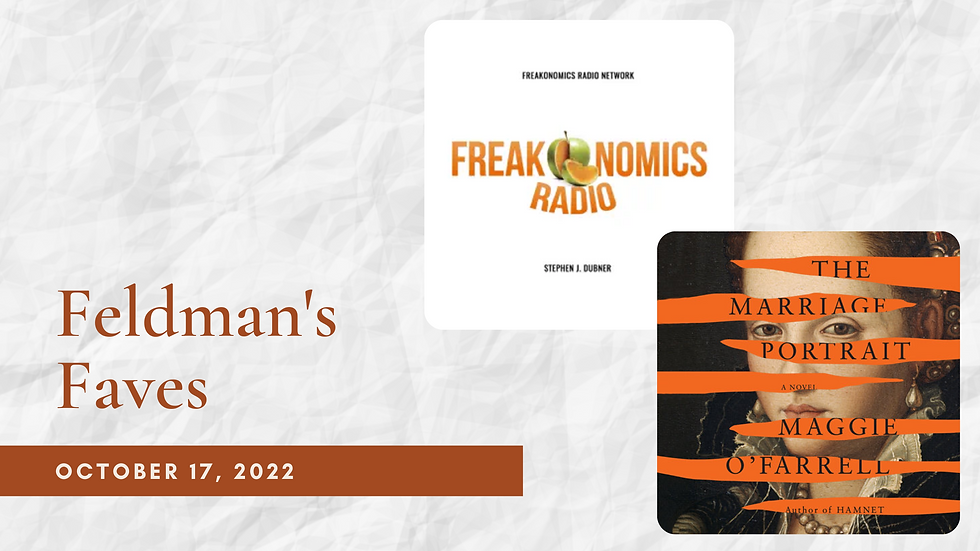
THE MARRIAGE PORTRAIT By: Maggie O’Farrell – Earlier this year I reviewed O’Farrell’s take on the Shakespeare family in Hamnet. In The Marriage Portrait, O’Farrell goes back to the Medici era in Italy and presents another perspective of that time. Many of you are familiar with Machiavelli’s classic The Prince, which was written to help the ruling class manage the crazy politics and backstabbing that took place during that time, a time that is perfectly captured by O’Farrell in this novel. O’Farrell seems to be on a mission (or at least has a pretty good formula) for filling in the gaps of history with hypotheses as to how certain lesser known characters viewed and experienced well known events, that is not told through the male gaze with which we are all familiar. Getting Agnes’ perspective of life with her husband William Shakespeare (whose name was not mentioned even once) in Hamnet was executed to perfection. Once again, O’Farrell takes all kinds of liberties in filling in the gaps this time around but that is the beauty and breadth that good historical fiction permits (at the end of the book is a really good explanation of where she used history and where she borrowed from it for the purpose of the story). In The Marriage Portrait, we learn immediately that our protagonist, 16 year old Lucrezia is experiencing high anxiety about the fact that her husband Alfonso (as 25 year old Duke from Ferrara) is planning to kill her (because we learn that she is incapable of producing an heir for him, without which his family will ultimately lose power- turns out, we later learn (after it is too late) that it is his fault, not hers….). This book does a great job in putting you in this era with great descriptions of the culture, architecture and daily life at that time. There is also a very descriptive discussion of the performers knowns as castratis (you can look this up…). It is also a murder mystery/psychological thriller where we all know the ending but still the tension mounts throughout. As one reviewer summarizes, “In 1558, Lucrezia, daughter of Cosimo de’ Medici, was married to Alfonso d’Este, the Duke of Ferrara. A year after entering her husband’s court in 1560, aged just 16, she died. Poison was suspected. Several portraits of Lucrezia survive. Nearly 300 years after her death, Robert Browning wrote “My Last Duchess”, a dramatic monologue in which Duke Alfonso displays a portrait of his late wife and allows the reader to deduce that – insanely jealous – he murdered her. Now O’Farrell has shuffled historical fact, portraiture and poetic fantasy together and used them as the basis for a piece of fiction in which a simple tale, of a girl forced too young into a dynastic marriage, is overlaid and embellished with elements from fairy-tale and myth….The Marriage Portrait is set in a world as fabulous as that of a millefleurs tapestry and inhabited by beings as flatly emblematic as embroidered ladies and their unicorns. There is a virgin heroine whose floor-length red hair, modestly confined in a pearl-decorated net, hints at rebellious energy. There is a devilish duke, handsome and cruel. Sisters come in pairs – the good (beautiful) one and the cross, ugly one. There is an old nurse whose gruff manner masks a kindly heart. There is the pure-hearted young man who might, perhaps, offer rescue. These stock figures are surrounded by fabulous beasts. Lucrezia’s father keeps a menagerie in the cellars of his palace. When Lucrezia is a tiny child she demonstrates her specialness by reaching through the bars of a cage and stroking a tiger, unharmed. Later, but still in the nursery, she reveals another superpower, a skill in perspectival drawing that impresses the artist Giorgio Vasari. She paints pictures of birds, dead or captive, avatars of her imprisoned self. When Duke Alfonso is being kind he gives her a white mule. When he is being frightening he talks about killing wild boar, a sow and her young. Lucrezia herself feels that there is a beast within her that could one day “crawl out into the light, blinking, bristling, unfurling its filthy fists and opening its jagged red mouth”. These animals, like the fantastic creatures writhing through the “grotteschi” decorations of Italian Renaissance palaces, hint at the untamed impulses contained by courtly rituals and cumbersome dresses. This is a book about a picture, and it is also pictorial. There is a lot going on in it under and around the surface narrative, in the way that there are other stories being enacted in the backgrounds of Renaissance paintings of biblical scenes. Late in the story, there is a banquet in the castle in Ferrara, when Lucrezia hears for the first time the singing of two castrati. As she listens, the narrative gaze moves around the table – lighting on a spaniel lapping at a dish, a woman wearing stuffed songbirds as ornaments in her hair, a man lasciviously handling a bowl of fruit. It could be a scene painted by Paolo Veronese…. When she believes Alfonso loves her we are alive to the bitter irony. When she is momentarily afraid of him we know she is right to be. Horror stains the narrative, introduced by dreams and fantasies, and by the terrible screams Lucrezia hears one night, coming from her husband’s room in a battlemented tower of Ferrara’s grim castle. This horror, though, is never quite fully felt.” While I didn’t like The Marriage Portrait as much as Hamnet (in part because I started to get a little tired of the formula by the end), this is a very entertaining and well written story that is suspenseful and fast moving with a eerie and mystical tone, such that I could see it as a movie, with the music scored by an artist like Lana Del Rey (since we are thinking about music today). Maybe I should call Zitzerman and try to get the rights….Here’s a good review from the NYT - https://www.nytimes.com/2022/09/05/books/review/maggie-ofarrell-marriage-portrait.html
Freakonomics Radio - Are M.B.A.s to Blame for Wage Stagnation? Listening to this PODCAST reminded me of this classic FEDEX commercial about MBAs - https://youtu.be/8Vx1BTBhg4c- The discussion asks what impact an MBA has on business leaders and on employee wages. The basic finding is that MBA-led companies are less employee friendly because of two main schools of thought that are ingrained in the teachings at the top MBA schools, from where most of the “MBA CEO’s” graduate: (i) Milton Friedman’s shareholder primacy model and (ii) the focus of “management consultancy like thinking” and the rewards they get for reorganizing companies (i.e., cutting costs). Nothing is ever this simple, but it is an interesting study that makes you start to think about cause an effect. Here’s an excerpt from the PODCAST itself, “New research finds that bosses who went to business school pay their workers less. So what are M.B.A. programs teaching — and should they stop?” https://podcasts.apple.com/ca/podcast/freakonomics-radio/id354668519?i=1000581750769
Thank you for your ongoing engagement and participation.
And remember to stay safe, stay healthy and to docket daily.
Jon


Comments