
Feldman's Faves: October 2, 2023
- Jon Feldman
- Oct 2, 2023
- 4 min read
GOOD MORNING EVERYONE
The good news is that I been informed by my daughter Noa, that when we go to the Taylor Swift Concert movie later this month, my Chiefs shirt will be acceptable attire (at least for now).
I hope many of you were able to attend the session last week for Truth and Reconciliation Day. It was an incredibly informative and compelling discussion.
A friendly reminder of our welcome lunch for Max THIS THURSDAY (October 5). Please make every effort to join us we can officially welcome him to the section.
Finally, I want wish our good friend Randy a very happy birthday (from yesterday).
This week’s theme focuses on nutrition and the work of Chris van Tulleken.
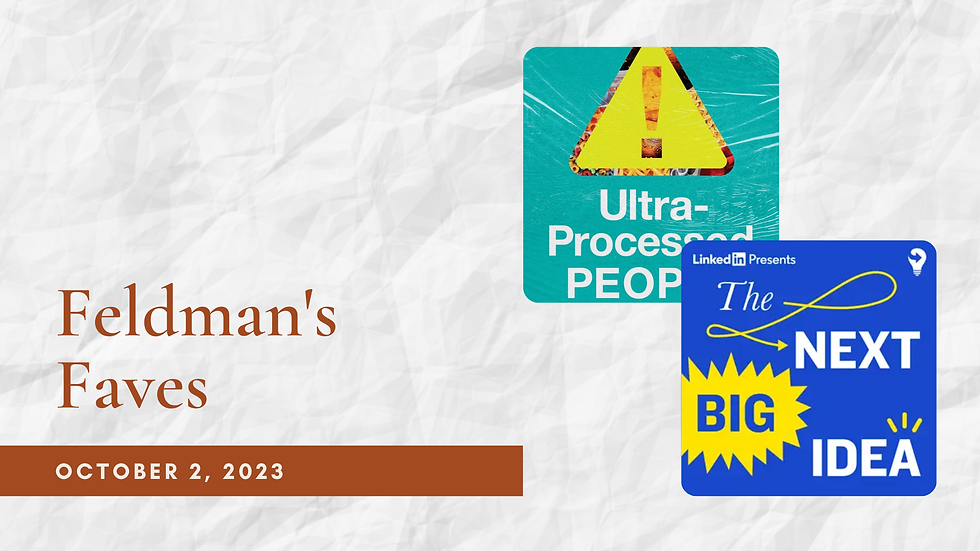
Ultra-Processed People: The Science Behind Food That Isn’t Food By: Chris van Tulleken - As someone who had been extolling the virtues of Peter Attia’s work and focus on longevity with an emphasis on exercise over diet I thought I was starting to get to place where I was figuring this out. But then, I read Chris van Tulleken’s new book, Ultra-Processed People, and I am back to a state of confusion. Van Tulleken hates the state of the food industry and takes issue (in case it is not obvious by the title) with ultra-processed food. He acknowledges the importance of processed food (e.g., think of pasteurized milk) but is very much against what Attia refers to as the SAD (standard American diet) that is full of ultra-food, which he describes as anything in a package that has ingredients that nobody understands when they read them – chips, cookies, canned soups, frozen dinners, etc., etc. He blames the food industry for creating a product that is addictive, bad for us and causing the diseases that are leading to premature deaths of millions of people every year. One interesting story is that of Nestle organizing a floating supermarket on the Amazon River that sell junk food to indigenous people and that has resulted in an exponential level of growth in obesity, diabetes and early death. He views this example as the perfect control group and the result of a disaster of an experiment. He hopes nobody will eat this stuff but recognizes how ingrained it is in everyone’s diet and especially for those that don’t have the ability, time or access to buy and eat and prepare whole foods. Tulleken thinks the government needs to step in here but I am skeptical this will work (think way back to Mike Bloomberg’s attempt to tax soda while he was Mayor of New York). This is a problem without an obvious solution, unfortunately. As one reviewer notes, “A fact-filled, discouraging attack on the modern diet. Van Tulleken, an infectious disease doctor and TV and radio commentator, rocks no boats by agreeing that our convenient, highly refined, additive-rich, chemically enhanced food is making us unhealthy. He has no kind words for “junk food,” but he also reveals the distressing details behind many of the organic, ultra-processed foods (UPFs) that tout their relative healthiness. ‘Almost every food that comes with a health claim on the packet is a UPF,’ he writes. Unfortunately, as van Tulleken shows, denouncing unhealthy food (containing too much sugar, salt, fat, and calories and too little fiber) hasn’t worked. People in nations where calorie consumption has dropped, including in the U.S., continue to get fatter. The author defines unhealthy food not for its ingredients but for how it’s processed. Generally soft and energy-dense, UPFs are literally addictive. The author also devotes generous space to obesity, the world’s leading dietary disorder. Most writers of this genre give advice on dieting, but van Tulleken, sticking to the science, admits that diets’ success rates are close to zero. It’s proven (but widely disbelieved) that obesity is not the result of weak will power, gluttony, or indolence but rather a mixture of genetics and environment. UPFs are cheap, so being poor is a risk factor. Delving into immersion journalism, the author tests the effects of spending a month on a diet containing 80% UPFs. At the end, he gained 13 pounds, and his appetite grew, but the food became unpalatable. Realistic to the end, van Tulleken maintains that UPF manufacturers will never make better food because it’s designed to be consumed in the largest possible quantities. Healthy food, made to be consumed less, will never sell as well as food that’s consumed more. Everyone, including food industry professionals, agrees that only stronger government regulations will improve matters. Unfortunately, in most countries, especially the U.S., that’s unlikely to occur. A painfully eye-opening study of food and health.” The simple answer is to eat better as a society - the hard part is making it happen. Here is a good review from the NYT – https://www.nytimes.com/2023/07/07/books/review/ultra-processed-people-chris-van-tulleken.html
The Next Big Idea- Ultra-Processed: What Fake Food Is Doing to Our Health – For those of you interested in the topic but not in reading the book, this PODCAST summarizes the key premises and arguments. Here’s an excerpt from the PODCAST itself, “Ultra-processed food makes up 60 percent of the American diet. Though to call it food is a stretch. Because it is not, strictly speaking, food at all. It is an industrially produced edible substance. And it’s killing us. That is the nauseating conclusion Chris van Tulleken reaches in his new book, “Ultra-Processed People: The Science Behind Food That Isn’t Food.” Today, he explains how big businesses have corrupted our diets and what we can do to stop them from causing further harm.” https://podcasts.apple.com/ca/podcast/the-next-big-idea/id1482067226?i=1000624744728
Thank you for your ongoing engagement and participation. And remember to stay safe, stay healthy and to docket daily.
Jon


Comments