
Feldman's Faves: October 24, 2022
- Jon Feldman
- Oct 24, 2022
- 5 min read
GOOD MORNING EVERYONE
Last month a CNBC reporter noted that, “this is Taylor Swift’s world and we are just living in it”. After last week’s release of ‘Midnights’ I think this observation holds even more true today. Just putting it on record that if I don’t get tickets for her concert for my daughter Noa, I risk losing ‘World’s Number 1 Dad’ status forever (so please help me if you can…).
I want to thank everyone who participated and contributed to our United Way Week Campaign. Your collective generosity is appreciated and very much needed.
Finally, this week I am very excited to announce that we are welcoming our new articling students, Caroline and Cole. Please make sure you meet them and get them involved on your files. I am sure they are ready and eager to jump right in.
No theme this week, just topics of interest.
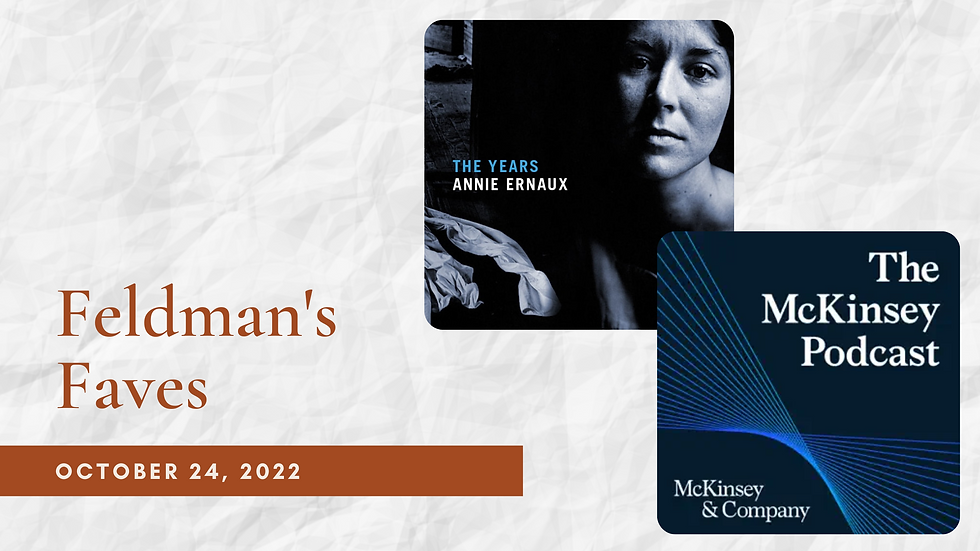
The Years By: Annie Ernaux – I have to admit, that I had never heard of Annie Ernaux prior to her winning the Nobel Prize in literature this year. Clearly, that’s on me….In any case I decided to do a little research. According to Anders Olsson, Chair of the Nobel committee, “Ernaux consistently and from different angles, examines a life marked by strong disparities regarding gender, language and class... and said “her path to authorship was long and arduous”. Her debut was Les armoires vides, published in 1974 in France and as Cleaned Out in English in 1990. It was her fourth book, La place or A Man’s Place, that was her literary breakthrough. A Man’s Place and A Woman’s Story, which was originally published in 1988 in French, have become contemporary classics in France. Ernaux won the Prix Renaudot in France in 2008 for her autobiography The Years, which was shortlisted for the Man Booker International prize in 2019 when it was translated into English by Alison L Strayer. Ankita Chakraborty in the Guardian said Ernaux’s Getting Lost, a book recording her obsessive affair with a Russian diplomat, would “become a kind of totem for lovers: a manual to help them find their centre when, like Ernaux, they are lost in love”.
Based on this limited research I decided that The Years would be a good first read of her work. Many critics say she is the heir apparent to Marcel Proust (who I have tried and failed to read, many, many times). The way I see, is that if Hemingway, Kerouac and Billy Joel (think “We Didn’t Start the Fire”) somehow had a child, then it could be Annie Ernaux. Her style is unique in so many ways but one way to think about it, particularly in The Years, is just a recitation of a long list of events (both personal and of global significance) that she remembers wrapped up in novel. There is a rhythm to her writing that is direct but with a feel of free flowing stream of conscious that is really easy to read. In The Years, one reviewer notes that, “Ernaux “invents a form, does something genuinely new with literature; it’s an intersection of the novel and autobiography and non-fiction… Ernaux’s ‘literary project has been to write about her life and to get at the truth of it somehow … I think she’s written about every important event in her life, from becoming aware of what social classes are as a child, to the death of her father and the death of her mother, to the illegal abortion she had in France in the 1960s, to her first sexual experiences and then to writing about love and passion and desire…” As another reviewer describes it, the book, “spans the timeframe from her birth in 1940 up to 2006, and moves from her working-class upbringing in Normandy to her years teaching French literature in a lycée, living in the Parisian suburb of Cergy, raising two sons and eventually divorcing. But it is not a straightforward autobiography; rather it is told in a choral “we”, which sometimes shifts into the third person, so the author appears as “she”. This is as close in as it gets. In so doing, Ernaux puts paid (hopefully once and for all) to the idea that memoirs by women are about the small-scale, the domestic. She shows it is possible to write both personally and collectively, situating her own story within the story of her generation, without ever confusing the two. She reflects on the book she is writing even as she writes it, resolving: “There is no ‘I’ in what she views as a sort of impersonal autobiography. There is only ‘one’ and ‘we’, as if now it were her time to tell the story of the time-before.”
Ernaux was underappreciated outside of France for many years. The recognition by the Nobel Committee in 2022 has forever changed her status, which I believe is very well deserved. Here is a good review from The LA Review of Books - https://lareviewofbooks.org/article/the-intimate-portrait-of-a-generation-annie-ernauxs-the-years/
The McKinsey Podcast - Build back better relationships at work– There is nothing more critical to one’s success inside and outside an organization than the relationships we form, which the team at McKinsey refers to as social capital. Social capital is the super power that is essential to career success. It is also something that can be problematic if it leads to the exclusion of others. How to build social capital and how to make sure it is equitably distributed within an organization is a supreme challenge. The pandemic years have made this process and objective more challenging than in the past but has also taught us new ways to connect with people and build those important relationships. It has also led to people thinking more deeply of the importance of inclusion to the success of a firm’s culture and ultimately bottom line. This PODCAST considers how past practice and new circumstances converge to allow us to improve relationships in the new hybrid work environment (yes a bit of a cliché…). Here is an excerpt from the PODCAST itself: “Social capital, a technical term for connectivity in the workplace, is important for helping employees execute, learn, innovate, and advance in organizations. Right now, because of the pandemic and the related upheaval in office and staffing norms, it’s in short supply. But there are ways to rebuild it say McKinsey partners John Parsons and Brooke Weddle on this episode of The McKinsey Podcast. Hear their conversation with editorial director Roberta Fusaro about McKinsey’s recent report on the state of social capital and why executives need to manage workplace interactions more intentionally—always, but especially now.“https://podcasts.apple.com/ca/podcast/the-mckinsey-podcast/id285260960?i=1000583294381
Thank you for your ongoing engagement and participation.
And remember to stay safe, stay healthy and to docket daily.
Jon


Comments