
Feldman's Faves: September 12, 2022
- Jon Feldman
- Sep 12, 2022
- 6 min read
GOOD MORNING EVERYONE
I hope you are all settling into your Fall routines. To me the most exciting part of this time of year is the start of the NFL season – so exciting. My heart is with the Bills but (like the Leafs) they have a way of making us fall in love and then just setting us up for disappointment. Maybe this time it will be different…. It is also apple picking season, and honey crisps are almost ready so get yourselves organized before they are all gone.
On a bitter sweet note I want to take this opportunity to say thank you to our friend and partner Dan Gormley for everything he has done for Goodmans for four decades. There is nobody at Goodmans like you and with your incredibly unique skill set as a lawyer. While we will all miss you tremendously as a partner, we are thrilled that you will continue to be in our lives as a friend (and, of course, as a client….). Wishing you nothing but the very best as you start your new work adventure.
BTW, I am sure many of you are well aware of this already, but I recently discovered the band Greta Van Fleet and it blew my mind. Hearing them for the first time reminded me of a time when I had hair, and lots of it. For anyone that is a fan of 1970s rock and in particular Led Zeppelin, this band seems to be their child (or probably grandchild) with a bunch of 20 year-olds creating and playing music from another time. There are apparently many haters out there on these guys – given their Spinal Tap vibe - but I think that is just foolish. This is real talent – but listen and judge for yourselves - https://youtu.be/vhbMbiYb5bg
No theme this week, just topics of interest.
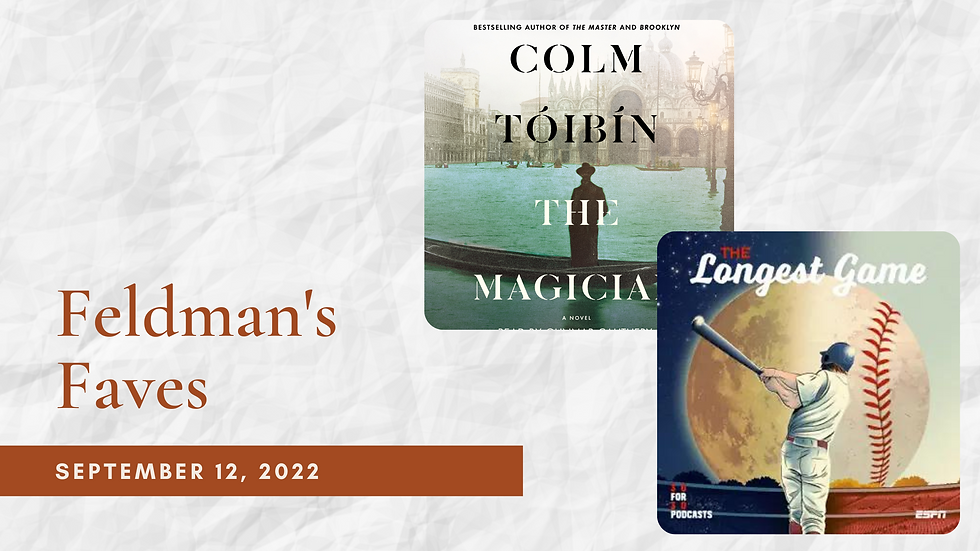
THE MAGICIAN By: Colm Tóibín –This book provides the author’s account of the life of Nobel Prize winning author Thomas Mann (thinks of Magic Mountain, Death in Venice, Dr Faustus, etc.). Mann lived a very interesting life, starting out as wealthy son of a distinguished Senator who died young and as a result the family lost its fortune. His family’s attempts to force young Thomas to become an insurance salesman failed as he (like his older brother) became a world famous author and ultimately a critic (in exile) of the Nazi regime from the very start. In The Magician, Tóibín does an excellent job describing the complex life of Thomas Mann (married with six children coupled with a strange infatuation for young boys) as well as the times in which he lived (the thriving era of pre-WWI Munich to WWI, WWII and beyond as an exile in both the United States and Switzerland).
As one reviewer notes, “Mann’s was a cinematic life — his politics alone made him an exile twice over (in Los Angeles, fleeing the Nazis, then in Switzerland, fleeing McCarthy). But The Magician, Colm Tóibín’s new novel about Mann, resists the shallow gestures of Hollywood biopics, reaching for something mainstream film couldn’t get at, or wouldn’t bother with. How does an artist create, and can a true artist live as the rest of us do? There are already several biographies of Mann (Tóibín’s acknowledgements list the ones he found useful) and The Magician is not a scholarly text. In both this novel and The Master — Tóibín’s extraordinary 2004 fictionalization of Henry James — the fundamental aim is to understand real men whose art has outlasted them. With James and Mann both, Tóibín is especially interested in these writers’ queerness (it’s hard to apply the contemporary language of identity to these men’s lives, but I think this word works) and the effect this had on their lives and work. Tóibín, the author of nine previous novels himself — as well as several volumes of nonfiction, some heartbreaking short stories, and sprightly criticism — knows he can’t say anything definitive about James or Mann. He mostly seems to be saying thank you to his heroes. It’s hard to imagine a reader for these novels who didn’t share the author’s affection for their protagonists.
The Magician begins with a teenage Mann and his siblings, in the family’s stately home, waiting for their mother, Julia, to emerge for a party. The scene is a nod to Death in Venice, one of Mann’s masterpieces: The first moment the hero, a middle-aged German writer, spies the object of his intense interest, a 14-year-old Polish boy, he and his siblings are waiting for their mother. Given this, I expected The Magician to focus on Mann writing Venice (can’t judge a book this way, but the jacket also implies this). It would have been familiar territory for Tóibín — The Master focuses on James in the years following the failure of his play Guy Domville. Instead, The Magician roams from Mann’s childhood in Lübeck — the port town immortalized in his first novel, Buddenbrooks — to the United States, and back to Europe.
Indeed Mann’s autobiographical debut, in which a patriarch dies and a fortune is lost as his heirs fiddle about, provides Tóibín a template. Both novels are family sagas but at the same time probe deeper — to ask about religion, politics, money, and the degraded modernity we have all inherited. But where Mann’s novels are patient (a contemporary reader might say plodding, but I disagree), Tóibín’s work has an often maddening pace, the book speeding through the decades: the death of Mann’s father, the dissolution of the family firm, Mann’s short-lived apprenticeship as a clerk, and finally, his wholesale immersion in art. There’s no condemnation in The Magician, nor is there pity. Instead there’s the understanding that a great artist might be, after all, only a human. When I finished The Magician, I returned to Death in Venice and found it more unsettling than when I last read it. I flipped through Buddenbrooks and was seized by a desire to lose myself in its long descriptions of a way of life now long gone. I considered the possibility of another winter of quarantine; would The Magic Mountain, with its slow and poetic depictions of solitude, and snow, and illness, and quiet, be a comfort? I suspect that Tóibín would consider my turning back to Mann a mission accomplished. The family nickname for Mann — at the family table, he entertains the children with tricks — provides Tóibín his title. It’s apt. That these books endure, and still possess the capacity to surprise, to thrill, to clarify life itself — it does seem a bit like magic.” I have always been a fan of Thomas Mann’s work but this book gave me a new appreciation of the person he was, the family he had and the life he lived that inspired his amazing body of work. Even if you don’t know Mann’s work, The Magician opens a window to an understanding of one of the 20th century’s greatest and most influential writers and the history and setting that influenced his work. Here’s a good review from The Guardian - https://www.theguardian.com/books/2021/sep/17/the-magician-by-colm-toibin-review-inside-the-mind-of-thomas-mann
30 For 30 Podcasts - The Longest Game – As we get closer and closer to another Jays playoff run, I can’t help thinking about the late 1980s early 1990’s – i.e. the Jays’ Golden Era. For those of you who are baseball fans and interested in the history of the game in general, this story of the longest game in history (33 innings) is fascinating. There were no cellphones at the time so parents thought their children (who were at the game) had gone missing…. The fact that future Hall of Famers, Wade Boggs and Cal Ripken Jr. (before they were in the big leagues) played in this game is amazing enough. The game was epic and never even close to being repeated. Here is an excerpt from the PODCAST itself: “Baseball holds its records sacred. Most home runs, strikeouts, career wins. But what about the longest game ever? That honor goes to a 1981 AAA game, when the Pawtucket Red Sox and Rochester Red Wings slugged it out from dusk to dawn. The record-breaking 33 innings brought hope, despair and drama on and off the field. Radio Diaries and 30 for 30 Podcasts take listeners to that frigid, surreal night with the voices who lived it – including Hall of Famers Wade Boggs and Cal Ripken Jr. Most heroes of The Longest Game never made it big, but their unflagging endurance made history.”: https://podcasts.apple.com/ca/podcast/30-for-30-podcasts/id1244784611?i=1000577076000
Thank you for your ongoing engagement and participation.
And remember to stay safe, stay healthy and to docket daily.
Jon


Comments