
Feldman's Faves: September 22, 2025
- Jon Feldman
- Sep 22, 2025
- 4 min read
GOOD MORNING EVERYONE
First and foremost, SHANA TOVA to all of you who are celebrating tonight.
Step 1 – Jays clinch a playoff spot. Step 2 – Win the World Series. It’s that easy. What could possibly go wrong???
No theme this week – just topics of interest.
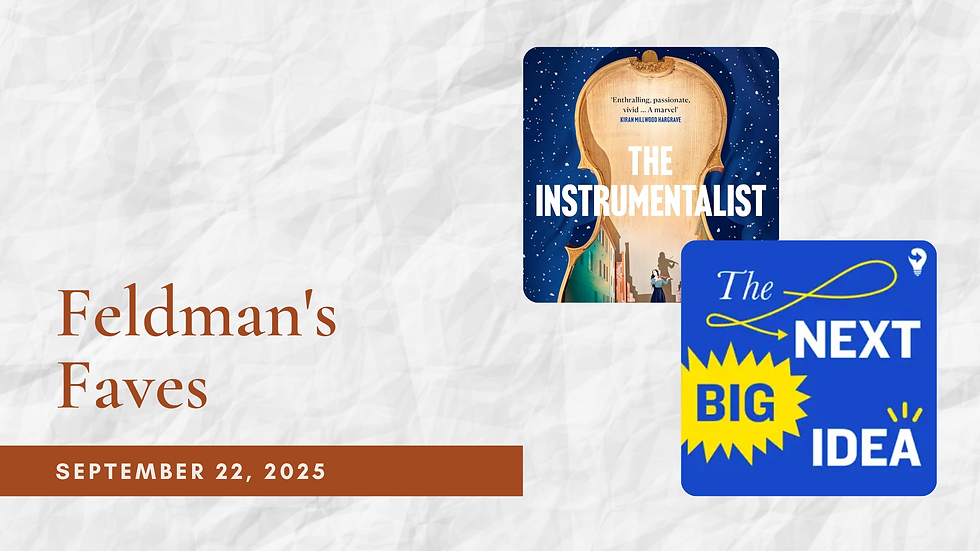
THE INSTRUMENTALIST By: Harriet Constable – I have always been fascinated by musical genius and I am envious of those who have musical talent. There are so many books written about musical prodigies and how they see the world in a way that is so different than we regular mortals do. Harriet Constable’s latest novel, The Instrumentalist, was recommended to me by my mother who is also a huge music fan (and who actually has musical talent – which was reflected in my youth with her frustration with my piano practicing ….). We all know that Antionio Vivaldi was the maestro of his era who composed many magical pieces of music with the most famous being his FOUR SEASONS. In The Instrumentalist (which is historical fiction – an important point to make) we learn about 18th century Venice the reign of Vivaldi as well as the children he taught, conducted and collaborated in an orchestra of highly talented orphans that would otherwise be married off, put to work in terrible jobs or just discarded as outcasts of society. When Vivaldi finds a prodigy he first builds her up, then tears her down and quite possibly steals from her (but the historical record on this point is not crystal clear). As one reviewer notes, “In the 18th century, Venice’s fig lie di corowas widely regarded as the best orchestra in the republic. It was comprised of girls from the Ospedale della Pietà, an orphanage established by wealthy individuals and run by nuns. Unwanted babies – those that had escaped being drowned – were “posted” through a tiny hole in the orphanage’s wall. They were given shelter and a musical education, as well as enduring grueling domestic work, before they were married off or took the veil. However, a talented few joined the orchestra and performed in churches and private houses, earning money for the orphanage. Despite their skill, members of the orchestra often had to play behind screens because they were disfigured – scarred from the pox or missing eyes and toes. Antonio Vivaldi served as violin director at the orphanage from 1703 to 1715. Anna Maria, a violin prodigy at the tender age of eight, became his star pupil. Journalist and documentary-maker Harriet Constable’s compassionate coming-of-age tale, inspired by true events, explores youthful ambition and the allure of fame. Anna Maria’s obstinacy and outspokenness sit uneasily with her status and the period, but Constable understands the power music has to sustain us – her mother was a classically trained musician and she grew up playing the flute and piano. Anna Maria sees colours when she plays, her instrument “an extension of her own body”, and her all-consuming obsession to be the best, to become first violinist and win acclaim as a maestro are vividly described. As her career takes off, however, she becomes increasingly isolated. Constable is good on atmosphere. Her admirable research and careful accretion of detail as she describes life in Venice, inside and outside the orphanage, gradually work their magic. The pace picks up in the final quarter when Anna Maria’s success and talent as a budding composer threaten to eclipse that of her mentor, and their relationship turns to one of rivalry. Her attempts to emerge from Vivaldi’s shadow and shape her own future are compelling.” The “student becoming the master” is one of the oldest stories around. Whether the master actually stole from the student in this case is a controversial issue raised by the author for which there is no clear answer – but it does make you wonder. Here’s a good review from Get Kids into Music- https://getkidsintomusic.com/2025/01/27/music-book-review-for-older-children-adults-the-instrumentalist-by-harriet-constable/
THE NEXT BIG IDEA - INTUITION: The Science of Trusting Your Gut – We live in a world right now where data science and analytics rule. Ever since the Moneyball era, which was written to show they world how success in baseball could translate into all aspects of life the best and brightest have turned away from using gut and instinct in making decisions. But I do think this overreliance on data may be gone too far. As lawyers we get paid for using our judgement and while we often rely heavily on precedent you can see how the really good lawyers use precedent as a tool not as gospel, which to me is one indicator of the importance of using both. I do think that experience is a great teacher and makes your ability to use your instincts and gut more effectively. And btw, since the A’s never actually won the World Series during the Billy Beane era... Here’s an excerpt from the PODCAST itself, “We all have eureka moments, sudden bursts of certainty that seem to come out of nowhere. What if you could summon that feeling on command? Laura Huang, a business school professor, has been studying that question. She’s found that for the world's most successful people, intuition isn't an accident. It's a skill. A tool they’ve sharpened. Today on the show: the practical steps you can take to turn a random hunch into your most reliable guide.“: https://podcasts.apple.com/ca/podcast/the-next-big-idea/id1482067226?i=1000721928598
Thank you for your ongoing engagement and participation.
And remember to stay safe, stay healthy and to docket daily.
Jon


Comments