
Feldman's Faves: September 23, 2024
- Jon Feldman
- Sep 23, 2024
- 9 min read
GOOD MORNING EVERYONE
We all knew that Shohei Ohtani was special but last week’s “greatest performance of all time”, going six for six, with three homeruns, two stolen bases, and becoming Mr. 50/50 is otherworldly. I grew up watching and worshipping Gretzky and MJ and never thought there would be an equal in sports. It is possible that if he keeps going as he is going that Ohtani could stand alone on the Mt. Rushmore of all athletes.
Recently, JC and I each hit our 20th year anniversaries at Goodmans. We were in law school together and then both lateralled here in 2004 after time away from Toronto and we have been here ever since. We have seen our families grow and grow up, celebrated some really fun milestones, supported each other during some difficult times and have enjoyed a friendship that will always endure (still waiting for the invitation to stay for free in your house Ireland…). The reason I mention this is that while we all know that Goodmans is an incredible platform for us to learn the law, do great deals and build our practices, which I appreciate to no end, what makes Goodmans special to me, is the people we work with, the relationships we cultivate and the feeling that people here care for each other in a way that is so different than most places. Ask anyone who has worked anywhere else and you always get the same answer. I feel (although I know I don’t look) that I am still in my 20’s and that I am only getting started. I hope the next 20 years are as good as the first 20 (although along the way I may need some assistance getting in and out of my car….).
Finally, I want to remind you of our party on Thursday. I hope you can all make it – it should be a really fun night.
No theme this week – just topics of interest.
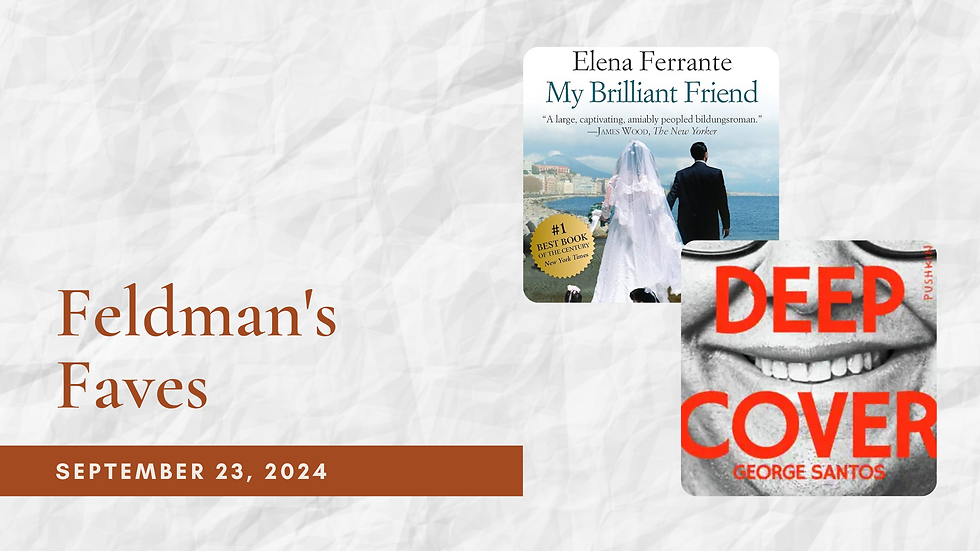
MY BRILLIANT FRIEND By: Elena Ferrante – Who is John Galt? Oops, I mean, who is Elena Ferrante? Nobody know for sure but the four book Neapolitan Series has made this Italian writer world famous. In fact, earlier this month the New York Times in its ranking of the Top 100 books of the 21st century so put My Brilliant Friend as numero uno. I have been wanting to read this book (and the series) for years and this ranking nudged me to do it. Ferrante’s tale of two friends growing up in the gritty and poor part of Naples in the 1950’s is a great story of friendship, competition, poverty, violence coming of age and all sorts of drama. While I found the start to be a little slow, I, like so many others, was brought into the world of Lila and Lena and didn’t stop reading until I finished all the first three books (and I am currently on the fourth right now). I have basically been binge reading these books. They are so good. As one reviewer notes, “My Brilliant Friend is the gripping first volume in Elena Ferrante’s widely acclaimed Neapolitan Novels. This exquisitely written quartet creates an unsentimental portrait of female experience, rivalry and friendship never before seen in literature. The story of Elena and Lila begins in the 1950s in a poor but vibrant neighbourhood on the outskirts of Naples. They learn to rely on each other and discover that their destinies are bound up in the intensity of their relationship. Elena Ferrante’s piercingly honest portrait of two girls’ path into womanhood is also the story of a nation and a meditation on the nature of friendship itself. My Brilliant Friend is a modern masterpiece, the work of one of Italy’s great storytellers….I wish I could read Italian. The translation is excellent, don’t get me wrong, but when it came to the dialogue, I have this feeling that it would have had a whole other layer of emotional depth in its original Italian….At times, you could imagine that if people had been shouting those same words in English, the effect would not have been the same. But this is a minor quibble, thank goodness for the translation, allowing the rest of the world outside of Italy to enjoy this wonderful novel. Elena Ferrante is some writer. This is more than a novel about friendship. The era in which she set the story plays just as much of a role in the telling as the characters. Italy’s turbulent history is evidenced within the very fabric of these characters, the community, and the codes they lived by. My Brilliant Friend is a coming of age novel not just for two girls, but for a nation, who had, in a relatively short amount of time, experienced extreme political turbulence under multiple political regimes, civil war, and two world wars. The characters wear this, they struggle with it, the younger generation want to break free from the fear and ways of the older generation. I absolutely love novels that explore society at such an intimate level like this. And it’s a tough read, at times. The normalized violence is shocking, particularly against children. The oppression is all encompassing, the lack of agency over one’s own life, not just women and children, but men too. This is a community run by the Camorra, which is not fictional. It’s an Italian Mafia-type crime syndicate which arose in the region of Campania and its capital Naples and is one of the oldest and largest criminal organizations in Italy, dating back to the 17th century. The stranglehold the Solara family, and the Carracci family before them, had on the community was no exaggeration. The way Ferrante articulated that intergenerational fear was so telling in how a community can remain in a cycle of oppression and forced compliance. This was demonstrated over and over throughout the novel but perhaps the most powerful symbol of it was evidenced in that ending: the inevitable appearance at the wedding of the unwanted guest and those shoes, a forceful statement of exactly where and with whom the power lies. For a sociologist with a long-term interest in Italy’s history, this novel is a gold class case study. Now, let’s talk about that friendship.….It’s Elena I don’t like. For such a smart young woman, she is almost entirely devoid of emotional intelligence. She misreads every situation and ascribes her own bitter discontent onto all those around her. She is of course the product of her mother’s fears and anger, manifested into a childhood anxiety that grips her and increases in severity throughout her teenage years, again, demonstrating to us how cycles are perpetuated, Elena’s fractured only by the tenacity of a teacher not willing to see another woman wasted. But it’s in Elena’s friendship with Lila that I liked her the least. She was, I felt, disingenuous, too slated with envy and suspicion, unable to love without it always being tinged with hate. I tired of her, particularly as they got older and maturity should have been setting in. Elena was entirely incapable of considering any part of her life separate from Lila, but in a toxic comparative way. Did Ferrante miss the beat with Elena and overplay the whining and apathy? I don’t think so. We all know Lila should have had the educational opportunities that Elena received, but while Elena’s father had a job as a porter at the city hall, Lila’s was a struggling shoe maker. Neither family had much money but the job held by Elena’s father meant that he saw education in action on a daily basis, whereas for Lila’s father, it was unnecessary, an unwanted expense and a possible danger to the order of his household. Much like Elena’s mother’s view, but she was overruled by her husband. Lila, unable to go to school, taught herself. I don’t believe, if the situations were reversed, that Elena would have done that. Elena’s inferiority complex was too great and she’d never have had the will to overcome her anxieties and apply herself under her own steam. She was too much about the external gratification. It was in this jealous way that Elena begrudged Lila her independent learning and intelligence that Elena was at her worst. I hope Elena grows in maturity and emotional complexity over the next three books. I adored Lila. She was ferocious, her own woman, trying her hardest within the limited confines of her life to go her own way. Marcello’s interest in her was frightening. I do believe he loved her, obsessively though. I don’t believe that she escaped his interest by marrying another man. In a society driven by retribution, she humiliated him too much for that, hence, the ending and that bold statement made by Marcello. Lila’s beauty came not only from her looks but from the fire within her, that dangerous mix that Alfonso pointed out to Elena. I feared for Lila for the entirety of the novel, and if it wasn’t for the fact that the beginning of the story introduces both of the women in their sixties, I felt certain on many occasions that Lila walked a fine line between life and death. No story that rests on the shoulders of a community can exist without the creation of a colourful community. I loved the vast cast of characters within this story and I thought Ferrante distinguished each person enough for her readers to not lose track of who was who. There was a helpful cast list in the front of the book but I didn’t need to refer to it once I’d started. I think out of everyone, my favourite was Maestra Oliviero, a woman who was tirelessly teaching the girls at the elementary level in the hopes that she might rescue, through education, at least one of them and set them free from their plebeian existence. I haven’t mentioned Donato Sarratore and his presence within Melina’s life and later Elena’s. What a snake. I saw the writing on that wall right from the get go. I don’t think his son, Nino, was quite worth the mental and emotional energy Elena expended on him. I feel that he was a young man who closed himself off long ago as a precautionary measure against his father’s repeated misconduct. A complex young man, but devoid of any real emotional capability. Elena alludes to Lila’s panic attacks (not that they were called that back then) and Rino’s bouts of depression that would lead to sleep walking. We see through these conditions, as well as Melina’s mental illness, how people struggled, reliant on empathy and the protection of those around them. With Melina in particular, the community protected her, shielded her, did everything they could to keep her free of an asylum. This community had many characteristics defining it, but not all of them were negative, not by a long shot. My Brilliant Friend is a five-star read for me, not just for the story and characters, but also for the thought provoking nature of the text. It’s a stimulating and lively novel and I could see at a glance on Goodreads that it’s one of those love it or hate it novels. This reader loved it…..”. I guarantee that if you read the first book you will want to follow the soap opera to its conclusion with the whole series – I wish it would keep going. Here’s a good review of the book (and the show) from The Guardian -https://www.theguardian.com/tv-and-radio/2022/mar/10/my-brilliant-friend-review-this-gorgeous-drama-is-television-at-its-best
Solvable - Episode 1: The Campaign - To say that there has been a lot weird sh@t taking place in American politics over the last decade or so would be a bit of an understatement. If Olympic medals were being handed out for the “most weird” competition I think that George Santos would be a clear favourite for GOLD. For those of you who are unfamiliar with his story, Santos is the former Republican Congressman from New York who was a brilliant scholar, accomplished athlete, Goldman Sachs alum, successful businessman, etc., etc., etc. The perfect candidate with the stellar background, which would be even more impressive if any of it was actually true. The one thing Santos was great at was lying - about himself, his accomplishments and his struggles. Needless to say he was found out and exposed for who he really is – a crook and a fraudster. It seems that his political career is over but in this environment you never know. Santos’ story is guaranteed to be a movie, Netflix special or something of that nature. In the meantime this PODCAST does a good job telling the crazy story. Here’s an excerpt from the PODCAST itself, “George Santos runs for Congress and wins. Then the stories he told on the campaign trail start to fall apart. Semafor’s Kadia Goba wants to figure out where his money is coming from. Saurav Ghosh, of the Campaign Legal Center, finds the Santos filings suspicious. As Santos’ criminal trial approaches, Producer Amy Gaines McQuade walks Jake Halpern through the moment when the cracks began to show. Note: George Santos is now expected to plead guilty, as first reported by Talking Points Memo. This is a developing story. We will update listeners as more information becomes available.” https://podcasts.apple.com/ca/podcast/solvable/id1463448386?i=1000668214476
Thank you for your ongoing engagement and participation.
And remember to stay safe, stay healthy and to docket daily.
Jon



Comments