
Feldman's Faves: September 5, 2023
- Jon Feldman
- Sep 5, 2023
- 5 min read
GOOD MORNING EVERYONE
I hope you had a great (final) long-weekend of the summer (not at Burning Man) and are psyched about starting the new school year (yeah, right)….
Well at least for those of us who are football fans the good times are already rolling with an amazing kick off to the College season already and the NFL season starting on Thursday. I for one, am happy about that. So many questions? Does Georgia Threepeat? Do the Chiefs Repeat? Is this finally the year for the Bills? Is “Coach Prime” for real? I could go on and on and on….. so exciting – can’t wait!
Also for those of you (us) who are Swifties, Cineplex just did the world a solid – starting October 13 you can see the Eras Tour in theatres, which should be, lit. Reminds me a little of the pandemic era presentation of Hamilton on Disney plus that brought that show to the world in a way that was not previously accessible. A great development for those who have not or will not be able to see the show live (i.e., the vast majority of the planet).
No theme this week, just random topics of interest.
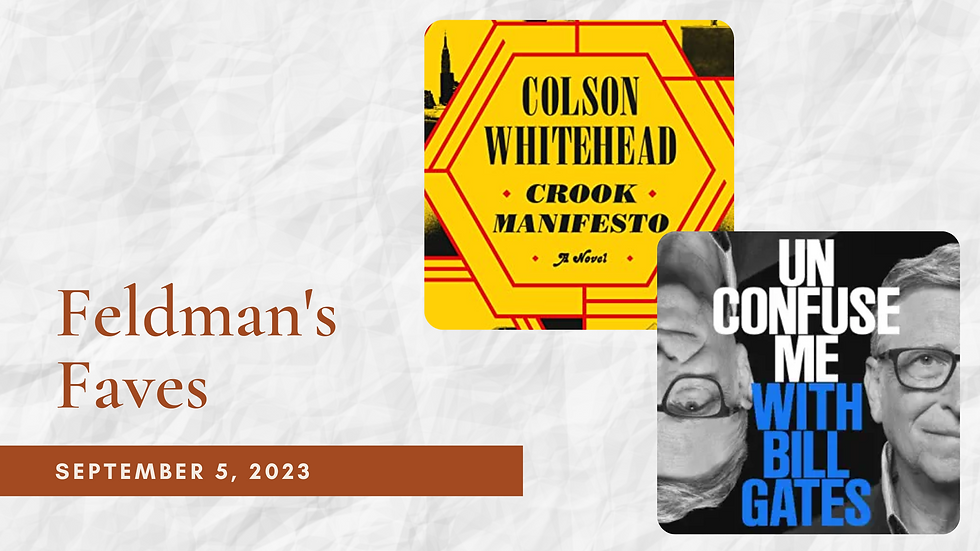
CROOK MANIFESTO By: Colson Whitehead – A few weeks ago I had the opportunity to attend a talk with Colson Whitehead who is promoting his new book, Crook Manifesto. Whitehead is a literary star having won the Pulitzer Prize twice already in his relatively young life (he is my age) for The Underground Railroad and for The Nickel Boys, both of which are extraordinary novels. So when Whitehead came out with Harlem Shuffle (the first in a trilogy of which Crook, is part 2), I was excited to read it. I read it. I liked it but didn’t love it. The story centres around Ray Carney, a “fence” who live in post-war Harlem where the reader gets a sense of the character, the city and the times (1950-60s). Crook Manifesto then came out and I was hoping for Whitehead greatness, in this case where we find Ray and team in 1970s and early 1980s Harlem. The story is good but not great, but I kept on reading. There is a third book in the works that will come out soon that is supposed to tie it all together, but I must admit I am a little unsure. I have looked at a number of reviews hoping they saw something I did not, but in general the view is that this is not Whitehead’s best. As one reviewer (typical of many) notes, “Crook Manifesto is a sequel to Whitehead’s previous novel, Harlem Shuffle, a crime story about a man named Ray Carney, who earns a living acquiring stolen goods and selling them for profit. Crook Manifesto also revolves around Carney, but in this novel, we’ve advanced several years, and he’s recently retired from illicit activities to focus on running his thriving furniture store in Harlem. The backdrop is a decaying 1970s New York City where, as Whitehead puts it, “you knew the city was going to hell if the Upper East Side was starting to look like crap, too.” Carney’s teenage daughter, May, is eager to attend the Jackson 5’s upcoming concert at Madison Square Garden. Unable to acquire tickets through conventional means, Carney decides to participate in one last illegal scheme to obtain them. Things go haywire, and he soon finds himself involved in a harrowing crime spree. The trouble with the novel starts in the second section, which takes place a couple of years later and mostly concerns the attempts of a character named Zippo to film a blaxploitation picture in Harlem (Carney’s store serves as a set for one of the scenes). Carney is now a minor figure, and the narrative threads that Whitehead established in the prior section are mostly abandoned; as a result, Crook Manifesto begins to read less like a novel and more like an anthology of glancingly related anecdotes. This development draws more attention to the third-person narrator, who assumes an outsize presence. The story, such as it is, recedes; the narrator becomes the only meaningful link between the various sections of this book. Whitehead’s chatty prose reliably carries the reader along, sometimes advancing the plot and sometimes appearing to be taken with its own fluency, its startling virtuosity. This is a boon for a novel in which determining why we’re taking this journey grows more and more difficult….Early on, Whitehead introduces several tropes that seem to hint at a particular kind of story. We have the reformed outlaw who reluctantly reenters the crime world, the devoted-but-ignorant wife, the corrupt police officers who are working on both sides of the law, and so on. But rather than using these elements to build momentum, Whitehead layers literary pyrotechnics over them: his ambitious, involved sentences; the seemingly random shifts in point of view; his frequent insertion of long-winded descriptions whenever his story seems to be gathering steam; and—perhaps most jarringly—a narrative structure that prevents the novel from cohering…Although he doesn’t get the recipe right, there are many reasons to read this book. Whitehead writes about New York with verve, and the novel is studded with fascinating social commentary about the lives of African Americans in the city during the disco decade. Yet as I read, I could not stop thinking about my conversations with my students. It occurred to me that they are advancing a simple and revolutionary idea—that genre fiction is a better reflection of real life than literary fiction. I believe both kinds of literature can offer a bracing view of reality; the key, of course, is how well the stories are executed. Sometimes our lives seem to be dictated by plots that carry us along without our permission; other times, we derive comfort and meaning from insights about ourselves and the characters who populate our days. The best fiction highlights at least one—and occasionally both—of these realities. Crook Manifesto, unfortunately, doesn’t satisfy either remit. I learned a great deal from reading it, but it never felt quite real.” This may not be Whitehead’s best work but it is still good work and I will no doubt read book #3 when it comes out. Here’s a good review from the NYT – https://www.nytimes.com/2023/07/13/books/review/crook-manifesto-colson-whitehead.html
Unconfuse Me with Bill Gates - Seth Rogen & Lauren Miller Rogen– As many of you know, I am often inspired by the suggestions that come from Bill Gates and “Gates Notes”. The reason for that is that Gates has earned the right to sit back and think deeply about fundamental issues that impact all of humanity including fighting disease, addressing climate change and improving the overall quality of life. One of the fundamental issues that we are running right into over the next few years is how to deal with the tsunami that will be the growth of the aging population and all of the issues associated with this trend. One issue that is of real interest and importance to me is understanding the aging brain and figuring out ways to cure and treat the inevitable dementia wave that is on the horizon. In this PODCAST, Gates chats with Seth Rogen and Lauren Miller about a number of issues, but of most interest to me is their discussion Alzheimer’s disease and their approach to it. Here is an excerpt from the PODCAST itself, “Can Alzheimer’s disease be funny? I was skeptical, especially given the devastating experience my family had watching my dad suffer from it. So, I asked two experts in using humor to raise awareness—Seth Rogen and Lauren Miller Rogen—to help me see the light. We had a great conversation about their organization Hilarity for Charity, hope for the future of Alzheimer’s research, the importance of a good night’s sleep, and why Seth started a cannabis lifestyle company.” https://podcasts.apple.com/ca/podcast/seth-rogen-lauren-miller-rogen/id1695132549?i=1000622494189
Thank you for your ongoing engagement and participation. And remember to stay safe, stay healthy and to docket daily.
Jon


Comments